

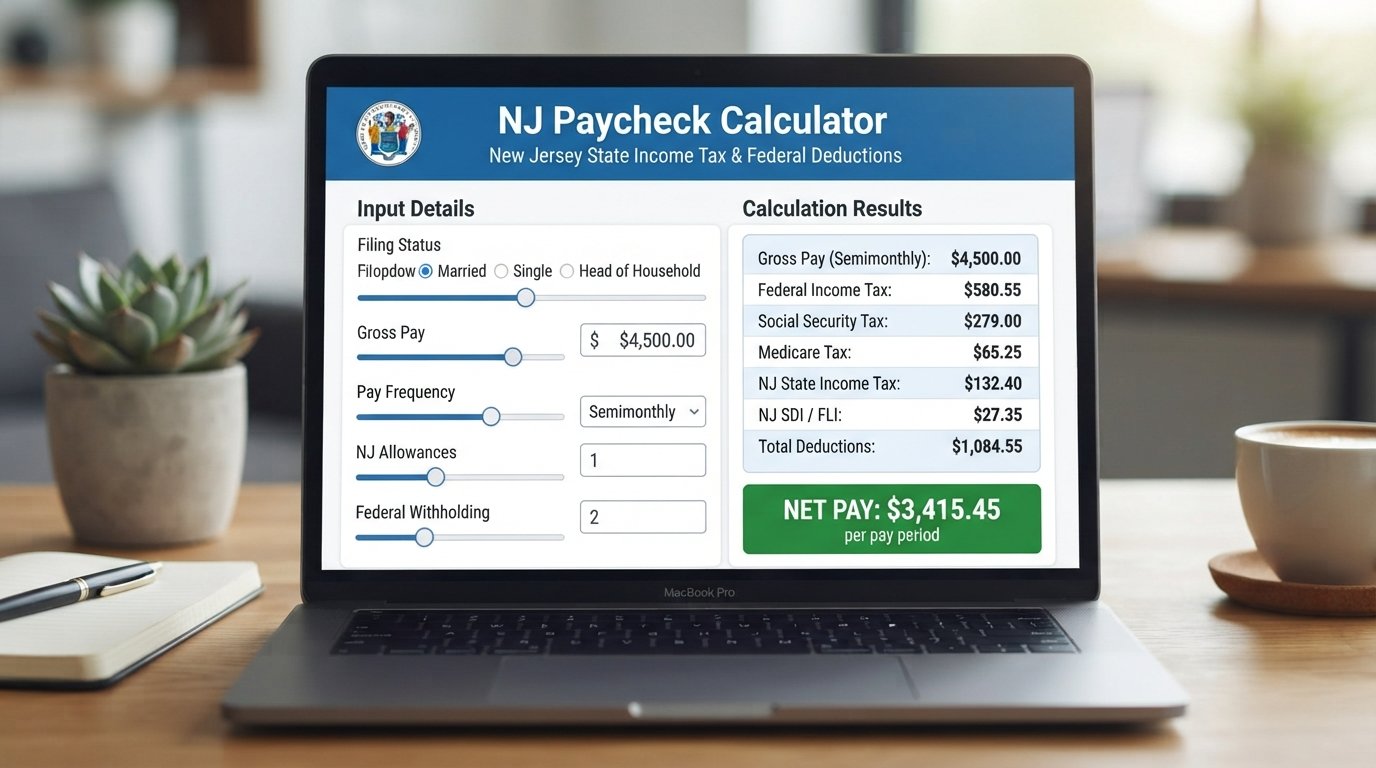
Figuring out your real take-home pay in New Jersey is not always simple. Your gross salary passes through federal tax, Social Security, Medicare, New Jersey state tax, and three New Jersey-specific payroll deductions before it ever reaches your bank account. Because of this, two people with the same salary can take home noticeably different amounts. The NJ paycheck calculator solves this problem. It applies every current federal and New Jersey withholding rule to your gross pay, so you see an accurate net pay figure in seconds. Whether you are comparing a new job offer, planning a budget, or simply curious about your next payslip, this tool removes the guesswork.
Use our free NJ Paycheck Calculator to calculate your results instantly.
Quick Answer
Your New Jersey take-home pay equals your gross wages minus federal income tax, Social Security, Medicare, New Jersey state income tax, and New Jersey’s Unemployment Insurance (UI), Temporary Disability Insurance (TDI), and Family Leave Insurance (FLI) contributions. For instance, a single filer earning $75,000 a year takes home roughly $58,500 annually after every deduction, which works out to about $2,250 every two weeks. Your own result will vary based on filing status, pay frequency, and any pretax deductions you have set up.
How to Use the NJ Paycheck Calculator
The calculator only needs a handful of details to run an accurate estimate. Follow these steps:
- Enter your gross pay, either as an annual salary or an hourly rate.
- Select your pay frequency, such as weekly, biweekly, semimonthly, or monthly.
- Choose your filing status: single, married filing jointly, married filing separately, or head of household.
- Add any pretax deductions, including 401(k) contributions or health insurance premiums.
- Include extra withholding amounts, if your W-4 specifies one.
- Click “Calculate” to see your gross pay, total deductions, and net pay side by side.
Once you review the breakdown, you can adjust any field and instantly see how the change affects your paycheck.
Input Fields Explained
Each field feeds directly into the formula, so understanding them helps you trust the result.
- Gross Pay: Your total earnings before any tax or deduction is applied.
- Pay Frequency: How often you are paid, which determines how annual figures are divided.
- Filing Status: This sets your federal standard deduction and your tax bracket thresholds.
- Pretax Deductions: Amounts such as retirement contributions or health premiums, which reduce your taxable wages before tax is calculated.
- Additional Withholding: Any extra dollar amount you have asked your employer to withhold, usually to avoid owing tax at year-end.
- State: New Jersey, which applies its own income tax brackets plus UI, TDI, and FLI contributions.
Formula Used
The calculator layers several official formulas on top of one another. Each layer is sourced from a government agency, so nothing here is estimated or invented.
1. Federal income tax (IRS, Revenue Procedure 2025-32): Taxable income = Gross pay − Pretax deductions − Standard deduction. For 2026, the standard deduction is $16,100 for single filers, $32,200 for married filing jointly, and $24,150 for head of household. Tax is then applied using the seven marginal brackets: 10%, 12%, 22%, 24%, 32%, 35%, and 37%.
2. Social Security and Medicare (FICA, per the Social Security Administration): Social Security is withheld at 6.2% up to the 2026 wage base of $184,500. Medicare is withheld at 1.45% on all wages, with an additional 0.9% on wages above $200,000 for single filers.
3. New Jersey state income tax (NJ Division of Taxation): New Jersey applies seven graduated brackets ranging from 1.4% on the first $20,000 up to 10.75% on income above $1,000,000. Unlike the IRS, New Jersey does not offer a standard deduction; instead, it uses a $1,000 personal exemption per taxpayer.
4. New Jersey UI, TDI, and FLI (NJ Department of Labor and Workforce Development): For 2026, employees contribute 0.425% toward Unemployment Insurance and the Workforce Development Fund, up to a $44,800 wage base. Temporary Disability Insurance is withheld at 0.19%, and Family Leave Insurance at 0.23%, both up to a $171,100 wage base.
Net pay formula: Net pay = Gross pay − Federal tax − Social Security − Medicare − NJ state tax − NJ UI − NJ TDI − NJ FLI − Additional withholding.
Worked Example
Consider a single filer earning $75,000 a year, paid biweekly, with no pretax deductions. First, federal taxable income is $75,000 minus the $16,100 standard deduction, which equals $58,900. Applying the 2026 brackets produces a federal tax of about $7,670 a year. Next, Social Security takes 6.2%, or $4,650, and Medicare takes 1.45%, or roughly $1,088.
New Jersey state tax, calculated on $74,000 after the $1,000 exemption, comes to about $2,596 using the graduated brackets. UI contributions are capped at the $44,800 wage base, so the annual amount is $190.40. TDI adds $142.50, and FLI adds $172.50, since both apply to the full $75,000.
Adding these together gives total annual deductions of roughly $16,509. Subtracting this from $75,000 leaves a net annual pay of about $58,491, or approximately $2,250 per biweekly paycheck. This example uses simplified annual figures; your actual per-paycheck withholding may differ slightly because employers use IRS wage-bracket tables rather than a straight annual split.
Result Interpretation
Once the calculator finishes, you will see three key numbers: gross pay, total deductions, and net pay. In the example above, roughly 22% of gross pay goes toward combined federal, state, and payroll taxes, leaving about 78% as take-home pay. A lower percentage of deductions generally means a lower income or more pretax contributions, while a higher percentage often points to a higher tax bracket or additional withholding. Comparing this ratio across job offers can reveal which one truly pays more after tax.
Practical Uses
People use the NJ paycheck calculator for several real situations. Job seekers use it to compare a New Jersey offer against one from New York or Pennsylvania, since commuting across state lines changes the tax picture. New employees use it to check whether their first paycheck matches expectations. Renters and homeowners use it to build a realistic monthly budget, since rent affordability depends on net income, not gross salary. Small business owners and HR teams also use it to sanity-check payroll software before running an actual pay cycle.
ALSO READ: Weight Loss Percentage Calculator Track Real Progress
Benefits
This calculator saves time, since manual tax calculations across seven New Jersey brackets and three payroll programs can take much longer by hand. It also reduces errors, because every rate is pulled from an official 2026 source rather than an outdated table. Additionally, it is free, requires no signup, and updates automatically as tax law changes each year.
Limitations
The calculator provides an estimate and should not replace professional financial or tax advice. It does not account for municipal payroll taxes, such as those charged to employers in Newark or Jersey City, since these do not typically reduce an individual employee’s paycheck directly. It also assumes standard withholding elections rather than a customized W-4, and it does not model supplemental wages like bonuses, which the IRS taxes at a flat 22% federal rate rather than through the regular brackets. Finally, it does not include local credits, court-ordered garnishments, or union dues, since these vary by employer and individual circumstance.
Common Mistakes
Many users make the same errors when estimating their paycheck. First, they forget that pretax deductions, such as a 401(k) or health premium, lower taxable wages before tax is applied, not after. Second, they assume New Jersey taxes work the same as New York’s, when in fact the brackets and rates differ significantly. Third, they overlook the UI and TDI wage caps, which stop applying once income crosses $44,800 or $171,100. Fourth, they enter an annual salary while selecting the wrong pay frequency, which distorts the per-paycheck result. Avoiding these mistakes leads to a far more accurate estimate.
Comparison Table: Take-Home Pay by Pay Frequency
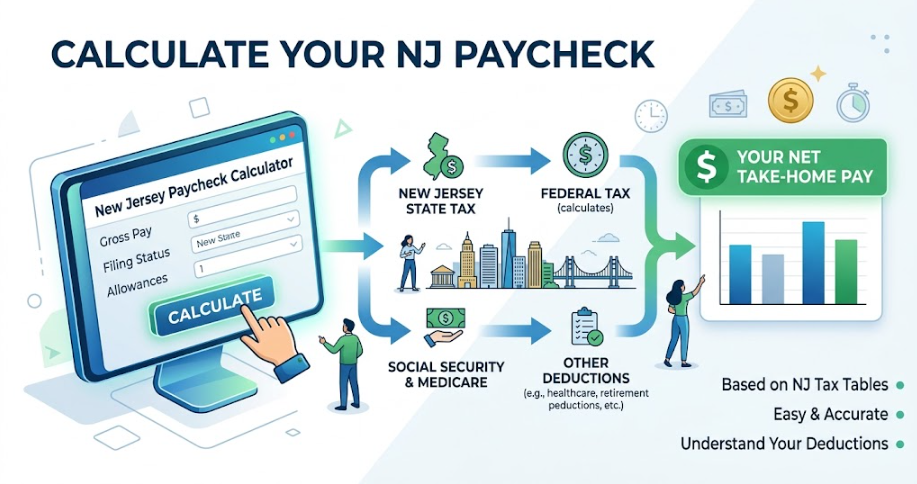
The table below shows how a $75,000 salary for a single filer breaks down across common pay frequencies, based on the worked example above.
| Pay Frequency | Pay Periods per Year | Gross per Paycheck | Approx. Net per Paycheck |
|---|---|---|---|
| Weekly | 52 | $1,442.31 | $1,124.83 |
| Biweekly | 26 | $2,884.62 | $2,249.66 |
| Semimonthly | 24 | $3,125.00 | $2,437.13 |
| Monthly | 12 | $6,250.00 | $4,874.26 |
Conclusion
Overall, your paycheck is shaped by more layers than most people realize, from federal brackets to New Jersey’s own UI, TDI, and FLI programs. That’s why the NJ paycheck calculator brings every one of these layers together, so that you get one clear, dependable number instead of piecing together several tax tables yourself. Therefore, try it before your next job offer, budget review, or payroll run, and as a result, you will know exactly what lands in your account.
FAQs
Does New Jersey have local income taxes on employees?
No, New Jersey itself does not impose a municipal income tax on residents. However, Newark and Jersey City charge employers a 1% payroll tax, which typically does not appear as a direct deduction on an individual employee’s paycheck.
Is New Jersey a high-tax state for paycheck purposes?
Indeed, New Jersey’s top rate of 10.75% is among the highest in the country, but it only applies to income above $1,000,000. As a result, most workers fall into the lower brackets, so their effective state tax rate is much smaller than the headline rate suggests.
How is a bonus taxed differently from regular pay in New Jersey?
Federally, bonuses and other supplemental wages are usually withheld at a flat 22% rate instead of the regular marginal brackets. On the other hand, New Jersey applies its standard state brackets to bonus income, so only the federal treatment changes.
Do part-year New Jersey residents pay the full state tax rate?
Generally speaking, part-year residents pay New Jersey tax only on income earned while they lived in or worked within the state. Meanwhile, non-New Jersey income earned before moving in, or after moving out, is generally excluded from the state return.
What is the difference between NJ UI and federal unemployment tax?
Basically, NJ UI is an employee-funded state program that helps pay unemployment benefits to New Jersey workers, whereas FUTA is a separate federal tax paid entirely by employers. Consequently, employees never see FUTA on their paycheck.
Can pretax retirement contributions lower my New Jersey withholding?
Yes, for federal tax purposes, this is true. However, New Jersey generally does not exclude traditional 401(k) contributions from state taxable wages, so the state tax benefit is smaller than the federal one.
For more updates visit: CALCIQ