

Decimal to Fraction Calculator
Converting a decimal into a fraction can seem tricky at first. However, the process becomes simple once you understand the basic steps. A decimal to fraction calculator can complete the conversion quickly and reduce common math errors.
The tool is useful for students, teachers, parents, and anyone working with numbers. You can enter a decimal and get its fraction form without doing the full calculation by hand.
Understanding the method is still helpful. It shows why the answer works and helps you check calculator results with confidence.
What Is a Decimal to Fraction Calculator?
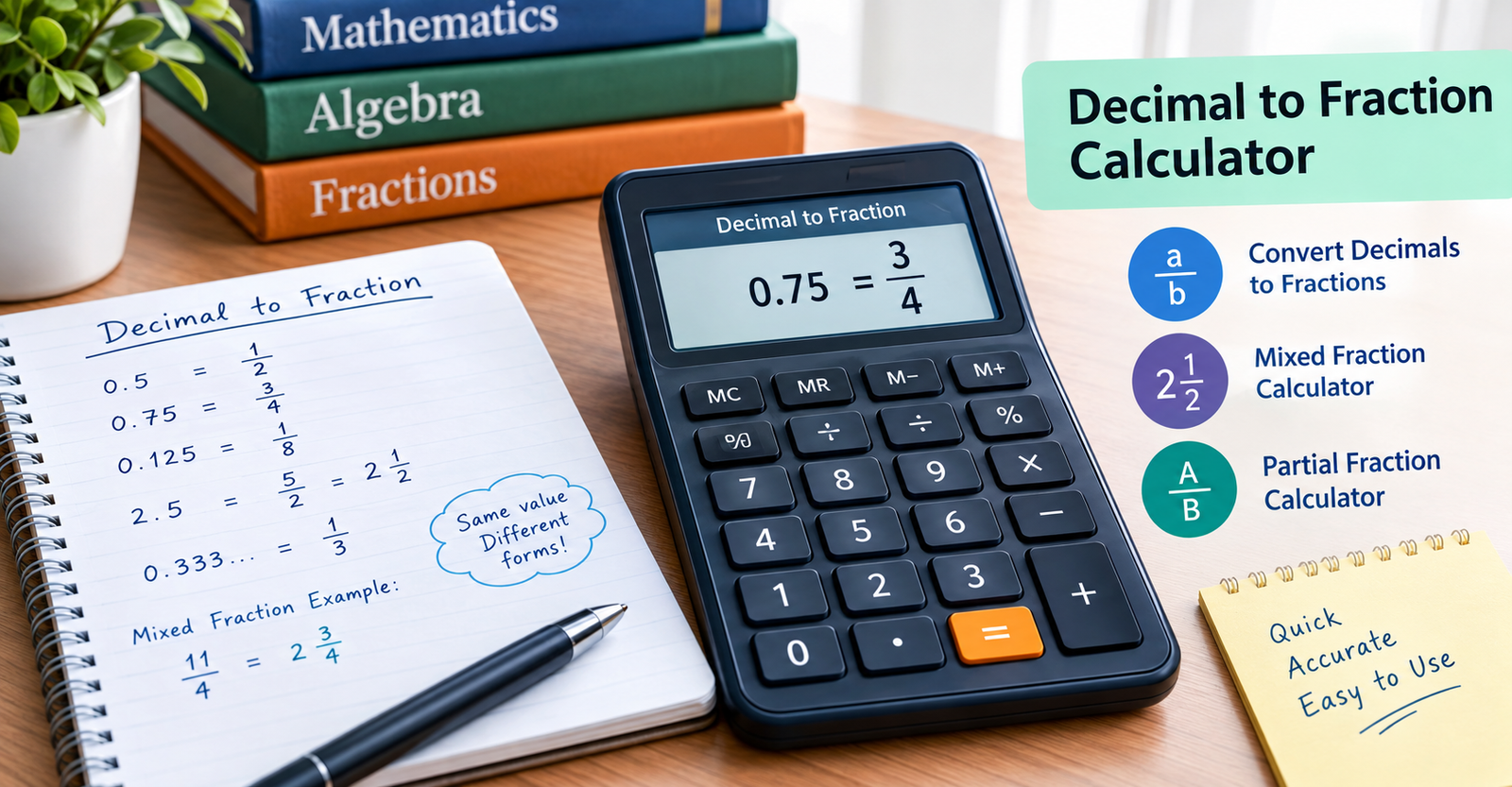
A decimal to fraction calculator converts a decimal number into an equivalent fraction. For example, 0.5 can become 1/2, while 0.75 becomes 3/4.
The calculator first identifies the place value of the decimal. It then writes the number as a fraction and simplifies the result.
For terminating decimals, this process is usually straightforward. The final fraction should have no common factor between its numerator and denominator.
How to Convert a Decimal to a Fraction
You can convert a decimal by following a simple mathematical process. First, count the digits after the decimal point.
Suppose you want to convert 0.75. There are two digits after the decimal point, so the denominator starts as 100. You can write the number as 75/100.
Next, simplify the fraction. Both 75 and 100 divide by 25. Therefore, 75/100 becomes 3/4.
The same method works with other terminating decimals. For example, 0.125 has three digits after the decimal point. You can write it as 125/1000 and then reduce it to 1/8.
Decimal to Fraction Formula
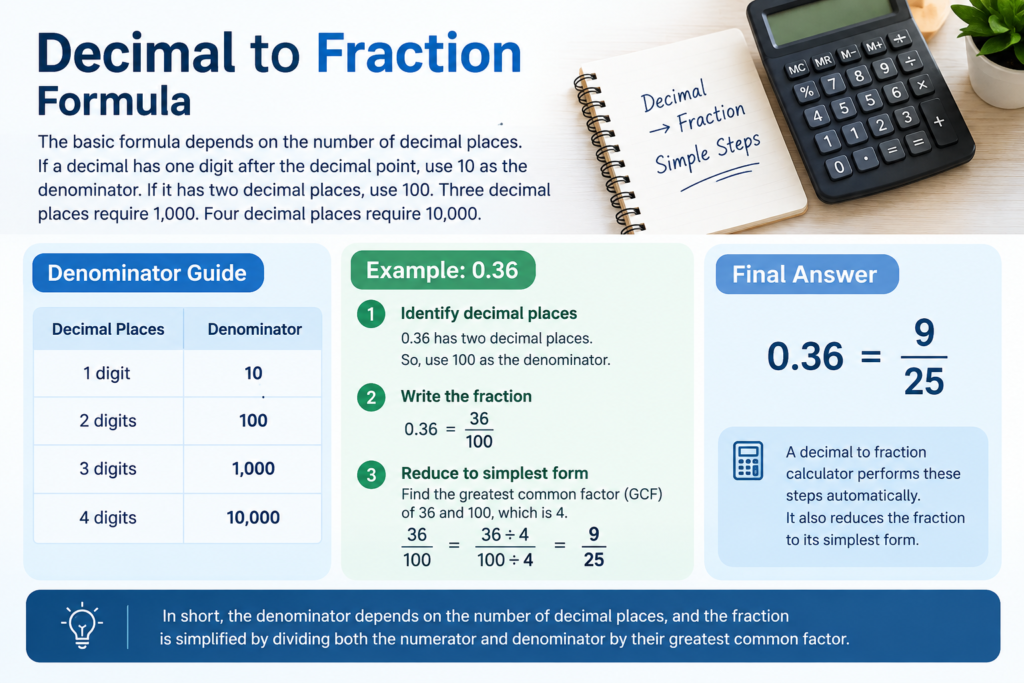
The basic formula depends on the number of decimal places. If a decimal has one digit after the decimal point, use 10 as the denominator.
If it has two decimal places, use 100. Three decimal places require 1,000. Four decimal places require 10,000.
For example, 0.36 has two decimal places. You can write it as 36/100. After reducing both numbers by their greatest common factor, the answer becomes 9/25.
A decimal to fraction calculator performs these steps automatically. It also reduces the fraction to its simplest form.
Converting Whole Decimals Into Fractions
Some decimal values are greater than one. You can still convert them using the same basic method.
Consider 2.5. The number has one decimal place, so you can write it as 25/10. After simplifying, the result is 5/2.
You can also express the answer as a mixed number. In this case, 5/2 becomes 2 1/2.
This format can make larger fractional values easier to understand. It is especially common in school mathematics and practical measurements.
What Is a Mixed Fraction Calculator?
A mixed fraction calculator works with numbers that contain a whole number and a proper fraction. For example, 3 1/4 is a mixed fraction.
You may need this type of calculator when converting an improper fraction into a mixed number. The calculator divides the numerator by the denominator and uses the remainder as the new numerator.
For example, 11/4 equals 2 3/4. The whole number is 2 because 4 fits into 11 twice. The remainder is 3, which becomes the numerator.
Mixed fractions can also be converted back into improper fractions. Multiply the whole number by the denominator, then add the numerator. Keep the same denominator.
Terminating and Repeating Decimals
Not every decimal behaves in the same way. Terminating decimals end after a fixed number of digits. Examples include 0.5, 0.25, and 0.875.
Repeating decimals continue with a repeating pattern. Examples include 0.333… and 0.666….
A repeating decimal can also represent an exact fraction. For instance, 0.333… equals 1/3.
However, the conversion requires a different method. You cannot simply place the visible decimal digits over a power of ten and stop there.
How Does a Decimal to Fraction Calculator Handle Repeating Decimals?
A calculator designed for exact fraction conversion may recognize repeating decimals and apply algebraic methods.
For example, let x equal 0.333…. Multiplying both sides by 10 gives 10x = 3.333….
Subtracting the original equation from the new equation removes the repeating decimal portion. This produces 9x = 3, so x = 1/3.
This method works because the repeating section continues forever. It gives an exact fraction instead of an approximation.
When Should You Use a Fraction Calculator?
A fraction calculator can save time when you need quick and accurate results. It can help with homework, math practice, measurements, recipes, and everyday calculations.
It is also useful when you need to check manual work. You can calculate the answer yourself and then compare it with the calculator result.
Students can use the process to learn the underlying math. The calculator should support understanding rather than replace it.
What Is a Partial Fraction Calculator?
A partial fraction calculator solves a different type of problem. It is mainly used in algebra and calculus to break a rational expression into simpler fractions.
For example, a complex algebraic fraction may contain a polynomial in both the numerator and denominator. Partial fraction decomposition rewrites the expression into smaller terms that are easier to work with.
This process often appears in integration and algebra courses. It should not be confused with ordinary decimal-to-fraction conversion.
A partial fraction calculator is therefore useful for advanced mathematical expressions, while a decimal to fraction calculator focuses on converting numerical decimal values.
Common Decimal to Fraction Examples
Simple examples can make the conversion process easier to understand.
A decimal such as 0.2 becomes 2/10. Reducing the fraction gives 1/5.
For 0.4, the starting fraction is 4/10. After simplification, the result is 2/5.
The decimal 0.125 becomes 125/1000. Dividing both numbers by 125 gives 1/8.
For a larger value such as 3.75, you can write 375/100. Reducing the fraction gives 15/4, which is also 3 3/4.
These examples show why simplifying the final fraction matters. The first fraction may be correct, but the reduced form is usually easier to use.
Common Mistakes When Converting Decimals
One common mistake is choosing the wrong denominator. The denominator must match the decimal’s place value.
Another mistake involves forgetting to simplify the fraction. A result such as 50/100 is mathematically correct, but 1/2 is the simplest form.
Rounding can also cause problems. If the decimal is repeating, treating it as a short terminating decimal may produce an inaccurate fraction.
Finally, check whether the answer should be an improper fraction or a mixed number. Both forms can represent the same value, but they serve different purposes.
Benefits of Using a Decimal to Fraction Calculator
A calculator makes conversions faster and easier. It can also reduce arithmetic mistakes during busy study sessions.
The biggest benefit is convenience. Instead of manually finding a denominator and reducing the fraction, you can get the simplified result quickly.
It can also help you understand patterns. By converting several decimals, you can see how decimal places relate to powers of ten and fraction denominators.
For students, this makes the calculator a useful learning aid. You can use it to check your work after solving a problem manually.
Decimal to Fraction Calculator for Students
Students often encounter decimals and fractions in arithmetic, algebra, geometry, and statistics. Knowing how to move between these formats is an important math skill.
A decimal to fraction calculator can help when homework requires an exact fractional answer. It can also help students verify calculations before submitting their work.
Still, learning the manual method remains valuable. Once you understand place value and fraction reduction, many conversions take only a few seconds.
Conclusion
A decimal to fraction calculator provides a quick way to convert decimal values into simplified fractions. The basic process uses decimal place value, followed by fraction reduction.
The same idea works for many terminating decimals. Repeating decimals require a different mathematical approach, while mixed fractions and partial fractions involve separate concepts.
Whether you are checking homework or solving a practical math problem, understanding the conversion process helps you use the calculator with confidence.
FAQs
What does a decimal to fraction calculator do?
A decimal to fraction calculator converts a decimal number into an equivalent fraction. It usually simplifies the result so the numerator and denominator have no common factor.
How do I convert 0.5 into a fraction?
Write 0.5 as 5/10 because there is one digit after the decimal point. Reduce the fraction by dividing both numbers by 5. The result is 1/2.
How do I convert 0.75 into a fraction?
Write 0.75 as 75/100. Both numbers can divide by 25, giving 3/4. Therefore, 0.75 and 3/4 represent the same value.
Can a decimal become a mixed fraction?
Yes. Decimals greater than one can become mixed fractions. For example, 2.5 converts to 5/2, which can also be written as 2 1/2.
What is a mixed fraction calculator used for?
A mixed fraction calculator helps convert between mixed numbers and improper fractions. It can also support calculations involving mixed fractions.
Can repeating decimals become fractions?
Yes. Repeating decimals can represent exact fractions. For example, 0.333… equals 1/3. The conversion requires an algebraic method rather than a simple power-of-ten denominator.
For more updates visit: CALCIQ