

Your GPA can give you a quick view of your academic performance. However, calculating it by hand can become confusing when your courses have different credit values and grades.
A gpa calculator college tool makes this process much easier. It can help you work out your average grade points and understand how individual courses affect your overall result.
For students in the UK, there is an important point to remember. UK universities commonly use degree classifications and percentage marks rather than the traditional 4.0 GPA system used by many US colleges. Even so, GPA calculations are useful when studying abroad, applying to international institutions, or comparing academic results.
What Is a College GPA?
GPA stands for Grade Point Average. It represents academic performance using a numerical scale. The most familiar system is the 4.0 scale, although colleges and universities can use different grading systems.
Each letter grade normally has a corresponding grade-point value. For example, an A may represent 4.0 points, while lower grades receive fewer points. Your GPA is then calculated from the grade points earned across your courses.
Credit hours can also affect the calculation. A course with more credits may have a greater impact on your final GPA than a course with fewer credits.
That is why simply adding your grades and dividing by the number of subjects may not always give the correct result.
How Does a GPA Calculator College Tool Work?
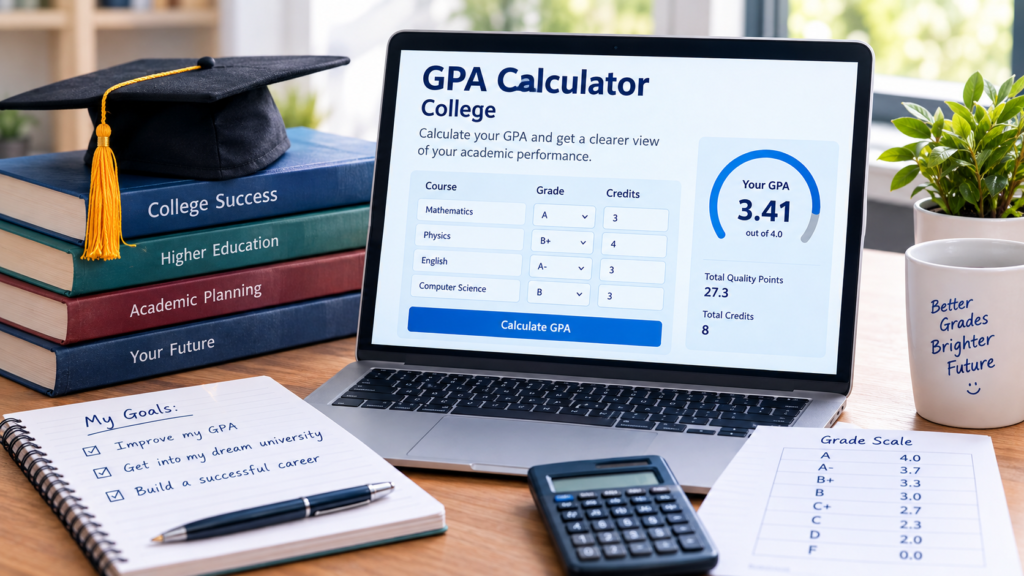
A gpa calculator usually needs three main pieces of information: your course grade, the number of credits, and the grade-point value assigned to that grade.
The basic weighted GPA formula is:
GPA = Total Quality Points ÷ Total Credit Hours
Quality points are calculated by multiplying the grade points for a course by its credit hours.
For example, imagine you completed three courses. One course is worth three credits and you earned 4.0 grade points. Another is worth three credits and you earned 3.0 points. The final course is worth two credits and you earned 3.5 points.
The total quality points would be calculated by multiplying each grade value by its credits. You then add those results together and divide by the total number of credits.
This gives you a weighted GPA that reflects the credit value of each course.
Why Credit Hours Matter
Credit hours are important because not every course carries the same academic weight.
Suppose you receive a high grade in a one-credit course and a lower grade in a four-credit course. The lower grade may have a bigger effect on your GPA because the four-credit course contributes more quality points to the calculation.
A college GPA calculator accounts for this difference. As a result, it can provide a more accurate picture of your academic average.
Students should always check their institution’s grading and credit rules before relying on a standard GPA scale. Some universities use different scales, weighting methods, or rules for particular courses.
GPA Calculator College vs High School GPA Calculator
A high school GPA calculator and a college GPA calculator follow a similar basic idea, but their grading systems can differ.
High schools may calculate GPA using standard, honours, or advanced courses. Some schools also use weighted GPAs, where advanced classes receive additional grade points.
College calculations often depend more directly on credit hours. Each course can carry a specific number of credits, so the course’s credit value affects the overall average.
The grading scale can also vary between institutions. Therefore, you should use the grading system provided by your school or university instead of assuming every institution uses the same 4.0 scale.
Is GPA Used in UK Universities?
GPA is not the main grading system across UK higher education.
UK universities commonly assess undergraduate performance using percentage marks and degree classifications. These classifications can include First-Class Honours, Upper Second-Class Honours, Lower Second-Class Honours, and Third-Class Honours.
Because of this difference, a GPA from another country should not automatically be treated as identical to a UK university classification.
The relationship between percentage marks, degree classifications, and GPA can also vary by institution. If you are applying to a UK university with an international qualification, check the specific entry requirements for your course.
How to Calculate Your GPA Manually
Calculating your GPA manually is straightforward when you know your grades, grade points, and credits.
Start by identifying the grade-point value for each course. Next, multiply each grade-point value by the number of credits assigned to that course.
Add all the resulting quality points together. Then add the credits from every course.
Finally, divide the total quality points by the total number of credits.
For instance, if your courses produce a combined total of 30 quality points across 8 credits, your GPA would be 30 divided by 8, giving you a GPA of 3.75.
The example uses a standard numerical approach. Your actual result may differ if your institution uses another grading scale or calculation method.
How Can a GPA Calculator Help Students?
A GPA calculator can save time and reduce simple calculation errors.
It can also help students understand how their grades affect their academic average. You can use it to estimate the effect of a new grade, review your current performance, or understand how many credits contribute to your result.
Students preparing for international applications may also find GPA calculations useful. A numerical average can make it easier to organise academic records before checking the exact requirements of a university or programme.
However, a calculator should support your academic planning rather than replace official records.
What Is a Good College GPA?
There is no single GPA that is considered good for every student.
The answer depends on the institution, course, scholarship, programme, and career goal. Some competitive programmes may expect strong academic performance, while other situations may have more flexible requirements.
A GPA around 3.0 on a 4.0 scale is often viewed as solid, while results around 3.5 or higher generally indicate strong performance. However, these figures should not be treated as universal admission standards.
UK students should be especially careful when comparing GPA figures with UK degree classifications. The systems measure academic performance differently, so direct comparisons can be misleading.
Common GPA Calculation Mistakes
One common mistake is using the wrong grading scale. A 4.0 system is widely recognised, but it is not the only system used by educational institutions.
Another mistake is ignoring credit hours. If your courses have different credit values, an unweighted average may give you an inaccurate result.
Students may also confuse cumulative GPA with semester GPA. A semester GPA covers a specific study period, while a cumulative GPA combines results across multiple periods.
Finally, do not assume that an online GPA result is an official academic record. Your university or college’s transcript remains the authoritative record of your grades.
GPA and Academic Planning
Your GPA can be useful when setting academic goals.
For example, you can calculate your current average and then estimate how future grades might change it. This can help you understand whether improving one course could make a meaningful difference.
It is also useful to consider credit weight. Improving a high-credit course may have a larger effect than improving a low-credit course.
Still, students should focus on learning and consistent performance rather than chasing a number alone. A strong academic record involves more than one calculation.
Final Thoughts on GPA Calculator College
A gpa calculator college tool provides a simple way to understand your academic average. It uses grades, grade points, and credit values to calculate a weighted result.
For international students, GPA can also help when comparing academic systems. However, UK universities generally rely on percentage marks and degree classifications rather than treating GPA as the universal standard.
Whether you are checking your current results or planning future grades, understanding the calculation can help you make better academic decisions. Always compare your result with the grading rules used by your own institution.
FAQs
What is a GPA calculator?
A GPA calculator is a tool that estimates your grade point average from your course grades and credit values. It can make GPA calculations faster and easier.
How is college GPA calculated?
College GPA is generally calculated by dividing total quality points by total credit hours. Each course’s quality points usually come from multiplying its grade points by its credit value.
Is a 3.5 GPA good in college?
A 3.5 GPA on a 4.0 scale generally represents strong academic performance. However, what counts as a good GPA depends on your institution, programme, and academic goals.
Is GPA used in the UK?
GPA is not the standard grading system across UK universities. UK higher education commonly uses percentage marks and degree classifications for undergraduate degrees.
Can I use a high school GPA calculator for college?
A high school GPA calculator may use a different grading structure from your college. You should check whether its scale and weighting method match your college’s rules before using the result.
What is the difference between GPA and cumulative GPA?
GPA can refer to an average for a particular study period, while cumulative GPA normally represents your combined performance across multiple terms or semesters.
For more updates visit: CALCIQ