


Trying to work out what your GPA means in percentage terms? You are not alone. Many students need a percentage score for college applications, scholarships, or job applications, even though their transcript only shows a GPA. This guide explains exactly how a 4.0 GPA to percentage calculator works, walks through the formula, and shows a full worked example so you can convert your own score with confidence.
Quick Answer
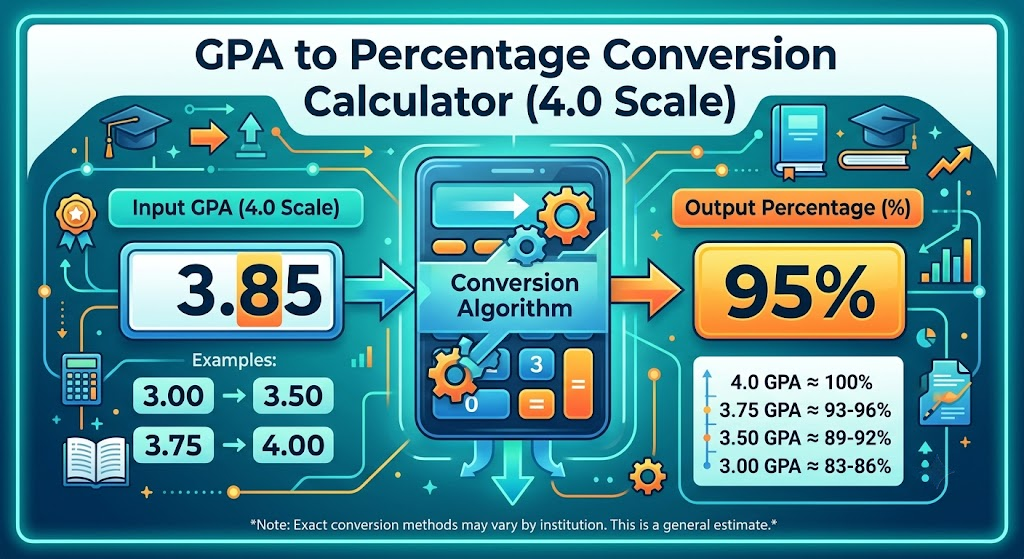
On the standard 4.0 scale, you convert GPA to percentage using this formula: Percentage = (GPA ÷ 4.0) × 100. So, a 3.5 GPA equals 87.5%, and a perfect 4.0 GPA equals 100%. This method is widely used by US colleges and universities, though individual institutions can apply their own grading curves.
Use our free 4.0 GPA to Percentage Calculator to calculate your results instantly.
[CALCULATOR GOES HERE]
How to Use the Calculator
Getting your percentage takes only a few seconds. First, enter your current GPA into the input box. Next, confirm that the scale is set to 4.0, since some tools also support 5.0, 7.0, and 10.0 scales. Then, click “Calculate” to see your percentage instantly. Finally, check the result against the reference table below to understand what grade range it falls into.
Because the calculator does the maths for you, there is no need to remember the formula. However, understanding it still helps you interpret the result correctly, especially when comparing scores across different grading systems.
Input Fields Explained
The calculator typically asks for two pieces of information.
GPA Value: This is your grade point average as shown on your transcript, usually somewhere between 0.0 and 4.0. Enter it exactly as it appears, including any decimals.
Grading Scale: Most US schools use a 4.0 maximum, but some use 4.3, 5.0, 7.0, or 10.0. Selecting the correct scale matters a great deal, since the same numeric GPA means something different on a 5.0 scale than it does on a 4.0 scale.
If your school uses weighted GPA, note that scores can sometimes exceed 4.0. In that case, the standard formula still applies, but the resulting percentage may also exceed 100%, which reflects the extra credit built into weighted grading rather than an error in the calculation.
Formula Used
The universal formula for converting a 4.0 scale GPA to a percentage is:
Percentage = (GPA ÷ 4.0) × 100
This is mathematically the same as multiplying your GPA by 25, since 100 divided by 4.0 equals 25. Therefore, you can also use the shortcut:
Percentage = GPA × 25
Both versions produce identical results. This method is the most commonly accepted approach and is used by the majority of US universities when a percentage equivalent is needed. That said, individual institutions may apply their own grading policies, so this formula should be treated as a standard estimate rather than an official conversion for every school.
Worked Example
Suppose a student has a GPA of 3.6 on a 4.0 scale. Here is how the calculation works, step by step.
First, divide the GPA by the maximum scale: 3.6 ÷ 4.0 = 0.9. Then, multiply that result by 100 to convert it into a percentage: 0.9 × 100 = 90%. So, a 3.6 GPA converts to a 90% equivalent, which typically falls within the A- grade range at most US institutions.
Let’s try a second example for clarity. A GPA of 2.8 converts as follows: 2.8 ÷ 4.0 = 0.7, and 0.7 × 100 = 70%. This score generally corresponds to a C+ average.
Result Interpretation
Once you have your percentage, it helps to know what it actually represents. A higher percentage reflects stronger academic performance relative to the maximum possible score. However, the exact letter grade tied to each percentage band can vary between schools, so always cross-check with your institution’s grading scale if the result will be used for an official application.
| GPA (4.0 Scale) | Percentage | Approximate Letter Grade |
|---|---|---|
| 4.0 | 100% | A+ |
| 3.7 | 92.5% | A |
| 3.3 | 82.5% | B+ |
| 3.0 | 75% | B |
| 2.7 | 67.5% | B- |
| 2.0 | 50% | C |
| 1.0 | 25% | D |
Practical Uses
Students convert GPA to percentage for several real-life reasons. International university applications often require a percentage score rather than a GPA, since many countries outside the US use percentage-based grading. Similarly, scholarship providers sometimes set a minimum percentage threshold for eligibility, so applicants need a converted figure to check whether they qualify.
ALSO READ: Dutch Bros Calorie Calculator Know Before You Sip
Additionally, employers occasionally ask for academic percentages during recruitment, particularly for graduate programmes or fresher-level roles. Visa applications for study abroad can also require a percentage equivalent as part of the documentation process.
Benefits
Using a calculator instead of manual maths saves time and reduces the chance of small errors. It also standardises your score for comparison across different grading systems, which is especially useful when applying to schools or employers in countries with different academic conventions. Furthermore, an instant online tool lets you test multiple GPA values quickly, which is handy if you are estimating a projected GPA before final grades are released.
Limitations
While the formula is simple, it does have limits worth understanding. Because grading policies differ between institutions, this calculator provides a standard estimate rather than an official transcript conversion. Some universities apply grading curves, credit-weighted averages, or custom scales that do not map neatly onto the 4.0-to-percentage formula.
Moreover, weighted GPAs can exceed 4.0, which may produce a percentage above 100%. In such cases, the number is mathematically correct but should still be interpreted carefully, since it reflects bonus points rather than a literal test score. For any formal application, always confirm the required conversion method with the receiving institution.
Common Mistakes
Many users select the wrong grading scale, which throws off the entire calculation. For example, entering a GPA that was earned on a 5.0 scale while leaving the calculator set to 4.0 produces an inflated percentage. Others forget that weighted and unweighted GPAs are not directly comparable, even though both use the same 4.0 maximum.
It is also common to assume the percentage result is an official score. In reality, it is only an estimate unless your target institution explicitly accepts the standard formula. Finally, rounding errors can creep in when GPA figures are truncated too early in manual calculations, so it is best to keep at least two decimal places until the final step.
Comparison Table: Common GPA Conversion Scales
| Scale Used | Formula | Example (GPA 3.5) |
|---|---|---|
| 4.0 Scale | (GPA ÷ 4.0) × 100 | 87.5% |
| 4.3 Scale | (GPA ÷ 4.3) × 100 | 81.4% |
| 5.0 Scale | (GPA ÷ 5.0) × 100 | 70% |
| 10.0 Scale (CGPA, common in India) | CGPA × 9.5 | Not directly comparable |
Conclusion
Converting a GPA to a percentage is straightforward once you know the formula: divide your GPA by the maximum scale and multiply by 100. For most US students on a 4.0 scale, this simply means multiplying GPA by 25. While the result gives a reliable estimate for applications, scholarships, and comparisons, it is always worth double-checking your target institution’s specific grading policy before submitting an official percentage figure.
FAQs
Is a 4.0 GPA equal to 100%?
Yes. On the standard 4.0 scale, a perfect 4.0 GPA converts to exactly 100% using the formula GPA × 25.
Does every university use the same GPA-to-percentage formula?
No. While the (GPA ÷ 4.0) × 100 method is widely used, some institutions apply their own grading curves or credit-weighted calculations, so results can vary slightly between schools.
Can a weighted GPA produce a percentage above 100%?
Yes. Since weighted GPAs can exceed 4.0 due to extra points for advanced or honours courses, the resulting percentage can technically go above 100% under the standard formula.
Why do international applications ask for a percentage instead of GPA?
Many countries outside the US use percentage-based grading systems as their primary standard, so admissions offices request a percentage to compare applicants fairly across different educational backgrounds.
Is this calculator suitable for official transcript conversions?
Not necessarily. This tool provides a standard estimate. For official purposes, such as visa applications or credential evaluations, always check the receiving institution’s accepted conversion method.
How is a 10-point CGPA different from a 4.0 GPA?
A 10-point CGPA, common in Indian universities, typically converts using CGPA × 9.5, which is a different formula from the 4.0 scale. The two systems measure academic performance differently, so a direct numeric comparison is not accurate without converting first.
For more updates visit: CALCIQ