

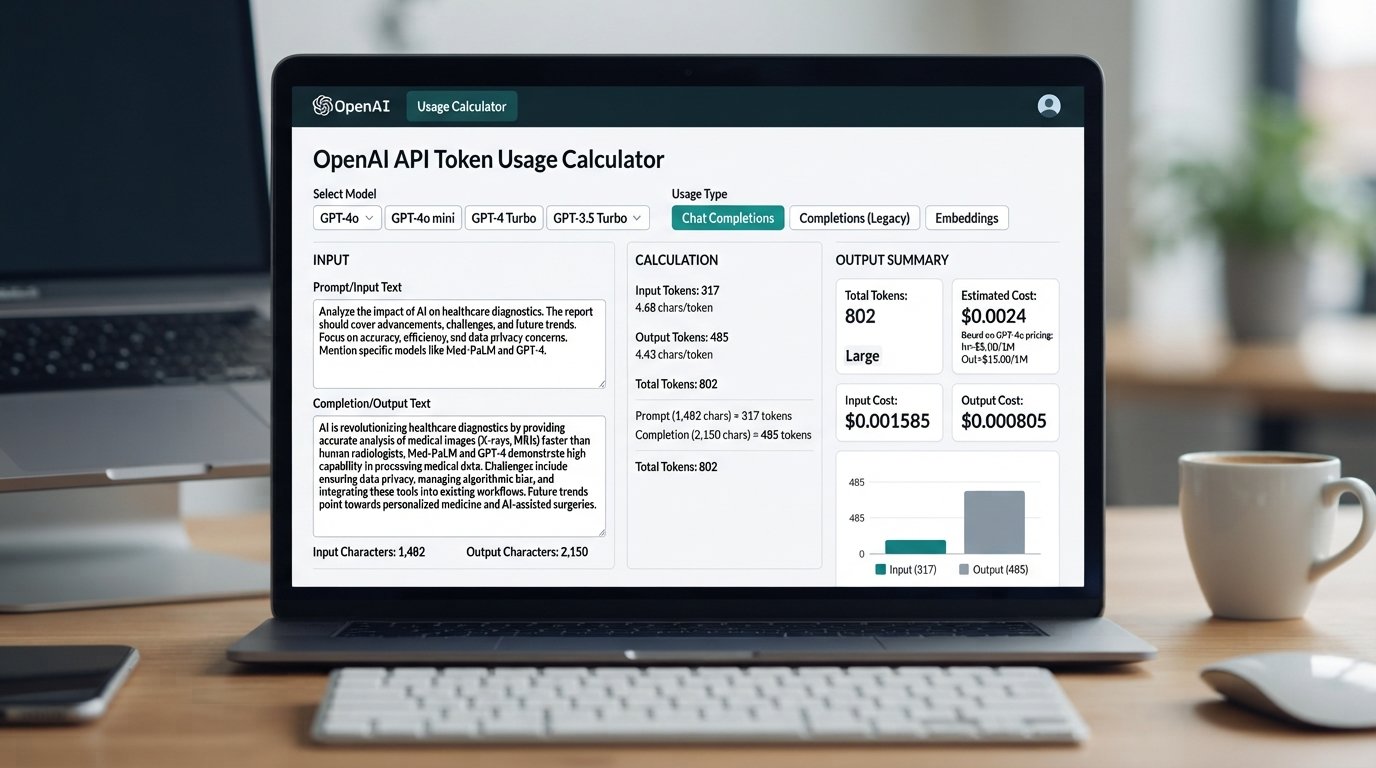
Building with GPT models is exciting, but bills can climb fast if you don’t track tokens. An OpenAI API token usage calculator helps you predict costs before you send a single request. Instead of guessing, you plug in your model, your prompt length, and your expected output, and you get a clear dollar figure. This guide explains exactly how the calculator works, so you can budget your AI project with confidence.
Whether you’re a solo developer testing a chatbot or a team scaling a production app, knowing your token cost per request changes how you plan. Consequently, this page walks through the formula, a worked example, and the mistakes that quietly inflate API bills.
Use Our Free OpenAI API Token Usage Calculator to Calculate Your Results Instantly
[CALCULATOR GOES HERE]
Quick Answer
To estimate your OpenAI API cost, multiply your input tokens by the model’s input rate, then multiply your output tokens by the model’s output rate, and add the two figures together. As of July 2026, OpenAI’s current flagship pricing runs from $1.00 to $5.00 per million input tokens and $6.00 to $30.00 per million output tokens, depending on the model tier you choose. Cached input tokens cost roughly 90% less than fresh input tokens on most current models.
How to Use the Calculator
Using the calculator only takes a few steps. First, select the model you plan to call, since each model has its own input and output rate. Next, enter your expected input tokens, which is the size of your prompt plus any system instructions. After that, enter your expected output tokens, which is the length of the response you expect the model to generate. Finally, add the number of requests per day or month if you want a recurring cost estimate rather than a single-call figure.
The tool then applies OpenAI’s published per-token rates and returns your estimated cost in seconds. You don’t need to know the formula by heart, though understanding it helps you spot errors in your own estimates.
Input Fields Explained
Each field in the calculator maps directly to a real billing variable in the OpenAI API. Here’s what each one means:
- Model: The specific GPT model you’re calling, such as GPT-5.6 Sol, Terra, or Luna. Pricing varies significantly between tiers, so this choice matters most.
- Input tokens: The tokens in your prompt, including system messages, user messages, and any documents you attach. Roughly 100 tokens equals about 75 words in English.
- Cached input tokens: Tokens from a repeated prompt prefix, such as a fixed system prompt or shared context. OpenAI bills these at a steep discount.
- Output tokens: The tokens the model generates in its response. Output is almost always billed at a much higher rate than input.
- Number of requests: Optional, but useful if you want to project daily, weekly, or monthly spend rather than a single API call.
- Batch processing toggle: If you’re using OpenAI’s Batch API for non-urgent jobs, this applies a 50% discount to both input and output rates.
Formula Used
The official OpenAI pricing model bills input and output tokens separately, and the calculator follows this exact structure:
Total Cost = (Input Tokens ÷ 1,000,000 × Input Rate) + (Output Tokens ÷ 1,000,000 × Output Rate)
If your prompt reuses a cached prefix, the formula adjusts slightly:
Total Cost = (Fresh Input Tokens ÷ 1,000,000 × Input Rate) + (Cached Tokens ÷ 1,000,000 × Cached Rate) + (Output Tokens ÷ 1,000,000 × Output Rate)
This formula comes directly from OpenAI’s official API pricing page, which lists per-token costs per one million tokens for each model. All current rates apply to standard, non-batch processing unless stated otherwise.
Worked Example
Let’s say you’re building a customer support chatbot using GPT-5.6 Terra, priced at $2.50 per million input tokens and $15.00 per million output tokens. A typical support conversation uses about 800 input tokens and generates around 300 output tokens.
Here’s the calculation, step by step:
- Input cost: 800 ÷ 1,000,000 × $2.50 = $0.002
- Output cost: 300 ÷ 1,000,000 × $15.00 = $0.0045
- Total cost per conversation: $0.002 + $0.0045 = $0.0065
Now imagine your app handles 5,000 conversations a day. Multiply $0.0065 by 5,000, and your daily cost lands around $32.50, or roughly $975 a month. Small per-request costs add up quickly at scale, which is exactly why forecasting matters before launch.
Result Interpretation
The calculator’s output shows your total estimated cost, broken into an input cost and an output cost. Because output tokens typically cost four to eight times more than input tokens, a short prompt with a long response can cost more than a long prompt with a short response. If your result looks higher than expected, check whether your output length assumption is realistic, since verbose responses are the most common source of budget overruns.
Practical Uses
Developers and teams use this calculator for several real-world purposes:
- Pre-launch budgeting: Estimating monthly API spend before deploying a chatbot, assistant, or content tool.
- Model comparison: Testing whether a cheaper model like Luna delivers acceptable quality at a fraction of the cost of Sol.
- Prompt optimization: Measuring how shortening a system prompt or trimming output length reduces cost per call.
- Client quoting: Freelancers and agencies use it to price AI features accurately when billing clients.
- Scaling forecasts: Projecting cost growth as user numbers or request volume increases over time.
Benefits
This calculator saves you from surprise invoices. Because it uses OpenAI’s official rate card, your estimates stay accurate as long as you keep the token inputs realistic. It also helps you compare models side by side, so you’re not stuck guessing whether a pricier model is worth the extra spend. Furthermore, it turns an abstract token count into a concrete dollar figure that’s easy to share with a manager or client.
Limitations
The calculator gives an estimate, not an exact invoice. Actual token counts depend on your specific tokenizer output, which can vary slightly based on formatting, whitespace, and special characters in your text. Additionally, OpenAI updates its pricing periodically, so always cross-check the current rate against the official pricing page before finalizing a budget. The tool also can’t predict how many tokens a model will actually generate in its response, since output length varies with prompt design and model behavior.
ALSO READ: Army Body Fat Calculator Check Your AR 600-9 Standard Instantly
Common Mistakes
Many users underestimate their bill because they overlook a few key details. First, they forget that output tokens cost far more than input tokens, so a chatty model response inflates costs quickly. Second, they estimate token counts from word counts alone, without accounting for punctuation, code, or non-English text, which tokenizes differently. Third, they ignore system prompts and tool definitions, both of which count as input tokens on every single request. Finally, some users forget that reasoning-capable models can consume additional internal tokens before producing a visible answer, which increases the effective output cost.
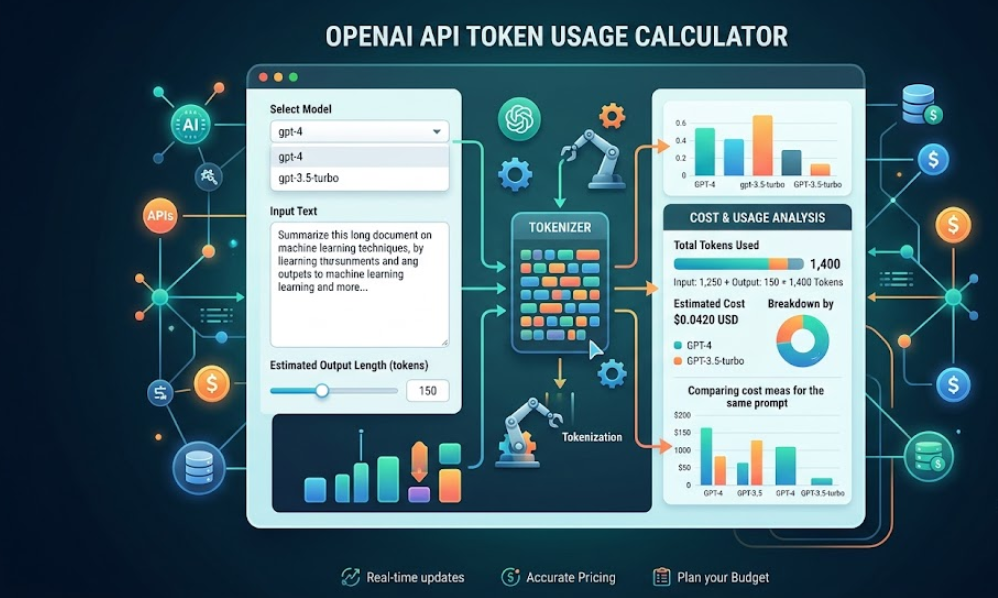
Comparison Table: Current OpenAI Model Pricing (July 2026)
| Model | Input (per 1M tokens) | Cached Input (per 1M tokens) | Output (per 1M tokens) | Best For |
|---|---|---|---|---|
| GPT-5.6 Sol | $5.00 | $0.50 | $30.00 | Complex, agentic, high-stakes tasks |
| GPT-5.6 Terra | $2.50 | $0.25 | $15.00 | Balanced, everyday production work |
| GPT-5.6 Luna | $1.00 | $0.10 | $6.00 | High-volume, cost-sensitive tasks |
Pricing sourced from OpenAI’s official API pricing page. Batch API processing applies a 50% discount to both input and output rates. Prices apply to standard context lengths and may change without notice, so always confirm current rates before budgeting.
Conclusion
Tracking token usage doesn’t have to feel complicated. With a clear formula and a few accurate inputs, you can predict your OpenAI API costs before you write a single line of production code. Use the calculator above whenever you plan a new feature, switch models, or scale your user base, so your budget stays as predictable as your product roadmap.
FAQs
Is the OpenAI API free to use?
No, the API key itself is free to create, but every request you send is billed based on the number of input and output tokens processed. There’s no free monthly token allowance for standard API access.
How many words is one token?
One token roughly equals 0.75 words in English, so 1,000 tokens is about 750 words. However, this ratio shifts for code, non-English languages, and text with heavy punctuation.
Why does output cost more than input on OpenAI models?
Generating text requires more computation per token than reading it, since the model must predict each new token in sequence. As a result, OpenAI consistently prices output tokens several times higher than input tokens across its model lineup.
What is a cached input token?
A cached input token comes from a prompt prefix that’s identical to one you’ve sent recently, such as a fixed system message. OpenAI automatically detects these repeated segments and bills them at a steep discount compared to fresh input.
Does the Batch API really save 50%?
Yes, OpenAI’s Batch API processes requests asynchronously within 24 hours and applies a 50% discount to both input and output token rates. It’s ideal for non-urgent workloads like bulk summarization or data labeling.
Can this calculator predict my exact monthly bill?
It provides a close estimate based on your inputs, but your actual bill depends on real usage patterns, retries, and any additional tools like web search or code execution that carry separate charges.
For more updates visit: CALCIQ