

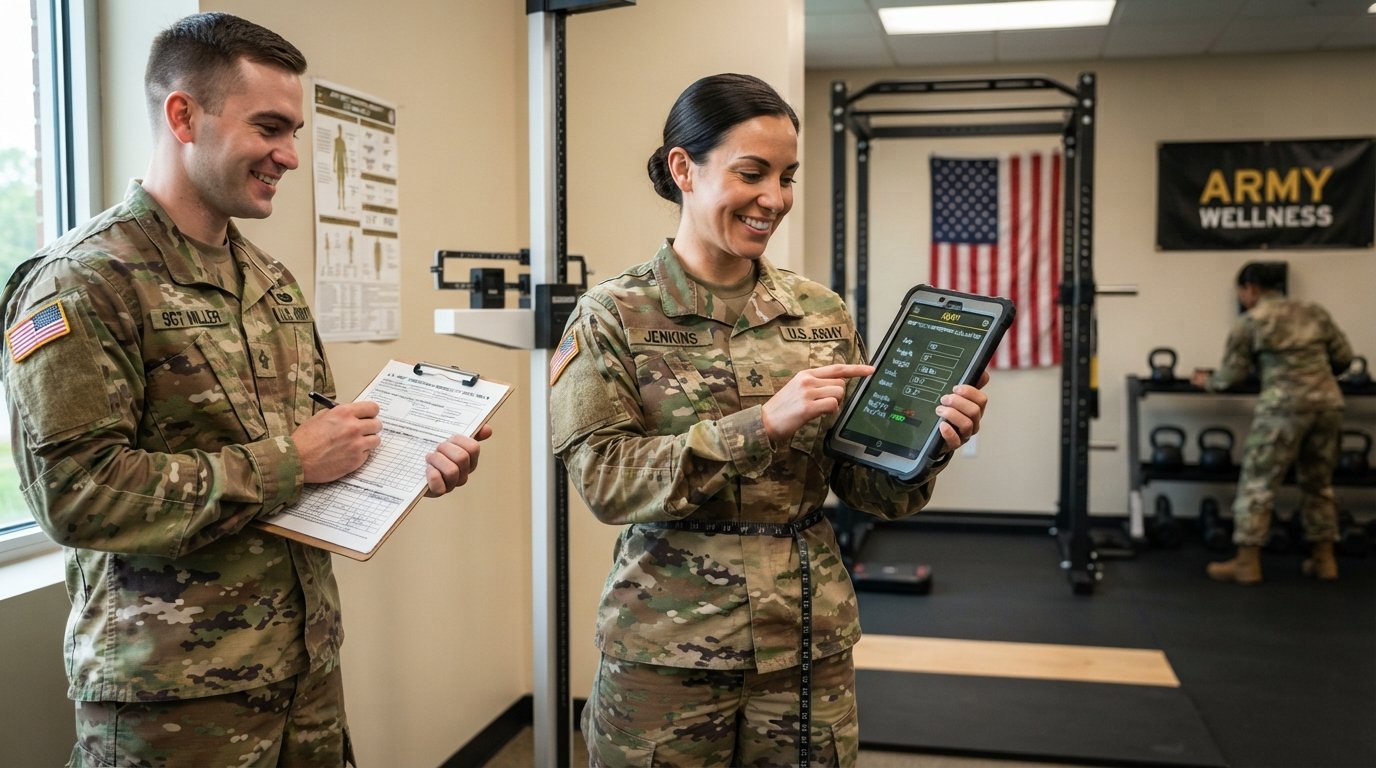
If you’re preparing for a fitness test, tracking your weigh-in, or trying to stay clear of the Army Body Composition Program, you need a fast, accurate way to check where you stand. First, our Army Body Fat Calculator uses the same tape test measurements the Army relies on. As a result, you get a realistic body fat estimate before you ever step on a scale for official record.
This tool is built for active-duty soldiers, National Guard and Reserve members, recruits preparing for enlistment, and anyone coaching a soldier through a body composition review. It saves you the guesswork of manual formulas and cross-referencing charts by hand.
Enter your height, gender, age, and circumference measurements, and the calculator does the rest. Use our free calculator below.
Use the Calculator
Grab a flexible tape measure and enter your height, neck, waist, and (for female soldiers) hip measurements below. The calculator instantly returns your estimated body fat percentage and compares it against the current Army standard for your age and gender.
[CALCULATOR WIDGET DISPLAYS HERE]
What Is an Army Body Fat Calculator?
An army body fat calculator is a tool that estimates a soldier’s body fat percentage using circumference measurements instead of expensive lab equipment. In addition, it provides a quick and practical way to assess body composition. As a result, soldiers and recruiters can determine whether a person meets Army body fat standards more efficiently. Furthermore, the calculator helps save time during evaluations. For example, it allows users to estimate body fat without specialized equipment. Therefore, it is widely used for screening and fitness assessments. Overall, it offers a simple, reliable, and convenient method for checking compliance with Army body fat requirements.
It replicates the tape test procedure defined under Army Regulation 600-9, the regulation that governs the Army Body Composition Program (ABCP).v
The Army does not use bioelectrical scales or skinfold calipers for official record. Instead, it relies on a circumference-based formula developed by the Department of Defense. This method was chosen because it’s fast, requires no special equipment beyond a tape measure, and can be repeated consistently across thousands of soldiers at once.
People can also read this: How to Calculate Percentage Decrease (Free Formula + Examples)
Every soldier who exceeds the height and weight screening table is required to complete a tape test. The result determines whether they meet body composition standards or need to be enrolled in the ABCP for remediation.
Because the stakes are real — failing this test can affect promotions, school selection, and career progression — soldiers use this calculator to check their numbers privately before an official assessment.
How Does the Calculator Work?
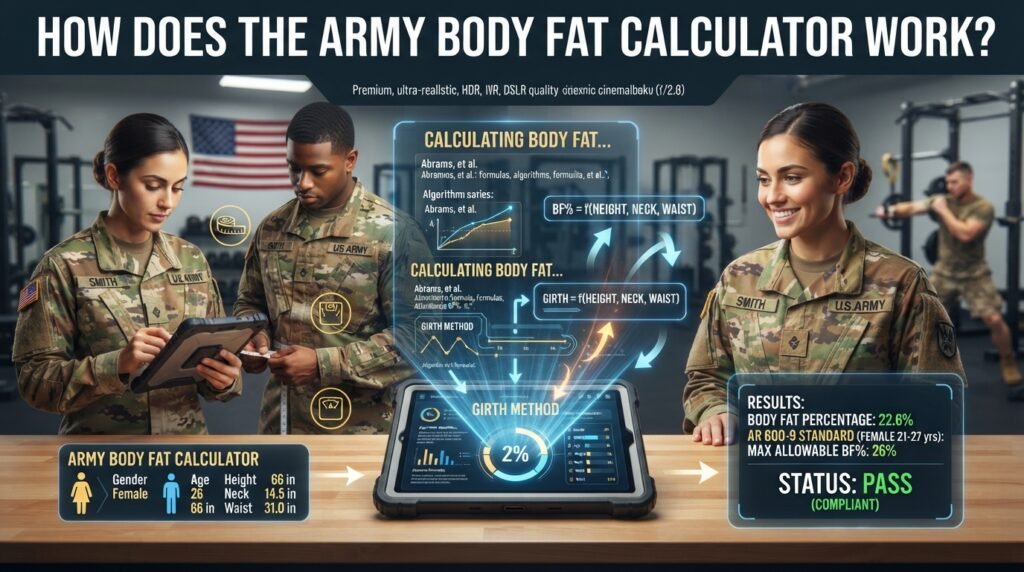
The calculator applies the DoD circumference-based body fat formula, which converts your measurements into a percentage using logarithmic equations.
Inputs required:
| Input | Applies To | Notes |
|---|---|---|
| Height | All soldiers | Measured in inches, without boots |
| Neck circumference | All soldiers | Measured just below the larynx |
| Waist/abdomen circumference | All soldiers | Measured at the navel |
| Hip circumference | Female soldiers only | Measured at the widest point |
| Age and gender | All soldiers | Determines the applicable standard |
Calculation logic:
The formula compares the difference between waist (or waist plus hip, for women) and neck measurements relative to height. A larger neck-to-waist ratio produces a lower estimated body fat percentage, while a smaller ratio produces a higher one.
Output:
The calculator returns your estimated body fat percentage, then checks that figure against the maximum allowable percentage for your age bracket and gender under current Army standards. It tells you plainly whether you fall within limits or exceed them.
You don’t need to understand the underlying logarithms to use this tool. Enter your numbers, and the calculator translates the math into a clear pass or fail result.
How to Use This Calculator
Step 1: Gather your measurements. Use a flexible cloth tape measure, not a metal one. Stand naturally and avoid pulling the tape too tight.
Step 2: Measure your neck. Place the tape just below your larynx, angled slightly downward at the front.
Step 3: Measure your waist or abdomen. Measure at the navel level, keeping the tape parallel to the floor. Female soldiers should also measure hips at the widest point.
Step 4: Enter your height, age, and gender. Select your gender first, since the calculator applies different formulas and standards for men and women.
Step 5: Review your results. The calculator displays your estimated body fat percentage and compares it directly to the AR 600-9 maximum for your category.
Take each measurement twice and average the results for better accuracy.
Real Examples
Below are five realistic scenarios showing how different soldiers’ measurements translate into results.
A 24-year-old male soldier standing 70 inches tall with a 15.5-inch neck and 34-inch waist works out to an estimated 16.8% body fat. Against the 24% maximum for the 21–27 age bracket, he sits comfortably within standard.
At age 35, a male soldier who is 68 inches tall with a 16-inch neck and a 40-inch waist comes out to 25.9% body fat. That’s 1.9 points over the 24% maximum for the 28–39 bracket, putting him outside the standard.
For a 22-year-old female soldier at 64 inches tall, with a 12.5-inch neck, 28-inch waist, and 38-inch hip, the result lands at 25.1%. The 21–27 bracket allows up to 26%, so she meets the standard with a small margin.
Things look tighter for a 41-year-old female soldier who is 66 inches tall with a 13-inch neck, 33-inch waist, and 42-inch hip. Her estimated 32.4% sits just under the 34% ceiling for the 40+ bracket — within standard, but close enough that a small measurement error could tip the result.
The widest margin belongs to a 19-year-old male recruit at 72 inches tall, with a 15-inch neck and 31-inch waist. His estimated 11.2% body fat falls well under the 20% maximum for the 17–20 bracket.
Taken together, these five cases show how much a few inches of difference at the waist or neck can shift the outcome — especially for soldiers sitting near their age group’s limit.
Want me to run the same variation pass over the Common Mistakes or Tips sections too? Those also use a fairly repetitive sentence-opener pattern (“Measuring…”, “Pulling…”, “Use…”) that Yoast will likely flag next.
These examples show how small differences in waist and neck measurements shift the outcome significantly, particularly for soldiers sitting close to the threshold.
Benefits of Using an Army Body Fat Calculator
Soldiers and recruits rely on this tool for several practical reasons.
It prepares you before official weigh-ins. Knowing your estimated result in advance means no surprises during a record assessment.
It removes manual formula errors. The DoD formula involves logarithms that are easy to miscalculate by hand.
It supports fitness planning. Soldiers close to the limit can adjust training and nutrition with a clear numeric target instead of guessing.
It helps recruiters and instructors. Anyone screening potential enlistees can quickly confirm eligibility without lab equipment.
It reduces ABCP anxiety. Understanding where you stand removes uncertainty around a process that affects career progression.
Common Mistakes
Users frequently enter inaccurate measurements, which skews the result. Watch for these errors.
Measuring over clothing. Thick clothing adds inches to your neck and waist reading. Measure against skin or a thin shirt.
Pulling the tape too tight. Compressing the tape produces an artificially small measurement and an unrealistically low body fat estimate.
Measuring the waist at the wrong point. Many people measure at the narrowest point of the torso instead of at the navel, where the Army standard requires it.
Rounding measurements. Rounding half an inch up or down can shift your result by several percentage points, especially for soldiers near the limit.
Entering height with shoes on. The Army measures height without footwear, and even an inch of difference changes your result.
Mixing up gender-specific inputs. Female soldiers must include hip measurement; omitting it produces an inaccurate calculation.
How to Interpret Your Results
| Result | Meaning | Next Step |
|---|---|---|
| Below the maximum, with margin | You meet the standard comfortably | Maintain current fitness routine |
| Just below the maximum | You meet the standard but have little buffer | Monitor waist measurement monthly |
| At or slightly above the maximum | You do not currently meet the standard | Review nutrition and training before official assessment |
| Well above the maximum | Significant adjustment needed | Consult unit fitness resources and consider ABCP guidance |
A result close to the limit doesn’t guarantee failure or success on an official test, since measurement technique varies slightly between assessors. Treat borderline results as a signal to reassess in a few weeks rather than a final verdict.
Tips to Get Accurate Results
Morning measurements tend to be the most reliable, since bloating later in the day can add up to half an inch to your waist.
A cloth or vinyl tape measure works better than a rigid one, because it follows your body’s contours instead of sitting flat against them.
Getting someone else to take your measurements is worth doing when possible — self-measuring the neck in particular tends to produce inconsistent results.
Three measurements beat one. Take the reading three times and go with the middle value rather than averaging, which limits the damage from a single inaccurate pull of the tape.
If your result lands within two percentage points of the standard, it’s worth rechecking your numbers, since that narrow margin is exactly where small technique errors start to matter.
Want me to do a final pass over the whole article to check for any other repeated-opener patterns Yoast might flag elsewhere (Benefits and FAQ sections are worth a quick look too)?
Conclusion
Checking your body fat percentage before an official Army assessment takes the uncertainty out of a process that carries real consequences for your career. This calculator applies the same measurement logic used in official tape tests, giving you a dependable estimate in under a minute.
Whether you’re a recruit preparing for enlistment, an active-duty soldier tracking your standing, or someone supporting a soldier through the ABCP process, accurate numbers make planning easier. Take your measurements carefully, enter them above, and see exactly where you stand against the current Army stand
FAQs
How accurate is the Army body fat calculator?
It closely mirrors the official DoD formula used during real assessments, but accuracy still depends on how precisely you take your measurements. Two people measuring the same soldier can get slightly different results.
Does the Army still use the neck and waist tape test?
The classic multi-site method (neck and waist for men, plus hips for women) has long been the standard reference formula, though the Army introduced a simplified one-site abdominal test as an initial screening option for soldiers who exceed weight limits.
What is the maximum body fat percentage allowed in the Army?
Limits vary by age and gender, generally ranging from around 20% to 26% for men and 30% to 36% for women, with older age brackets allowed slightly higher percentages.
What happens if I fail the Army body fat test?
Soldiers who exceed the standard are typically enrolled in the Army Body Composition Program, which involves monitored fitness and nutrition counseling along with follow-up assessments.
Do I need to pass the height and weight screening before taking the tape test?
Yes. The tape test is only required if you exceed the maximum weight listed for your height, age, and gender on the Army’s screening table.
Can I use this calculator if I’m not in the military?
Yes. Many people use it simply to estimate body fat percentage using a recognized, well-documented formula, even outside a military context.
For more updates visit: CALCIQ