

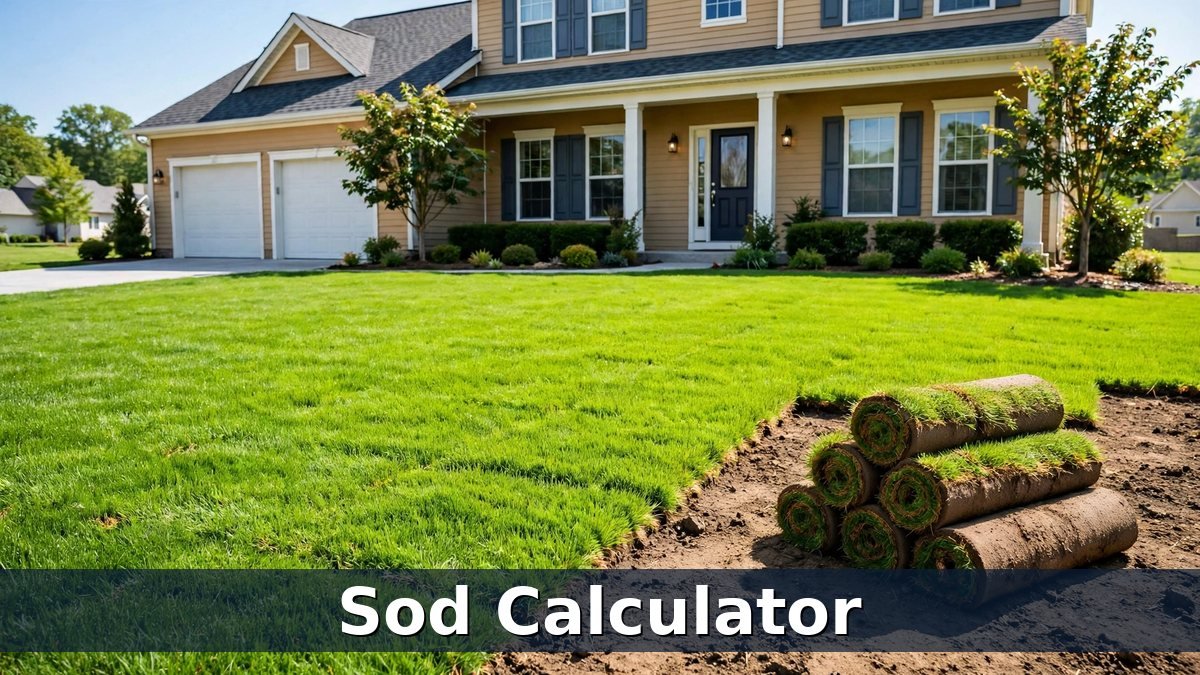
Sod is the fastest way to a finished lawn. Bare soil in the morning becomes green carpet by the evening. But it is also sold in confusing units. One supplier quotes rolls and another quotes pallets. Both want to know your square footage before they will quote at all. Order too little and the last strip of your yard stays mud while a second delivery is arranged. Order too much and fresh turf goes to waste. Cut turf cannot sit in a pile for more than a day or two. Our sod calculator removes the guesswork. Measure your lawn, and it tells you exactly how much sod to order in square feet, rolls and pallets.
The calculation itself is simple: area, plus a waste allowance. But the details around it decide whether the project goes smoothly. Roll and pallet sizes vary between farms. Curved beds eat into your allowance, and the ground preparation matters as much as the quantity. This guide explains how the sod calculator works, and it shows a full worked example. It also covers the measuring, ordering and laying tips that lawn professionals use.
Sod Calculator
Enter your lawn area to see how much sod to order, in square feet, rolls and pallets.
Table of Contents
- How to Use the Sod Calculator
- How to Measure Your Lawn
- How Much Sod Do I Need?
- Worked Example: A 40 × 25 Foot Lawn
- Rolls, Pallets and Slabs
- Preparing the Ground and Laying Sod
- Sod vs Seed: Which Is Better?
- FAQs
How to Use the Sod Calculator
The sod calculator asks for the length and width of your lawn in feet. It also asks for the waste allowance that matches your yard’s shape. Choose 5% for a plain rectangle with straight edges. Also, for a typical lawn with a few beds and paths to cut around, use 10%. Curved borders, slopes and lots of obstacles need 15%. The calculator then shows your lawn area and the total sod to order, with the allowance included. It also converts that amount into standard rolls and pallets.
The conversions assume the most common sizes in the trade. A roll covers 10 square feet, typically a 2 × 5 foot strip. A pallet covers 500 square feet. Because sizes vary, some farms cut bigger rolls, and pallets range from about 450 to 540 square feet. The sod calculator flags this under its results. It is worth confirming your supplier’s exact sizes before you order. If your lawn is an awkward shape, the measuring section below shows how to break it into pieces. The calculator can handle those pieces.
While you are planning the yard, our Fence Calculator and Paver Calculator estimate materials for the fence and patio projects that so often happen in the same season as a new lawn.
How to Measure Your Lawn
Accurate measuring is where a good sod estimate starts. For a rectangular lawn, life is easy: measure the length, measure the width, and multiply the two. Walk the tape along the ground rather than pacing it out. A single misjudged foot on a 40-foot lawn changes the order by a full roll or more.
Real lawns are rarely one rectangle. The professional method is to split the yard into simple shapes: rectangles, triangles and circles. Then measure each one and add the areas together. A triangle’s area is half its base times its height. A circular bed or a round lawn has an area of 3.1416 × radius × radius, where the radius is half the diameter. Sketch the yard on paper as you go. It takes five minutes. It also stops you measuring the same flower bed twice, or forgetting the side strip by the driveway.
Then subtract what will not be sodded: the house footprint if it falls inside your measurements, patios, driveways, sheds and large beds. The sod calculator works on the area you actually intend to cover, so give it the net figure after those deductions.
How Much Sod Do I Need?
One formula never changes: sod to order = lawn area × (1 + waste allowance). Here are the sod calculator results for four lawn sizes at the standard 10% allowance, converted into rolls and pallets:
| Lawn area | Sod to order (10% waste) | Rolls (10 sq ft) | Pallets (500 sq ft) |
|---|---|---|---|
| 600 sq ft (30 × 20) | 660 sq ft | 66 | 1.4 |
| 1,000 sq ft (40 × 25) | 1,100 sq ft | 110 | 2.2 |
| 2,000 sq ft (50 × 40) | 2,200 sq ft | 220 | 4.4 |
| 3,000 sq ft (60 × 50) | 3,300 sq ft | 330 | 6.6 |
In fact, fractional pallets are normal. Suppliers will usually sell a partial pallet or round your order to the nearest roll count. So a result of 2.2 pallets simply means ordering two full pallets plus about 20 extra rolls. What you should not do is round down. Sod is cut fresh for your order. Running short by even two rolls leaves a bare patch that can take weeks to fill in.
If your project also involves levelling low spots or building up the soil level before turfing, our Gravel Calculator helps estimate bulk material by weight for deliveries.
Worked Example: A 40 × 25 Foot Lawn
Consider a straightforward back lawn, 40 feet long and 25 feet wide. It has a couple of flower beds along one side. Entered into the sod calculator with the standard 10% waste allowance, the estimate runs as follows:
- Lawn area: 40 × 25 = 1,000 square feet.
- Waste allowance: 10% of 1,000 = 100 square feet for cuts around the beds and edges.
- Sod to order: 1,100 square feet.
- In rolls: 1,100 ÷ 10 = 110 rolls.
- In pallets: 1,100 ÷ 500 = 2.2 pallets.
That is the complete order. Two practical points follow from it. First, delivery: 2.2 pallets of sod weigh well over two tons in total. A single pallet typically weighs between 2,000 and 3,000 pounds, depending on soil moisture. This is a truck delivery to the kerb or driveway, not something that goes in a car. Second, timing: arrange the delivery for the morning of the day you lay it. The ground should already be prepared. Cut sod heats up and deteriorates fast in a stack, especially in warm weather.
Rolls, Pallets and Slabs
Sod reaches you in three main formats. Knowing which one your supplier uses keeps the sod calculator conversions honest. Rolls are the most common for homeowner projects. They are typically 2 feet wide and 5 feet long, covering 10 square feet. One person can carry them, and they are quick to lay in long straight runs. Some farms cut larger rolls for machine laying on big areas.

Pallets are how rolls are usually delivered and priced. A pallet most often holds 450 to 540 square feet of sod. Our sod calculator uses 500 as the working figure, with 45 to 54 standard rolls per pallet. In the warm-season grass regions of the Southeast, sod is also sold as slabs. These are smaller rectangles, often 16 × 24 inches (about 2.67 square feet each). A pallet holds 400 to 450 square feet. If your supplier quotes slabs, divide your total square footage by 2.67 to get the slab count. Our 1,100-square-foot example would need about 412 slabs.
Whichever format you buy, inspect it on arrival. For example, good sod is moist, green and firmly knitted together, with white roots visible on the soil side. Reject pallets that are yellowing, hot to the touch in the middle of the stack, or falling apart. Those are signs the turf was cut too long ago.
Preparing the Ground and Laying Sod
Sod forgives many things, but poor soil preparation is not one of them. University extension guidance on lawn renovation starts with the same first step for sod as for seed: find out why the old lawn failed, and test the soil so you know whether it needs lime, sulphur or fertiliser before the new turf goes down. Remove the old grass and weeds, till the top few inches, rake the surface level — about an inch below paths and patios so the new lawn sits flush — and firm it with a roller so footprints do not print through the finished surface.

Lay the sod the day it arrives, starting along your longest straight edge, such as a driveway or path. Work in rows and stagger the joints like bricks in a wall. Keep every joint tight so no soil shows through. On slopes, lay across the slope rather than down it, and peg the pieces if the gradient is steep. Roll the finished lawn to press the roots into contact with the soil. Then water deeply straight away, enough to wet the soil beneath to a depth of 3 or 4 inches.
Aftercare is mostly water discipline. Keep the sod and the soil under it constantly moist for the first two weeks, watering lightly once or twice a day rather than soaking occasionally. Mow for the first time when the grass reaches about 3.5 inches and the sod resists a gentle tug, which tells you the roots have knitted. Choosing the right grass for your region matters just as much as the watering; extension services publish grass selection guides comparing species for sun, shade and wear, and it is worth five minutes before you order.
Sod vs Seed: Which Is Better?
Seed is far cheaper per square foot and offers a wider choice of grass varieties. However, it takes months to become a usable lawn. It also washes away on slopes, and it needs the weed-free window of the right season. Sod costs more. You are paying the farm to grow your lawn for a year or more. But it is instant, erosion-proof from day one, and can be laid through most of the growing season.
For a small, flat, patient project, seed is often the sensible buy. For a yard you want to use this summer, a sloped site, or a home going up for sale, sod earns its price. Either way, measure first and run the numbers through the sod calculator. That way, the comparison is based on your real area rather than a guess at the garden centre.
FAQs
How much sod do I need for 1,000 square feet?
For a 1,000-square-foot lawn, order 1,100 square feet of sod with the standard 10% waste allowance. That equals 110 standard rolls of 10 square feet each. At 500 square feet per pallet, that is 2.2 pallets. In fact, the sod calculator applies the allowance automatically, so the figure you see is the figure to order.
How many square feet are on a pallet of sod?
Most pallets hold between 450 and 540 square feet. The most common working figure is 500 square feet — that is 45 to 54 standard rolls. In contrast, slab pallets in the Southeast run slightly lower, at about 400 to 450 square feet. Always confirm your supplier’s pallet size before ordering. The difference between a 450 and a 540 pallet changes your order by a fifth.
How much extra sod should I order for waste?
Add 5% for a simple rectangle. For a typical lawn with beds and paths, add 10%. Curved borders, slopes and awkward shapes need 15%. For example, the waste covers cuts, damaged rolls and the pieces trimmed around trees and edges. Ordering a little too much is far better than running short, because a second small delivery rarely matches the first batch.
When is the best time to lay sod?
Sod can be laid through most of the growing season whenever the ground is not frozen. It arrives with a mature root system. For example, warm-season grasses establish best from spring into early autumn, while cool-season grasses prefer early autumn or spring. Avoid laying sod in extreme heat unless you can water reliably. Never let cut sod sit stacked for more than a day or two before laying it.
How thick is sod, and how deep should I prepare the soil?
A piece of sod is typically half an inch to an inch thick, including its soil layer. Prepare the ground so the finished soil level sits about an inch below adjacent paths, patios and edging. The new lawn will then finish flush with hard surfaces, once the sod’s own thickness is added. Till and level the top 4 to 6 inches for the best rooting.
How much does sod cost per square foot?
Prices vary widely by region, grass species and whether you collect or have it delivered. This page therefore deliberately avoids a single figure. As a budgeting method, price your calculated square footage with two or three local suppliers. Include the waste allowance from the sod calculator. Remember that delivery of full pallets is often charged separately. Sod you lay yourself typically costs a fraction of a professionally installed lawn.
For more updates visit: CALCIQ



Comments 2