


A paver patio fails or succeeds long before the first paver is laid — it succeeds at the ordering stage. Pavers are heavy, sold by the piece or the pallet, and a patio needs hundreds of them, plus tons of gravel and sand underneath that most people forget to count at all. Our paver calculator does the whole estimate in one pass: enter the patio size, choose your paver, and you get the paver count with a waste allowance, the gravel base in cubic yards and the bedding sand, all worked out to the depths the industry recommends.
Getting the numbers right saves money twice. Under-order pavers and the replacement batch may come from a different production run with a slightly different colour blend. Under-order the base materials and you are tempted to spread what you have too thin — the single most common cause of patios that dip and rock within two winters. This guide explains how the paver calculator works, walks through a complete patio example, and covers the base depths, patterns and edge details that separate a lasting patio from a wobbly one.
Paver Calculator
Estimate pavers, gravel base and bedding sand for a patio or walkway.
Table of Contents
- How to Use the Paver Calculator
- How Many Pavers Per Square Foot?
- Worked Example: A 12 × 10 Foot Patio
- The Base: Gravel and Bedding Sand
- Patterns, Cuts and Waste
- Edge Restraints and Joint Sand
- FAQs
How to Use the Paver Calculator
The paver calculator needs the length and width of your patio or path in feet, and your paver size. Four of the most common sizes are built in: the classic 4 × 8 inch brick paver, 6 × 6 and 6 × 9 inch squares and rectangles, and 12 × 12 inch patio stones. Press the button and the calculator returns the patio area, the exact paver count, the count with a 10% waste allowance, and the base materials: gravel at a 4-inch compacted depth and bedding sand at 1 inch, both in cubic yards.
Those depths are not arbitrary. They follow the construction guidance of the Interlocking Concrete Pavement Institute (ICPI), the industry body for segmental paving, whose standards call for a minimum 4 inches of compacted aggregate base under patios and walkways on well-drained soil, with exactly 1 inch of bedding sand on top. Driveways need a deeper base — the paver calculator notes this under its results, and the base section below explains how to adjust.
Planning a full garden rebuild? Our Sod Calculator estimates turf for the lawn areas, so the whole project’s materials can be ordered together.
How Many Pavers Per Square Foot?
Paver counts are driven by face size. Divide 144 (the square inches in a square foot) by the paver’s length × width in inches, and you get pavers per square foot — the fastest sanity check for any quote:

| Paver size | Area per paver | Pavers per sq ft | Pavers for 100 sq ft |
|---|---|---|---|
| 4 × 8 in | 32 sq in | 4.5 | 450 |
| 6 × 6 in | 36 sq in | 4.0 | 400 |
| 6 × 9 in | 54 sq in | 2.67 | 267 |
| 12 × 12 in | 144 sq in | 1.0 | 100 |
Small pavers mean more pieces, more joints and a more forgiving surface on slightly uneven ground; large-format pavers cover ground fast but show every dip in the base, which is why their base preparation has to be the most careful. The paver calculator handles the counting either way — the table is there so you can check a supplier’s pallet quantities against your own figures. Note that pallet counts are usually quoted for the paver count before waste, so compare like with like.
Worked Example: A 12 × 10 Foot Patio
Here is a complete estimate for a modest patio: 12 feet by 10 feet, using classic 4 × 8 inch brick pavers in a simple running bond pattern. Run through the paver calculator, the figures are:
- Patio area: 12 × 10 = 120 square feet.
- Pavers: each 4 × 8 paver covers 32 ÷ 144 = 0.222 square feet, so 120 ÷ 0.222 = 540 pavers.
- With 10% waste: 540 × 1.1 = 594 pavers to order.
- Gravel base (4 in deep): 120 × (4 ÷ 12) = 40 cubic feet = 1.48 cubic yards.
- Bedding sand (1 in deep): 120 × (1 ÷ 12) = 10 cubic feet = 0.37 cubic yards.
That is everything structural: 594 pavers, about a yard and a half of crushed gravel base, and just over a third of a yard of coarse bedding sand. Add edge restraints for the two open sides and jointing sand for the finish, and the shopping list is complete. If this patio were instead poured as a slab, our Concrete Calculator gives the equivalent concrete volume for comparison.
The Base: Gravel and Bedding Sand
Ask a paver installer what makes a patio last and they will point down, not at the pavers. The industry construction standard — ICPI Tech Spec 2, summarised in base-depth guides and installation guides — sets a minimum of 4 inches of compacted aggregate for patios and walkways on well-drained soil, 6 inches for a residential driveway, and more where the soil is wet clay or the climate has hard freezes. The paver calculator builds in the 4-inch patio figure; for a driveway, double the gravel it reports and you are in the right territory.
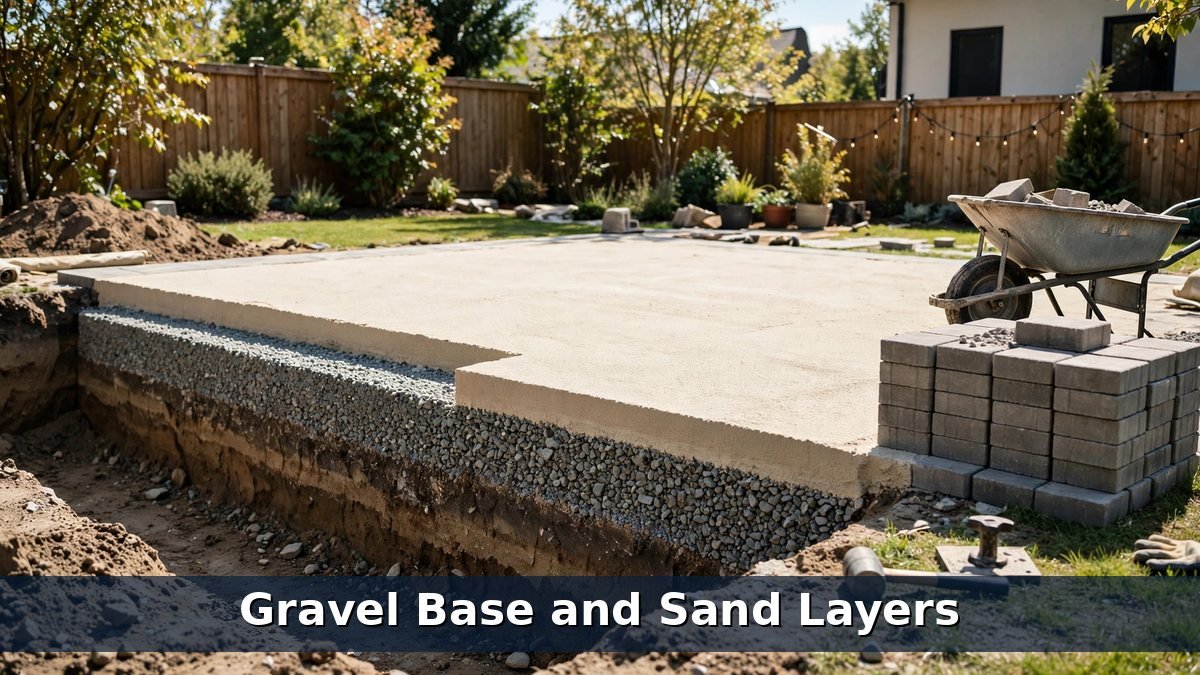
Two details catch out DIY builders. First, gravel loses roughly a fifth of its depth as it compacts, and it should be laid and compacted in layers of about 4 inches at a time rather than dumped to full depth — so order the compacted volume the calculator gives, and expect the loose pile to look bigger. Second, the base should extend at least 6 inches beyond the paver edge on every open side, so the edge restraint pins into base rather than soil; on a small patio that adds a noticeable strip of gravel to the order, and it is worth including in your measurements.
Bedding sand is the opposite discipline: exactly 1 inch, screeded level, and never used to fix a low spot in the base — ICPI guidance is explicit that thick sand is a failure waiting to happen, because pavers settle unevenly into it. The whole surface should also slope gently away from the house, around 1.5 to 2%, so rain runs off instead of pooling. For a driveway project in asphalt rather than pavers, our Asphalt Calculator estimates tonnage from the same kind of area and depth inputs.
Patterns, Cuts and Waste
The laying pattern changes both the look and the order quantity. Running bond — the brickwork pattern in our example — is the most economical, wasting little beyond edge cuts. Stacked bond is equally simple. Basketweave uses pairs of pavers at right angles and suits 4 × 8 bricks. Herringbone, at 45 or 90 degrees, is the strongest pattern for driveways because the interlock resists creep under tyres, but every edge becomes a diagonal cut, and waste climbs accordingly.
The paver calculator’s 10% allowance suits straight patterns on rectangular patios. Move to 15% for herringbone, curved edges or a patio with steps and obstacles. Keep the offcuts as you go: half-pavers from one edge often fit the next, and a wet saw or a splitter turns what looks like waste into the border course. Leftover whole pavers are worth storing, too — a cracked paver can be lifted and swapped in minutes years later, but only if the replacement matches.
Edge Restraints and Joint Sand
Two finishing items never appear in the paver count, yet both decide whether the patio stays tight. Edge restraint — rigid plastic, metal or a concrete haunch — locks the perimeter so the field of pavers cannot slowly spread outward under use. It is mandatory in the ICPI system, spiked into the base every 12 inches or so on patios. A paver patio without edge restraint is a patio in the process of escaping.
Joint sand is the second. After laying, dry kiln sand or polymeric sand is swept across the surface and vibrated into the joints with a plate compactor, then swept again until the joints are full. Polymeric sand hardens when misted with water and resists weeds and washout better than plain sand, at a higher price per bag. Budget roughly one 50-pound bag of polymeric sand per 25 to 35 square feet of standard-joint pavers, and expect to top up plain sand joints after the first season as they finish settling.
With the count, the base and the finishing materials settled by the paver calculator, the build itself becomes the enjoyable part: a flat, tight, well-drained patio that will still look crisp a decade from now.
FAQs
How many pavers do I need for a 12 × 10 patio?
With 4 × 8 inch pavers, a 12 × 10 foot patio (120 square feet) needs 540 pavers, or 594 with the standard 10% waste allowance. Bigger pavers cut the count sharply: 6 × 9 inch pavers would need 320, and 12 × 12 inch stones just 120. The paver calculator gives the count for your exact size combination, plus the base materials to go with it.
How deep should the base be under pavers?
For a patio or walkway, a minimum of 4 inches of compacted gravel base over well-drained soil, following ICPI guidance. A residential driveway needs at least 6 inches, and wet clay soil or freeze-thaw climates call for 2 to 4 inches more. On top of the base goes exactly 1 inch of bedding sand — no more, because thick sand lets pavers rock and settle unevenly.
How much gravel do I need for a 100-square-foot patio?
At the standard 4-inch compacted depth, a 100-square-foot patio needs 1.23 cubic yards of gravel base, plus 0.31 cubic yards of bedding sand at 1 inch. Remember that the base should also extend about 6 inches beyond the paver edges, which adds a little more — the paver calculator shows both figures for your exact patio size.
How much waste should I allow when ordering pavers?
Allow 10% for straight patterns like running bond on a rectangular patio — that is the allowance built into the paver calculator. Allow about 15% for herringbone patterns, curves and patios with many cuts around steps or posts. Keep usable offcuts during the build, and store a few spare whole pavers afterwards for future repairs.
Can I lay pavers directly on soil or sand only?
No — pavers laid on bare soil or on sand alone will shift, sink and grow weeds between the joints within a season or two. The compacted gravel base is what carries the load and drains water away, and the thin bedding sand layer exists only to fine-tune the level. Skipping the base is the most expensive shortcut in hardscaping, because the only fix is lifting the whole patio and starting again.
What is the difference between bedding sand and joint sand?
Bedding sand is the coarse, 1-inch screeded layer the pavers sit on; it must be concrete sand with angular grains that lock together. Joint sand is the fine material swept into the gaps on top after laying, either plain kiln-dried sand or polymeric sand that sets firm when misted. The two are not interchangeable — never use fine joint sand as the bedding layer.
For more updates visit: CALCIQ