

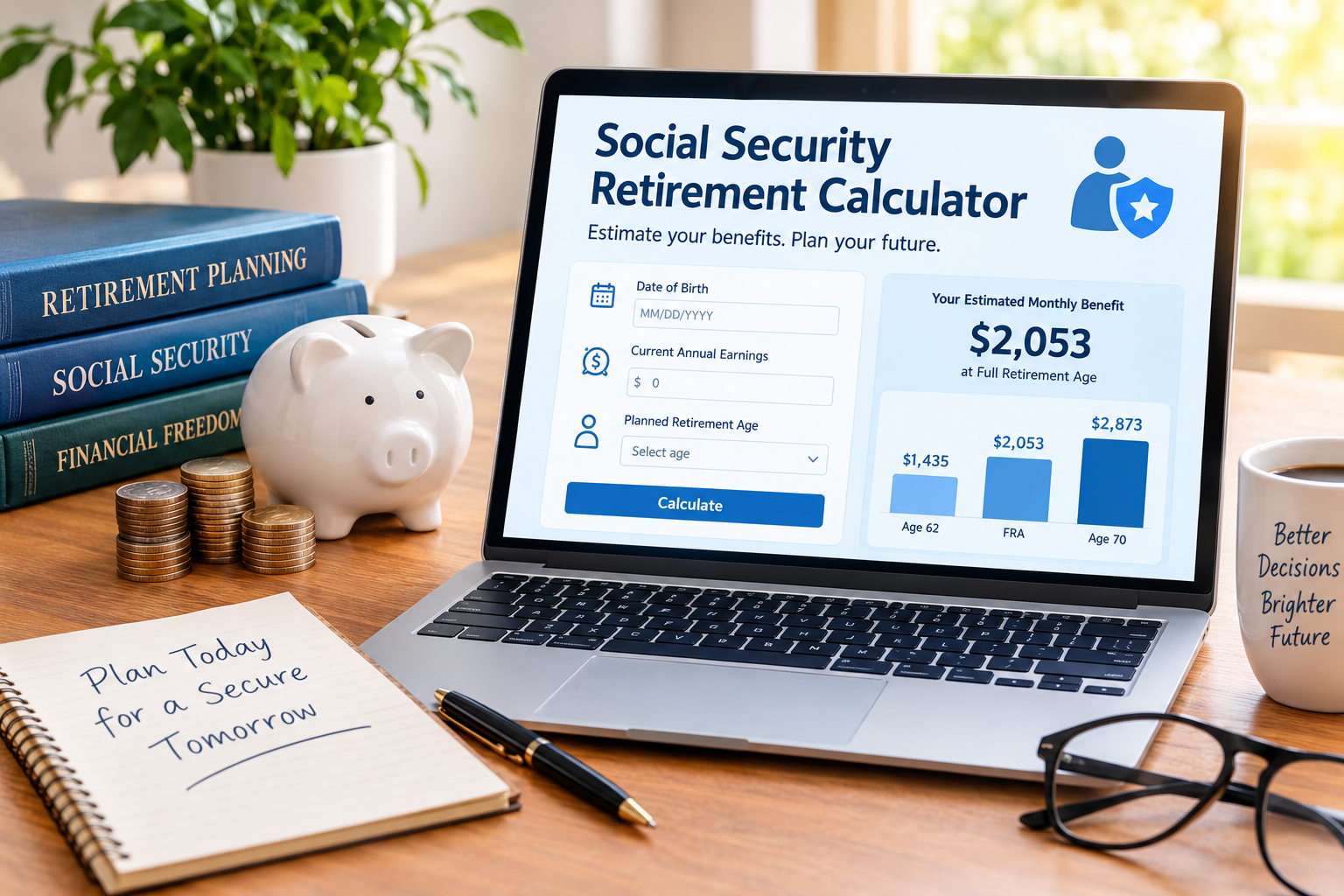
Planning when to claim Social Security can have a major effect on your retirement income. A social security retirement calculator can help you estimate your monthly benefit and compare different claiming ages before you make a decision.
Social Security retirement benefits are mainly based on your earnings history and the age when you start receiving benefits. You can generally begin receiving retirement benefits at age 62, but claiming before your full retirement age can reduce your monthly payment.
Waiting longer can increase your monthly benefit. For eligible workers, delaying retirement benefits beyond full retirement age can increase the payment until age 70. This makes your claiming age an important part of retirement planning.
What Is a Social Security Retirement Calculator?
A social security retirement calculator is a tool that estimates how much you could receive from Social Security retirement benefits. Depending on the calculator, you may enter your birth date, earnings history, expected future income, and planned retirement age.
Some calculators provide a quick estimate using limited information. More detailed tools can use your earnings record to produce a more personalised estimate.
The most useful calculators allow you to compare different claiming ages. For example, you may compare claiming at 62, your full retirement age, and 70 to see how the estimated monthly payments change.
How Social Security Retirement Benefits Are Calculated
Your Social Security retirement benefit is linked to your covered earnings over your working life. The calculation generally considers your highest 35 years of indexed earnings.
If you have fewer than 35 years of covered earnings, years without earnings can be included in the calculation. These years can reduce your average and therefore lower your eventual benefit.
Your earnings are adjusted to account for changes in average wages over time. The Social Security Administration then uses an average indexed monthly earnings figure to determine your basic benefit amount.
The age at which you claim also matters. Your benefit can be reduced if you claim before full retirement age, while delaying after full retirement age can increase your monthly payment.
What Is Full Retirement Age?
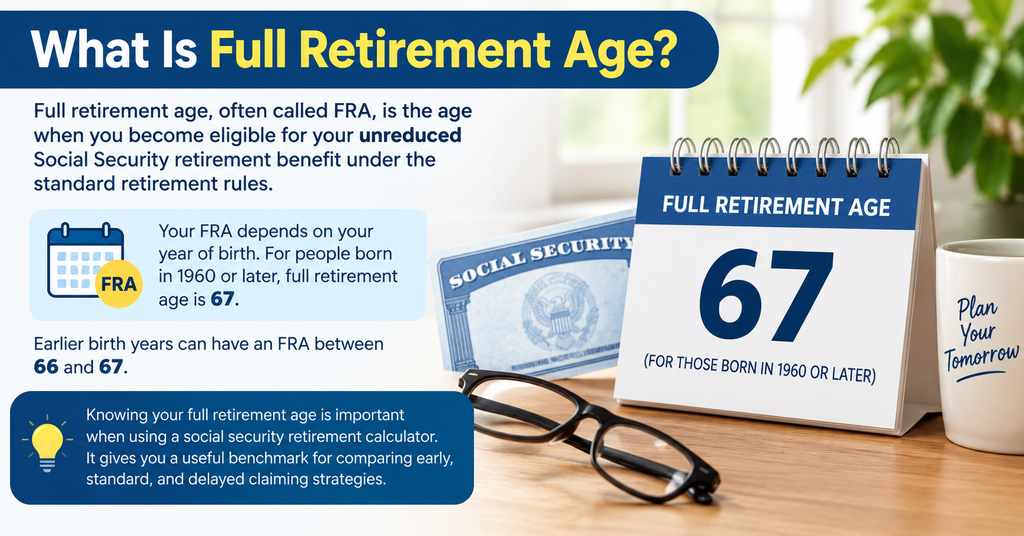
Full retirement age, often called FRA, is the age when you become eligible for your unreduced Social Security retirement benefit under the standard retirement rules.
Your FRA depends on your year of birth. For people born in 1960 or later, full retirement age is 67. Earlier birth years can have an FRA between 66 and 67.
Knowing your full retirement age is important when using a social security retirement calculator. It gives you a useful benchmark for comparing early, standard, and delayed claiming strategies.
Can You Claim Social Security at Age 62?
Yes, eligible workers can generally start Social Security retirement benefits at age 62. However, claiming at 62 usually means receiving a smaller monthly benefit than if you wait until full retirement age.
The reduction can be significant because you may receive payments for more years. Therefore, starting early is not automatically better or worse. Your health, financial needs, employment plans, savings, and expected longevity can all influence the decision.
A calculator can show the estimated difference between claiming early and waiting. This makes it easier to understand the long-term impact of your choice.
What Happens If You Wait Until Age 70?
Waiting beyond full retirement age can increase your Social Security retirement benefit. For eligible workers, delayed retirement credits can increase the monthly payment until age 70.
After age 70, there is generally no additional increase from continuing to delay retirement benefits.
This is why age 70 is often an important comparison point in retirement calculators. Someone who can afford to wait may receive a substantially higher monthly payment later in retirement.
What Information Do You Need for a Social Security Retirement Calculator?
The information required depends on the calculator you use. A basic calculator may only need your birth date, current earnings, and expected retirement age.
A more detailed calculator may require your historical earnings for different years. Your Social Security earnings record can provide much more personalised results than a simple estimate based only on current income.
You may also want to test different future earnings and retirement dates. This can help you understand how working longer could affect your estimated benefit.
How to Use a Social Security Retirement Calculator
Start by entering your date of birth and reviewing your estimated full retirement age. Then provide your current or historical earnings information if the calculator requires it.
Next, compare different claiming ages. Look at the estimated monthly benefit at age 62, full retirement age, and age 70.
You can then change your expected future earnings or retirement date to see how the estimate changes. Comparing several scenarios is usually more useful than relying on one calculation.
Remember that a calculator provides an estimate rather than a guaranteed future payment. Your actual benefit can depend on your final earnings record, claiming date, legislative changes, and other circumstances.
Social Security Benefits and Working After Retirement
You can work while receiving Social Security retirement benefits. However, if you are below full retirement age and earn above the applicable annual earnings limit, some benefits may temporarily be withheld.
In 2026, the annual earnings limit for someone under full retirement age for the entire year is $24,480. Different rules apply during the year you reach full retirement age.
Once you reach full retirement age, earnings from work no longer reduce your Social Security retirement benefit under the retirement earnings test.
This is an important factor to consider if you plan to keep working after claiming benefits.
How Accurate Is a Social Security Retirement Calculator?
The accuracy depends on the information entered and the type of calculator used. A personalised calculator connected to your Social Security earnings record can provide a more useful estimate than a simple calculator based on current income.
Your estimate can also change when you continue working. Additional high-earning years may replace lower-earning years in the calculation, potentially increasing your future benefit.
Economic assumptions and future changes can also affect estimates. Therefore, treat the result as a planning figure rather than a promise of your exact retirement payment.
Why You Should Compare Multiple Retirement Ages
Choosing a claiming age is one of the most important decisions you can explore with a social security retirement calculator.
Claiming early can provide income sooner but usually results in a lower monthly payment. Waiting can produce a larger monthly benefit but means giving up payments during the years you delay.
Comparing several ages helps you understand this trade-off. It can also help you consider how Social Security fits alongside pensions, retirement accounts, savings, investments, and other income.
Conclusion
A social security retirement calculator can be a valuable starting point for understanding your future retirement income. It can show how your earnings history and claiming age may affect your estimated monthly benefit.
The biggest value comes from comparing multiple scenarios rather than looking at one number. Consider age 62, your full retirement age, and age 70 to understand the potential differences.
Your Social Security estimate should also be considered alongside your wider retirement savings and expected expenses. With better information, you can make a more informed decision about when to claim your benefits.
FAQs
What is the best age to claim Social Security?
There is no single best age for everyone. Claiming at 62 provides income sooner but usually reduces the monthly benefit, while delaying can increase your payment. Your health, finances, life expectancy, and other retirement income should all be considered.
How does a social security retirement calculator work?
A social security retirement calculator uses information such as your earnings history, birth date, and planned claiming age to estimate your retirement benefit. More detailed calculators can provide estimates based on your actual Social Security earnings record.
Can I calculate my Social Security benefit at age 62?
Yes. A calculator can estimate your benefit if you begin receiving Social Security retirement benefits at age 62. The estimate can then be compared with potential benefits at your full retirement age or age 70.
What is full retirement age for Social Security?
Full retirement age depends on your birth year. For people born in 1960 or later, the full retirement age is 67. People born earlier may have a lower FRA between 66 and 67.
Does working longer increase Social Security benefits?
It can. Social Security generally considers your highest 35 years of indexed earnings. Continuing to work can increase your benefit if additional earnings replace lower-earning years in your calculation.
Can I receive Social Security and keep working?
Yes. You can generally work while receiving Social Security retirement benefits. However, if you are below full retirement age and earn more than the applicable earnings limit, part of your benefits may be withheld temporarily.
How much can Social Security pay in 2026?
The maximum depends on the age when benefits begin and whether you earned the taxable maximum throughout your working years. In 2026, the maximum monthly benefit is $2,969 at age 62, $4,152 at full retirement age, and $5,181 at age 70 for qualifying workers.
For more updates visit: CALCIQ