

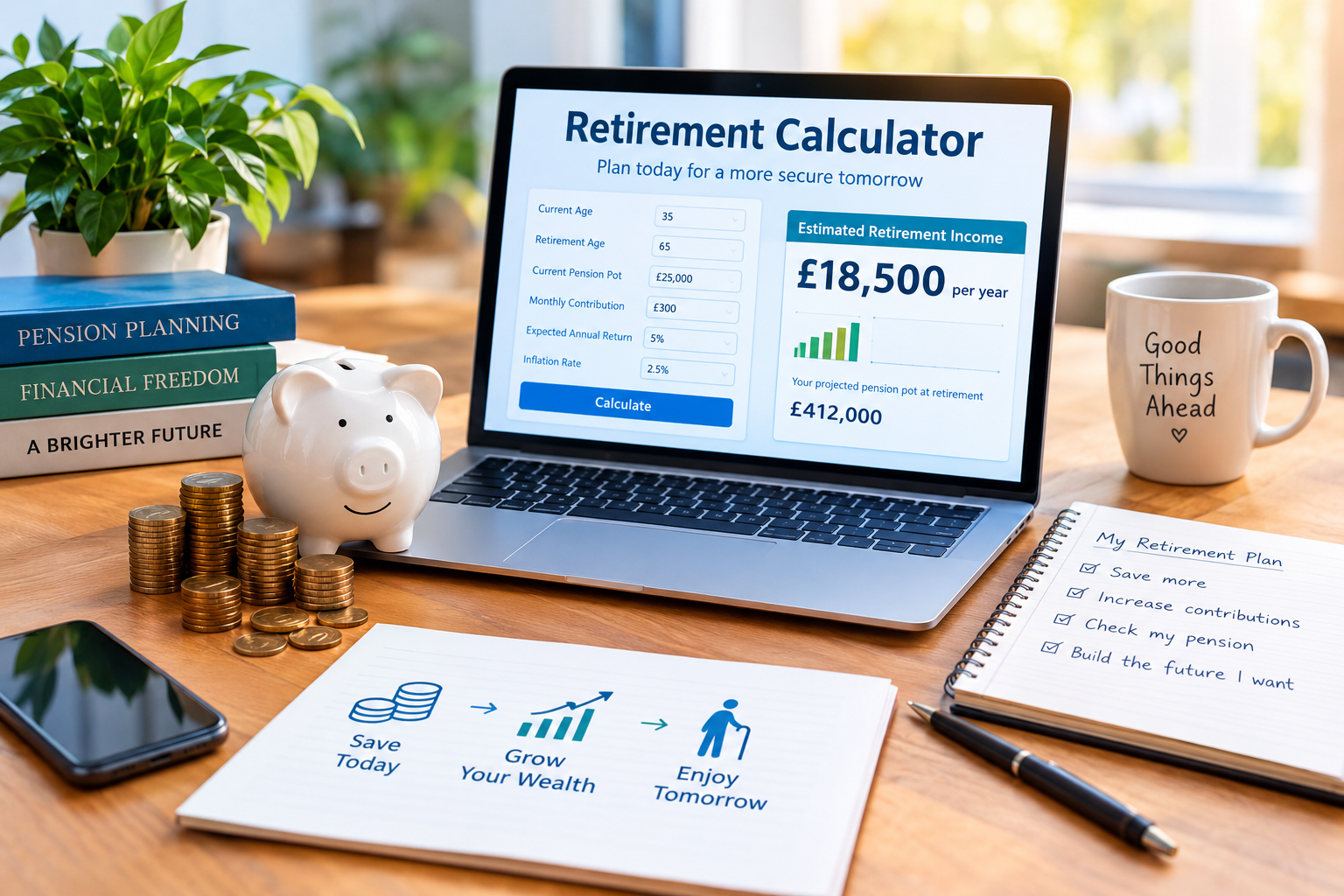
Planning for retirement can feel difficult when you do not know how much money you will need. A retirement calculator can help you turn your current savings, pension contributions, retirement age, and expected income into a clearer estimate.
Whether you are just starting your career or getting closer to retirement, estimating your future pension can highlight potential gaps in your plan. It can also help you understand how changing your contributions or retirement date could affect your future finances.
A retirement calculator is not a guarantee of what you will receive. Instead, it provides an estimate based on the information and assumptions you enter. The results can help you make more informed decisions about saving for retirement.
What Is a Retirement Calculator?
A retirement calculator is an online financial planning tool that estimates how much money you may have available when you retire. It normally considers factors such as your current age, retirement age, pension savings, regular contributions, investment growth, and expected retirement income.
Some calculators also consider inflation, workplace pensions, personal pensions, and other sources of retirement income. The exact features vary between calculators.
The main purpose is to give you an idea of whether your current retirement savings could support the lifestyle you want. If the estimate looks lower than expected, you can explore ways to increase your savings or adjust your retirement plans.
How Does a Retirement Calculator Work?
A retirement calculator uses the information you provide to estimate the future value of your pension savings. One of the most important inputs is your current pension pot.
Your regular pension contributions are then added over the years before retirement. The calculator may also apply an assumed investment return to estimate how your savings could grow.
For example, someone with £40,000 already saved who contributes £400 each month may build a significantly larger pension pot over several decades. However, the final amount depends on factors such as investment performance, fees, contribution levels, and the time remaining until retirement.
The calculator may then estimate how much income the resulting pension pot could provide during retirement.
What Information Do You Need?
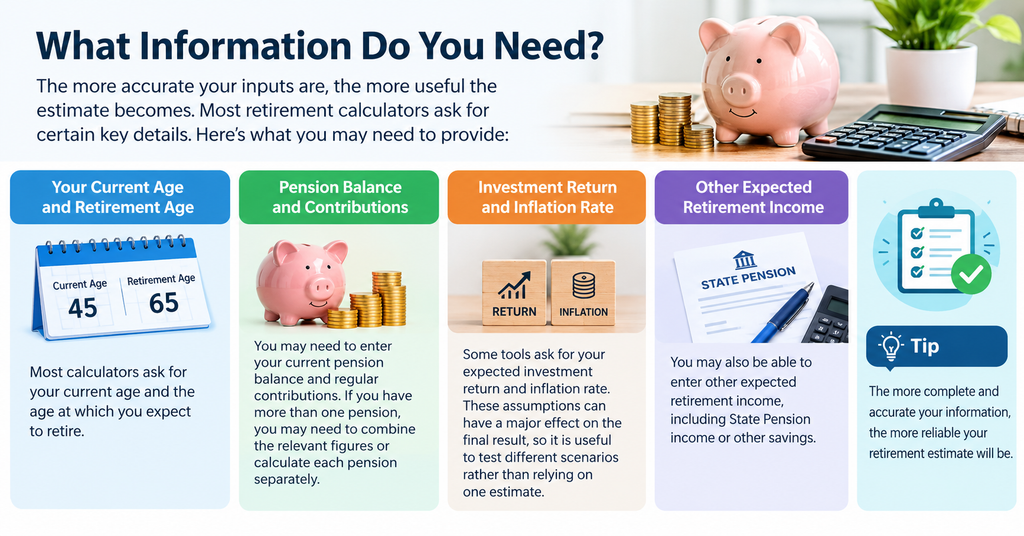
The more accurate your inputs are, the more useful the estimate becomes. Most retirement calculators ask for your current age and the age at which you expect to retire.
You may also need to enter your current pension balance and regular contributions. If you have more than one pension, you may need to combine the relevant figures or calculate each pension separately.
Some tools ask for your expected investment return and inflation rate. These assumptions can have a major effect on the final result, so it is useful to test different scenarios rather than relying on one estimate.
You may also be able to enter other expected retirement income, including State Pension income or other savings.
How Much Do You Need to Retire?
There is no single retirement savings figure that works for everyone. Your target depends on your lifestyle, housing costs, health, debts, family circumstances, and expected income.
Someone who owns their home outright may have different retirement needs from someone who expects to continue paying rent or a mortgage.
Your desired retirement age also matters. Retiring earlier generally means your savings may need to support you for longer. At the same time, you may have fewer years available to make pension contributions.
A retirement calculator can help you estimate the amount you may need by comparing your expected retirement income with your desired spending.
Understanding Your Pension Pot
Your pension pot is the amount accumulated in a pension arrangement. It can grow through your own contributions, employer contributions where applicable, and investment returns.
The earlier you start saving, the more time your contributions have to potentially grow. This is partly because investment growth can compound over long periods.
However, investment returns are not guaranteed. Pension investments can rise and fall, and charges can reduce the amount that remains invested.
For this reason, a calculator should be treated as a planning tool rather than a prediction of your exact future pension.
Why Starting Early Can Make a Difference
Time can be one of the most valuable factors in retirement planning. Even relatively small regular contributions can accumulate over many years.
For example, increasing your monthly contribution while you are younger gives the additional money more time to potentially grow. The same increase made shortly before retirement has less time to benefit from investment growth.
This does not mean everyone needs to contribute the same amount. Your income and financial priorities will change throughout your working life.
The important point is to review your pension regularly and increase contributions when your circumstances allow.
What Happens If You Retire Earlier?
Retiring earlier can change your retirement calculation significantly. You may have fewer years to build your pension while needing your savings to provide income for a longer period.
You may also stop receiving employer pension contributions once you leave work. Depending on your circumstances, you could need additional savings to cover the period before other pension income becomes available.
A retirement calculator can help you compare different retirement ages. For example, you could compare retiring at 60, 65, or 68 to see how changing the date affects your estimated pension income.
How Inflation Affects Retirement Savings
Inflation reduces the purchasing power of money over time. This means that the amount you consider sufficient today may not buy the same goods and services in the future.
For example, £30,000 a year may provide a particular lifestyle today, but your future spending needs could be higher after several decades of rising prices.
Many retirement calculators therefore include an inflation assumption. Looking at results in today’s money can make future estimates easier to understand.
It is important to remember that inflation will not necessarily increase at the same rate every year. Calculator results are therefore estimates rather than guarantees.
How Much Should You Contribute to Your Pension?
The right contribution depends on your age, income, existing pension savings, retirement goals, and expected retirement age.
If your calculator suggests that your projected pension income is below your target, increasing your regular contribution may be one option.
You could also consider whether your employer offers additional pension contributions. Workplace pension arrangements can differ, so check the rules that apply to your own scheme.
Even when your projected retirement income looks comfortable, reviewing your assumptions can help you understand how changes in investment returns, inflation, or retirement age could affect the outcome.
Retirement Calculator Results: What Should You Look For?
Do not focus only on the final pension pot. Look at the assumptions behind the result as well.
Check the retirement age, contribution amount, expected investment growth, inflation assumption, and estimated retirement income. A small change in one assumption can sometimes produce a large difference over several decades.
It is useful to run several scenarios. You could compare your current contribution with a higher contribution, or compare your planned retirement age with an earlier or later option.
This approach gives you a broader picture of your retirement position instead of relying on a single number.
Common Retirement Planning Mistakes
One common mistake is waiting too long before reviewing pension savings. Another is assuming that investment returns will remain consistent every year.
It is also easy to underestimate future expenses. Housing, energy, food, transport, travel, and healthcare can all affect retirement spending.
Some people also forget to review old workplace pensions after changing jobs. Keeping track of previous pension arrangements can make retirement planning easier.
Finally, avoid treating calculator results as guaranteed income. Financial markets, inflation, personal circumstances, and pension rules can change over time.
Is a Retirement Calculator Accurate?
A retirement calculator can provide a useful estimate, but it cannot predict the future with certainty.
Its accuracy depends on the information you enter and the assumptions used by the calculator. Investment returns, inflation, fees, pension contributions, and retirement income can all change.
Therefore, the best approach is to use the calculator regularly. Update your figures when your salary, pension contributions, savings, or retirement plans change.
For major financial decisions, consider getting appropriate professional financial advice rather than relying solely on an online calculation.
How to Improve Your Retirement Estimate
Start by using realistic figures for your current pension savings and contributions. Avoid assuming unusually high investment returns simply because markets have performed strongly in the past.
Next, think about the lifestyle you want during retirement. Your expected spending is just as important as the size of your pension pot.
You can then test different contribution levels and retirement dates. This can show which changes could have the greatest impact on your projected income.
Reviewing your calculation once or twice a year can also help keep your retirement plan aligned with your circumstances.
Conclusion
A retirement calculator can make pension planning easier by showing how your current savings and contributions could translate into future retirement income.
The result is only an estimate, but it can help you identify potential shortfalls and understand how different choices may affect your future.
Start with realistic figures, review your assumptions, and compare several scenarios. Most importantly, treat retirement planning as an ongoing process rather than a one-time calculation.
FAQs
What is a retirement calculator?
A retirement calculator estimates your potential pension savings and retirement income using information such as your age, pension pot, contributions, retirement age, investment growth, and inflation assumptions.
How much money do I need to retire in the UK?
There is no universal amount because retirement needs depend on your lifestyle, housing costs, debts, desired retirement age, and other sources of income. A retirement calculator can help estimate your personal target.
How much should I save for retirement?
The amount you should save depends on your income, age, existing pension savings, retirement goals, and expected retirement age. Testing different contribution levels can help you find a suitable target.
Does a retirement calculator include the State Pension?
Some retirement calculators allow you to include expected State Pension income, while others focus mainly on private or workplace pensions. Check which income sources the calculator includes before interpreting the result.
Can I retire early?
You may be able to retire early if your pension and other savings can provide sufficient income for your expected retirement period. Retiring earlier generally means you have less time to save and may need your money for longer.
Does inflation affect retirement savings?
Yes. Inflation can reduce the purchasing power of your retirement income over time. This is why many retirement calculators include an inflation assumption when estimating future spending and income.
For more updates visit: CALCIQ