

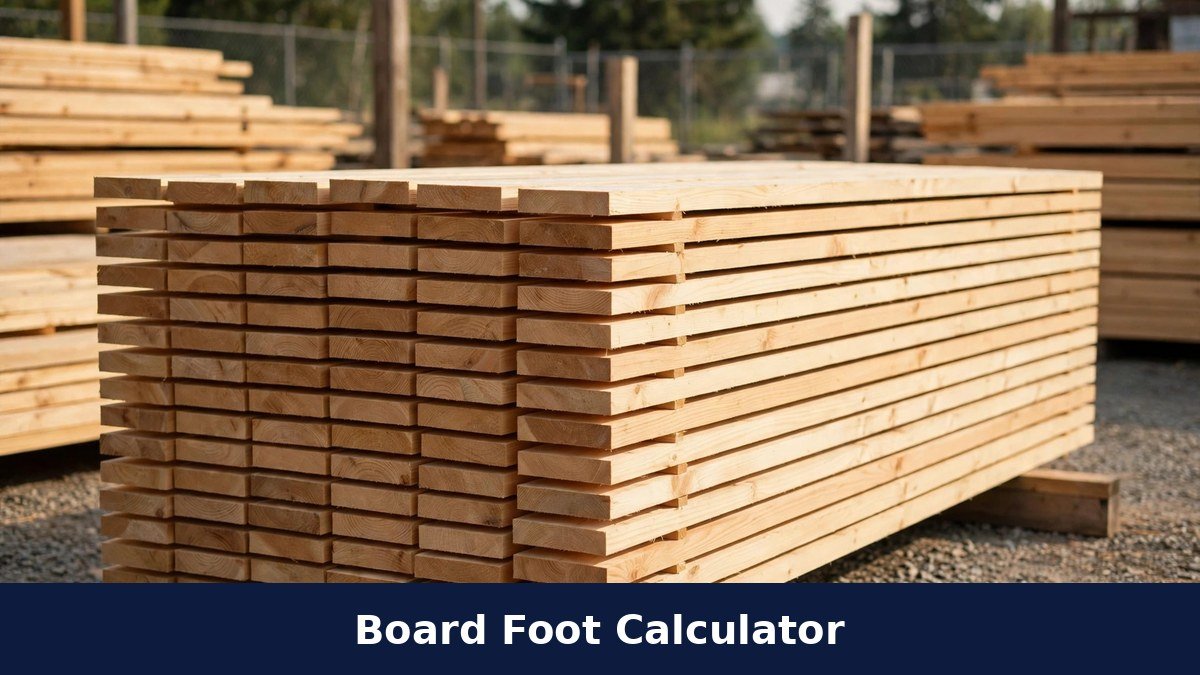
Buying lumber by the board foot can feel confusing at first, especially when every board on the rack has a different size. However, once you understand the board foot calculator method, the process becomes simple and quick. In this guide, you will learn what a board foot means, how the formula works, and how to check the price of any pile of lumber with confidence. As a result, you will order the right amount and never overpay for wood again.
Table of Contents
- What Is a Board Foot?
- The Board Foot Formula
- How to Use a Board Foot Calculator Step by Step
- Board Feet Chart for Common Lumber Sizes
- Nominal vs Actual Lumber Sizes
- Board Foot Calculator Project Example With Price and Waste
- Converting Board Feet to Linear Feet and Square Feet
- Board Feet for Logs: The Doyle Rule
- Tips for Buying Lumber by the Board Foot
- FAQs
What Is a Board Foot?
A board foot is a unit of volume that lumber yards use to measure and price wood. In simple terms, one board foot is a piece of wood that is 12 inches long, 12 inches wide, and 1 inch thick. That piece holds 144 cubic inches of wood, so 144 cubic inches always equals one board foot.
Because lumber comes in many sizes, the board foot gives everyone a fair way to compare prices. For example, a long, narrow board can hold the same volume as a short, wide board, and therefore both carry the same board foot value. Mills, yards, and carpenters across the United States all use this system, and the USDA Forest Products Laboratory publishes the standard wood measurement guidance behind it.
In addition, board feet work for rough lumber, hardwood, and softwood alike, so the same measurement applies whether you build a deck, a bookshelf, or a workbench.
The Board Foot Formula
The board foot formula is short, and you only need three measurements: thickness, width, and length. First, if your length is in inches, use this version:
Board Feet = (Thickness in inches × Width in inches × Length in inches) ÷ 144
Second, if your length is already in feet, the formula becomes even easier:
Board Feet = (Thickness in inches × Width in inches × Length in feet) ÷ 12
Both versions give the same answer, so choose the one that matches your measurements. Also, remember that the formula uses the nominal size printed on the label. We explain that point further down, because it confuses most beginners.
Finally, remember that board feet measure volume, not length, so doubling the length or the thickness doubles the board feet.
How to Use a Board Foot Calculator Step by Step
Let us work through one example, so you can see exactly how the board foot calculator method works. We will use a common board: a 2×4 that is 8 feet long.
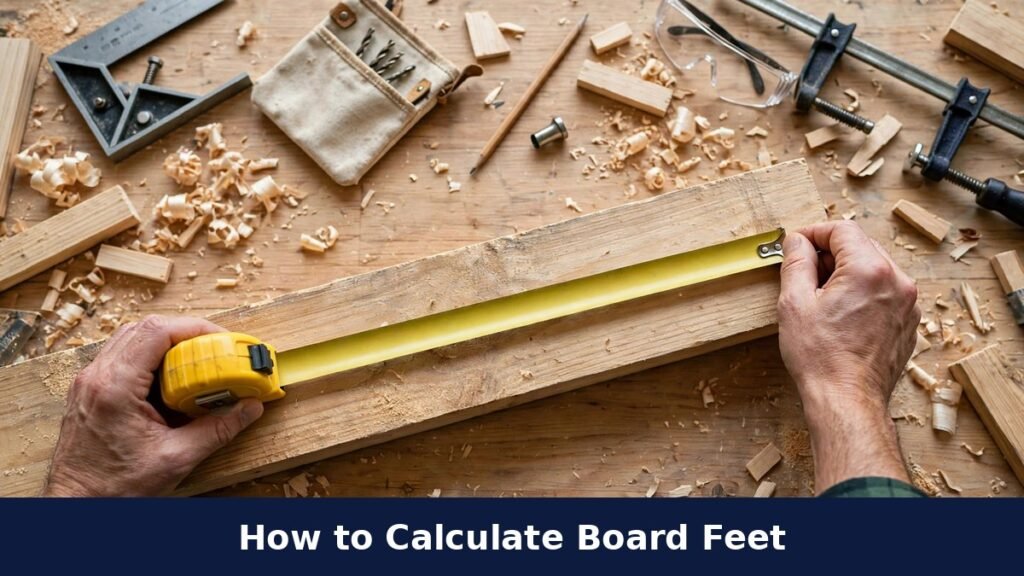
Step 1: Write down the three sizes. The thickness is 2 inches, the width is 4 inches, and the length is 8 feet.
Step 2: Convert the length to inches. Since 8 feet equals 96 inches, multiply 8 × 12 to get 96.
Step 3: Multiply the three numbers. So, 2 × 4 × 96 = 768.
Step 4: Divide by 144. Next, 768 ÷ 144 = 5.33.
Step 5: Read the answer. The board contains 5.33 board feet.
If you prefer the shorter formula, you can skip step 2 and divide by 12 instead: (2 × 4 × 8) ÷ 12 = 5.33 board feet. Either way, the answer stays the same, which makes checking your maths easy.
Board Feet Chart for Common Lumber Sizes
The table below lists the board feet for the sizes people buy most often, all using nominal sizes.
| Nominal Size | Length | Board Feet |
|---|---|---|
| 1×6 | 8 ft | 4.00 BF |
| 2×4 | 8 ft | 5.33 BF |
| 2×4 | 10 ft | 6.67 BF |
| 2×6 | 8 ft | 8.00 BF |
| 2×6 | 12 ft | 12.00 BF |
| 2×8 | 10 ft | 13.33 BF |
| 2×10 | 12 ft | 20.00 BF |
| 2×12 | 12 ft | 24.00 BF |
| 4×4 | 8 ft | 10.67 BF |
As you can see, wider and thicker boards add board feet quickly. For instance, a 2×12 holds more than four times the wood of a 2×4. Consequently, the price per board rises fast as size grows, even when the price per board foot stays the same.
Nominal vs Actual Lumber Sizes
Here is the classic beginner confusion: a 2×4 is not really 2 inches by 4 inches. Instead, those numbers are the nominal size, which is the name of the board. The actual size, after drying and planing at the mill, is smaller: a 2×4 actually measures 1.5 × 3.5 inches.

This difference matters because lumber is priced and sold by nominal size board feet, even though the actual wood you take home is smaller. So, when you calculate board feet for a purchase, always use the nominal size from the label, or your total will come out too low.
| Nominal Size | Actual Size (inches) |
|---|---|
| 1×6 | 0.75 × 5.5 |
| 2×4 | 1.5 × 3.5 |
| 2×6 | 1.5 × 5.5 |
| 2×8 | 1.5 × 7.25 |
| 2×10 | 1.5 × 9.25 |
| 2×12 | 1.5 × 11.25 |
| 4×4 | 3.5 × 3.5 |
However, the actual size still matters for planning. When you work out how many boards you need to cover a floor or a wall, use the actual width, because that is the space each board really covers.
Board Foot Calculator Project Example With Price and Waste
Now let us put everything together with a real project example. Suppose you need 10 boards of 2×6, each 12 feet long, for a raised deck frame.
From the chart above, one 2×6×12 holds 12.00 board feet. Therefore, 10 boards × 12 board feet = 120 board feet in total. Next, add the price: if the yard charges $6.50 per board foot, then 120 × $6.50 = $780 for the lumber.
But wait — you should also add a waste allowance. Cuts, defects, and small mistakes are normal, so experienced builders add 10–15% extra. For this project, that means ordering about 132 to 138 board feet instead of exactly 120. As a result, you avoid a second trip to the yard halfway through the job.
For bigger site jobs, you can pair this method with our Sonotube concrete calculator for footings, or the gravel calculator in tons for a slab base.
Converting Board Feet to Linear Feet and Square Feet
Sometimes you need to switch between units, especially when a plan lists lengths instead of volumes. Luckily, both conversions are quick.
Board feet to linear feet: LF = (Board Feet × 12) ÷ (Thickness × Width), using nominal inches. For example, 5.33 board feet of 2×4 gives (5.33 × 12) ÷ (2 × 4) = 8 linear feet, which matches the board we measured earlier.
Board feet to square feet: SF = Board Feet ÷ Thickness in inches. So, 12 board feet of 1-inch stock covers 12 square feet, because 12 ÷ 1 = 12. In other words, for 1-inch boards, board feet and square feet are the same number. For thicker stock, however, the coverage drops: 12 board feet of 2-inch stock covers only 6 square feet.
| Conversion | Formula | Example |
|---|---|---|
| Board feet to linear feet | LF = (BF × 12) ÷ (Thickness × Width) | 5.33 BF of 2×4 = 8 LF |
| Board feet to square feet | SF = BF ÷ Thickness (inches) | 12 BF of 1-inch stock = 12 SF |
Finally, very large orders are priced per thousand board feet, written as MBF. So, if a quote says $6,500 per MBF, that simply means $6.50 per board foot.
Board Feet for Logs: The Doyle Rule
Board feet also apply to logs, although the method changes because a log is round and loses wood during milling. One common method is the Doyle rule, which uses the log’s small-end diameter, measured inside the bark:
Board Feet (Doyle) = ((Diameter in inches − 4) ÷ 4)² × Length in feet
For example, take a log that is 16 inches across and 16 feet long. Then ((16 − 4) ÷ 4)² × 16 = (3)² × 16 = 9 × 16 = 144 board feet.
However, the Doyle rule underestimates small logs, so it favours the buyer on thin timber. For that reason, many mills use the Scribner rule or the International 1/4-inch rule instead. The USDA Forest Service describes these log rules in its forestry guidance.
Tips for Buying Lumber by the Board Foot
Before you pay, a few habits will protect your budget and your project.
- Check the board feet on the receipt. Multiply the size and length yourself, and compare the total with the yard’s figure.
- Use the nominal size for price checks. Remember, yards bill by nominal board feet, not actual size.
- Add your waste allowance first. Order 10–15% extra, so defects and offcuts do not stop your work.
- Inspect every board. Look for cracks, twists, and heavy knots, because you pay for volume, not for quality.
- Ask about MBF pricing on big orders. Bulk rates per thousand board feet can lower your cost per board foot.
- Plan lengths to reduce cutting. Longer boards often waste less than many short pieces.
Similarly, careful measurement helps on the rest of the job as well. For instance, our stair calculator takes the same measure-twice approach for steps and stringers.
FAQs
How do I calculate board feet?
Multiply the thickness, width, and length in inches, then divide by 144. Alternatively, if the length is in feet, multiply thickness × width × length in feet and divide by 12. Both formulas give the same result.
How many board feet are in a 2x4x8?
A 2×4 that is 8 feet long contains 5.33 board feet. The maths is (2 × 4 × 96) ÷ 144 = 5.33, using the nominal size of the board.
Why is a 2×4 not really 2 by 4 inches?
The name comes from the rough size of the board before drying and planing. After the mill finishes the surface, a 2×4 actually measures 1.5 × 3.5 inches. Lumber is still sold and priced by the nominal name.
How do board feet convert to square feet?
Divide the board feet by the thickness in inches. For example, 12 board feet of 1-inch stock covers 12 square feet, while 12 board feet of 2-inch stock covers 6 square feet.
What is the Doyle rule?
The Doyle rule estimates the board feet inside a log. It uses the formula ((Diameter − 4) ÷ 4)² × Length in feet, with the diameter measured at the small end, inside the bark. It tends to underestimate small logs.
How much extra lumber should I order for waste?
Add 10–15% more board feet than your exact calculation. This allowance covers cuts, defects, and mistakes, and it saves you from running short near the end of a project.
For more updates visit: CALCIQ



Comments 1