

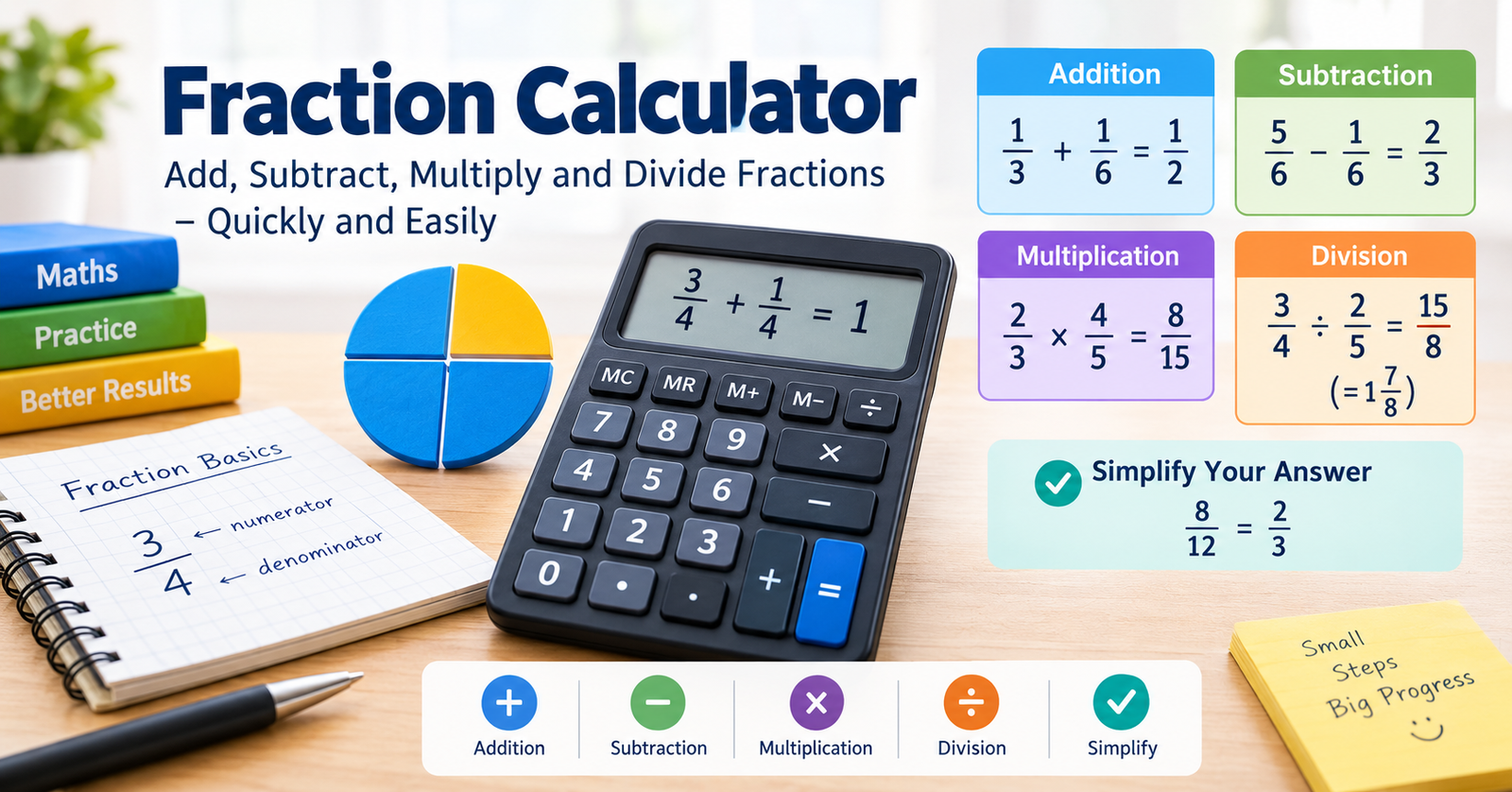
Working with fractions can be hard, especially when the numbers are large. Different denominators can make the maths even more confusing. A fraction calculator makes these tasks much easier.
You can use a fraction calculator to add, subtract, multiply and divide fractions. It can also simplify many answers for you.
Understanding fractions is still important. It helps you check the answer and avoid common mistakes. This guide explains how fraction calculations work and how to get the right result.
What Is a Fraction Calculator?
A fraction calculator is a maths tool that solves problems with fractions. It can handle common operations such as addition, subtraction, multiplication and division.
A fraction has two parts. The top number is the numerator. The bottom number is the denominator. For example, in 3/4, 3 is the numerator and 4 is the denominator.
Many calculators can also simplify fractions. Some tools support mixed numbers and improper fractions as well.
How Does a Fraction Calculator Work?
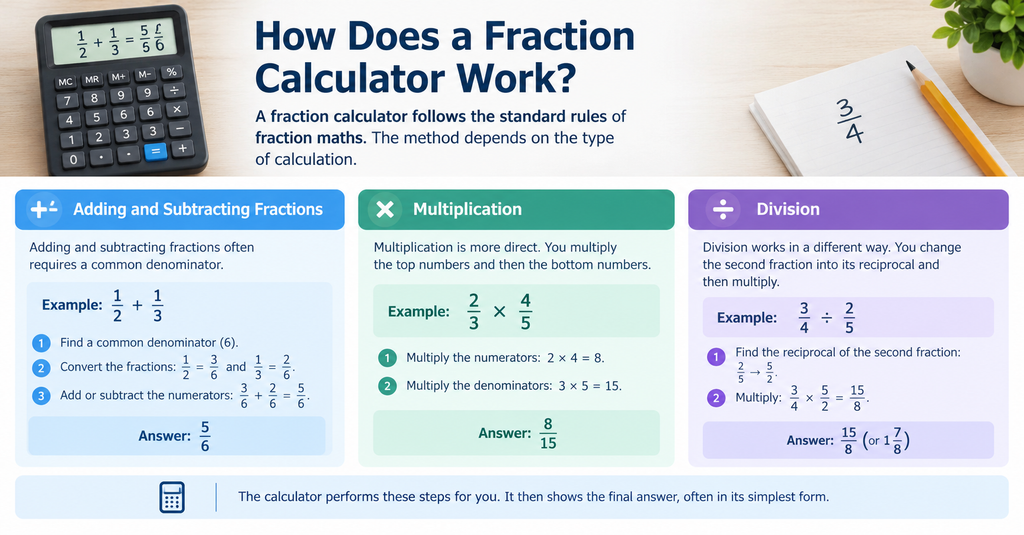
A fraction calculator follows the standard rules of fraction maths. The method depends on the type of calculation.
Adding and subtracting fractions often requires a common denominator. Multiplication is more direct. You multiply the top numbers and then the bottom numbers.
Division works in a different way. You change the second fraction into its reciprocal and then multiply.
The calculator performs these steps for you. It then shows the final answer, often in its simplest form.
How to Add Fractions
Adding fractions with the same denominator is simple. Add the numerators and keep the denominator the same.
For example, 2/7 + 3/7 equals 5/7.
Different denominators need another step. First, find a common denominator. Then change each fraction into an equal fraction with that denominator.
For example, 1/3 + 1/4 can use 12 as the common denominator. The fractions become 4/12 and 3/12. The answer is 7/12.
A fraction calculator can handle this process in seconds.
How to Subtract Fractions
Subtraction follows much the same rule as addition. Fractions with the same denominator can be subtracted by taking one numerator from the other.
For example, 6/9 − 2/9 equals 4/9.
When the denominators are different, you need a common denominator first. After that, subtract the numerators.
The final answer may need to be simplified. A fraction calculator can do this automatically.
How to Multiply Fractions
Multiplying fractions is often easier than adding them. Multiply the numerators together. Then multiply the denominators together.
For example:
2/3 × 4/5 = 8/15
The answer is already in its simplest form.
You can also multiply a fraction by a whole number. Write the whole number over 1 first. For example, 3 becomes 3/1.
Then use the normal multiplication rule.
How to Divide Fractions
Dividing fractions requires the reciprocal of the second fraction. A reciprocal is made by switching the numerator and denominator.
For example, the reciprocal of 2/5 is 5/2.
So, 3/4 ÷ 2/5 becomes:
3/4 × 5/2 = 15/8
The result can also be written as 1 7/8.
A fraction calculator completes this process for you. This can help reduce mistakes during longer calculations.
What Does It Mean to Simplify a Fraction?
Simplifying means reducing a fraction to its lowest terms. The value stays the same, but the numbers become smaller.
For example, 8/12 can be simplified to 2/3.
To simplify a fraction by hand, find a number that divides both the numerator and denominator. Divide both numbers by that factor.
A fraction calculator can often simplify the result automatically.
Proper, Improper and Mixed Fractions
Fractions can appear in different forms. A proper fraction has a smaller numerator than its denominator. An example is 3/5.
An improper fraction has a numerator that is equal to or larger than its denominator. An example is 7/4.
A mixed number contains a whole number and a fraction. For example, 1 3/4 is a mixed number.
Some calculations produce improper fractions. You can convert them into mixed numbers when that format is easier to read.
Fraction Calculator Formula
There is no single formula for every fraction calculation. The rule changes based on the operation.
For multiplication, multiply the numerators and denominators:
(a/b) × (c/d) = ac/bd
For division, multiply the first fraction by the reciprocal of the second:
(a/b) ÷ (c/d) = (a/b) × (d/c)
Addition and subtraction usually require a common denominator first.
These rules are the basis of most fraction calculator tools.
Why Use a Fraction Calculator?
A fraction calculator can save time and reduce simple maths errors. It is useful when fractions have large numbers or different denominators.
Students can use one to check their homework. It can also help when learning how fraction rules work.
Fractions are also common outside school. You may use them when cooking, measuring materials or working with quantities.
A calculator gives you a quick way to check your result. Still, knowing the basic rules helps you understand the answer.
Common Fraction Calculation Mistakes
One common mistake is adding the denominators when adding fractions. For example, 1/4 + 1/4 equals 2/4, not 2/8.
Another mistake happens during division. Remember to use the reciprocal of the second fraction before multiplying.
It is also easy to forget to simplify the final answer. A result may be correct but not reduced to its lowest terms.
Negative fractions can cause confusion too. Always check where the negative sign belongs before completing the calculation.
Fraction Calculations in Everyday Life
Fractions are used in many parts of daily life. They appear in cooking, building, measurements and other practical tasks.
A recipe may need three quarters of a cup of an ingredient. Measurements can also include fractions of an inch or metre.
Splitting something between people can involve fractions too. For example, you may need to divide one quantity into equal parts.
In these situations, a fraction calculator can help you check the maths quickly.
Conclusion
A fraction calculator gives you a quick way to solve fraction problems. It can help with addition, subtraction, multiplication and division.
Many calculators can also simplify the final answer. This makes the result easier to understand.
Learning the basic fraction rules is still useful. It helps you check your work and understand why the answer is correct.
Whether you are studying maths or solving an everyday problem, a fraction calculator can make fraction calculations much easier.
FAQs
What is a fraction calculator used for?
A fraction calculator is used to solve maths problems with fractions. It can usually add, subtract, multiply and divide fractions. Many tools can also simplify the answer.
Can a fraction calculator simplify fractions?
Yes. Many fraction calculators can reduce answers to their simplest form. For example, 8/12 can be reduced to 2/3.
How do you add fractions with different denominators?
First, find a common denominator. Then convert each fraction into an equal fraction with that denominator. Finally, add the numerators.
How do you multiply two fractions?
Multiply the two numerators together. Next, multiply the two denominators together. Simplify the answer if needed.
How do you divide fractions?
Keep the first fraction and change the division sign to multiplication. Then use the reciprocal of the second fraction and multiply.
Can a fraction calculator work with mixed numbers?
Many fraction calculators can work with mixed numbers. However, features can vary between tools. You can also convert a mixed number into an improper fraction before calculating.
For more updates visit: CALCIQ