


Buying a home is one of the biggest financial decisions you can make. Before choosing a property, it helps to understand how much your mortgage could cost each month.
A mortgage calculator gives you a quick estimate of your potential monthly repayment. You can adjust the mortgage amount, interest rate and loan term to see how different choices affect the overall cost.
For UK homebuyers, this can make budgeting easier. It can also help you compare different borrowing scenarios before speaking with a mortgage lender or adviser.
What Is a Mortgage Calculator?
A mortgage calculator is an online tool that estimates your mortgage repayments using key details about a home loan. These usually include the amount borrowed, interest rate and repayment period.
For a repayment mortgage, the calculator works out an estimated regular payment that covers both the interest and part of the amount borrowed.
The result can help you understand the likely cost of borrowing. However, an online estimate is not the same as a formal mortgage offer.
How Does a Mortgage Calculator Work?
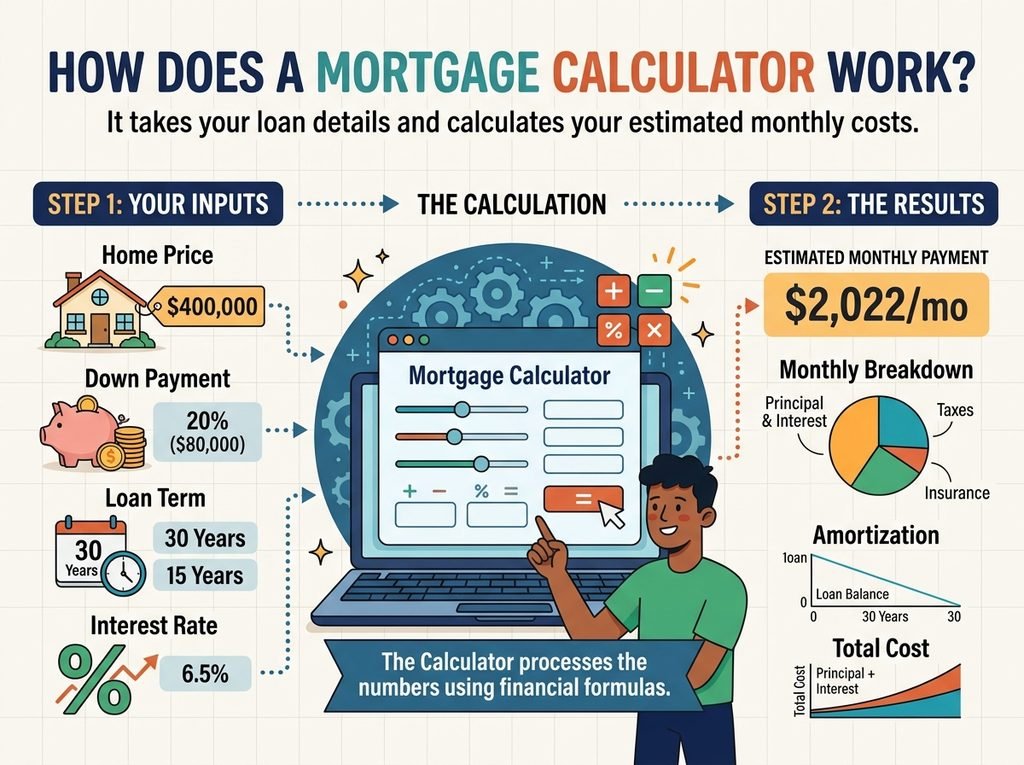
A mortgage calculator uses the loan amount, annual interest rate and mortgage term to estimate your repayment.
For a standard repayment mortgage, the calculation considers how much you borrow and how long you have to repay it. The interest rate also has a major effect on the amount you pay.
For example, borrowing more money generally increases your monthly payment. A higher interest rate can also increase your monthly cost, while extending the mortgage term can reduce the monthly payment but increase the total interest paid.
This is why looking only at the monthly payment can give an incomplete picture of the cost.
What Information Do You Need?
The exact information required depends on the calculator. Most mortgage calculators ask for the property price, deposit, mortgage amount, interest rate and mortgage term.
Your deposit is particularly important because it reduces the amount you need to borrow. For example, a £300,000 property with a £60,000 deposit would leave a £240,000 mortgage before considering any other costs.
The interest rate is another important figure. Even a relatively small difference in the rate can have a noticeable effect over a long mortgage term.
The mortgage term determines how long you have to repay the borrowing. Common terms can vary depending on your circumstances and lender.
How to Calculate Your Mortgage Payment
A standard repayment mortgage can be calculated using a mathematical formula based on the principal, interest rate and number of payments.
The monthly repayment formula is:
M = P × [r(1 + r)ⁿ] ÷ [(1 + r)ⁿ − 1]
Here, M represents the monthly payment. P is the amount borrowed, r is the monthly interest rate and n is the total number of monthly payments.
The annual interest rate must be converted into a monthly rate for this calculation. The mortgage term must also be converted into the total number of monthly payments.
A mortgage calculator performs these calculations automatically, making it easier to test different borrowing amounts and terms.
Mortgage Calculator Example
Suppose you want to borrow £250,000 over 25 years at an annual interest rate of 5%.
A mortgage calculator can use these figures to estimate the monthly repayment. You could then change the term to 30 years and compare the result.
The longer term may reduce the monthly payment because the borrowing is spread over more months. However, you would generally make payments for longer and could pay more interest over the full mortgage period.
This shows why comparing both the monthly repayment and total cost is important when considering a mortgage.
How Your Deposit Affects Mortgage Costs
Your deposit directly affects how much you need to borrow. A larger deposit usually means a smaller mortgage, which can reduce the amount of interest charged over time.
The deposit can also affect the loan-to-value ratio, commonly known as LTV. This represents the mortgage amount compared with the property’s value.
For example, if a property costs £300,000 and you borrow £240,000, the mortgage represents 80% of the property value.
A lower LTV can sometimes provide access to different mortgage rates. The available options depend on the lender and your individual circumstances.
How Interest Rates Affect Your Mortgage
Interest rates have a significant impact on mortgage repayments. When the rate is higher, more interest is charged on the outstanding balance.
A mortgage calculator allows you to test different rates before making a decision. This can help you understand how your budget might change if mortgage rates rise or fall.
This is particularly useful when comparing fixed-rate and variable-rate mortgage options. A fixed rate can provide more predictable payments for a set period, while variable rates can change according to the terms of the mortgage.
Your actual rate will depend on the mortgage product and your financial circumstances.
How the Mortgage Term Changes Your Payments
The mortgage term determines how long you have to repay the loan. A longer term usually results in lower monthly payments because the debt is spread across more payments.
However, reducing the monthly payment does not necessarily make the mortgage cheaper overall. A longer repayment period can mean paying interest for more years.
A shorter term can increase your monthly payment but may reduce the total interest paid over the life of the mortgage.
A mortgage calculator makes it easier to compare these options and find a balance between affordable monthly payments and the overall borrowing cost.
Can a Mortgage Calculator Tell You How Much You Can Borrow?
A mortgage calculator can provide an estimate, but it cannot guarantee how much a lender will offer you.
Mortgage affordability depends on more than your income. Lenders can consider your regular expenses, existing debts, deposit, credit history and other financial circumstances.
Your employment and income stability may also affect the lender’s assessment.
For this reason, treat the result from a mortgage calculator as an estimate rather than an approval. A lender or qualified mortgage adviser can provide a more personalised assessment.
What Other Costs Should You Consider?
Your mortgage payment is only one part of the cost of buying a home.
Depending on your circumstances, you may also need to budget for costs connected with purchasing a property, moving home, legal work, surveys, insurance and other services.
You should also consider regular household expenses after moving in. These can include energy bills, council tax, maintenance and other property-related costs.
Including these expenses in your wider budget can give you a more realistic picture of what you can comfortably afford.
Why Use a Mortgage Calculator Before Buying?
A mortgage calculator can help you explore different scenarios before committing to a property or mortgage product.
You can test different deposit amounts, mortgage terms and interest rates. This can show how a change in one factor could affect your estimated monthly repayment.
It can also help you establish a realistic price range when searching for a home. Instead of focusing only on the property price, you can consider how the potential mortgage fits into your monthly budget.
The calculator is most useful as an initial planning tool. Your final mortgage costs will depend on the product you choose and the terms offered by your lender.
Mortgage Calculator Limitations
Mortgage calculators provide estimates rather than guaranteed figures. The result may not include every cost associated with a mortgage or property purchase.
The interest rate used in the calculation may also differ from the rate you eventually receive. Mortgage products can have different fees, introductory periods and conditions.
Taxes, insurance and other property expenses may also be separate from the estimated mortgage repayment.
For an accurate picture of your borrowing options, compare the calculator result with the details of actual mortgage products and consider professional advice where appropriate.
Conclusion
A mortgage calculator is a useful starting point for understanding the potential cost of buying a home in the UK. By entering the mortgage amount, interest rate and repayment term, you can estimate your monthly payments and explore different scenarios.
The size of your deposit, mortgage term and interest rate can all make a significant difference to the overall cost. Comparing these factors can help you make better-informed decisions about your budget.
Remember that a calculator provides an estimate rather than a mortgage approval. Your actual borrowing capacity and mortgage costs will depend on your circumstances and the lender’s terms.
FAQs
What is a mortgage calculator used for?
A mortgage calculator estimates how much you could pay towards a mortgage each month. It can also help you compare different loan amounts, interest rates and repayment terms.
How accurate is a mortgage calculator?
A mortgage calculator can provide a useful estimate, but it may not reflect your final mortgage payment. Your actual rate, fees and mortgage terms can differ from the figures used in the calculation.
Can I use a mortgage calculator in the UK?
Yes. A mortgage calculator can be used to estimate potential mortgage repayments for UK property purchases. You can enter figures such as the mortgage amount, interest rate and term.
Does a mortgage calculator include interest?
A standard repayment mortgage calculator accounts for interest when estimating the monthly payment. The total interest cost can also be estimated over the mortgage term.
Does a larger deposit reduce mortgage payments?
A larger deposit usually means borrowing less money. A smaller mortgage can result in lower monthly repayments and less interest over the life of the loan.
Is a longer mortgage term cheaper?
A longer mortgage term can reduce your monthly payment, but it may increase the total interest you pay because the borrowing remains outstanding for longer.
For more updates visit: CALCIQ



Comments 1