Buying a home is one of the biggest financial decisions many people make. A mortgage calc can help you understand what your potential monthly payment could look like before you apply for a mortgage.
A mortgage calculation normally considers the amount borrowed, interest rate and mortgage term. By changing these figures, you can see how different borrowing choices may affect your monthly repayments and the overall cost of the mortgage.
A mortgage calc is useful for budgeting, comparing scenarios and understanding how mortgage payments work. However, the result is an estimate rather than a formal mortgage offer.
What Is a Mortgage Calc?
A mortgage calc is a tool that estimates the repayments on a mortgage. It uses information such as the property price, deposit, loan amount, interest rate and repayment period.
For example, if you are considering a £250,000 property and have a £50,000 deposit, you would potentially need to borrow £200,000. A mortgage calc can then estimate the monthly repayment based on the selected interest rate and term.
This gives you a clearer starting point when planning your home-buying budget. It can also show how changing the deposit, term or interest rate affects the figures.
How Does a Mortgage Calc Work?
A standard repayment mortgage calculation uses the principal borrowed, the interest rate and the number of monthly payments.
The mortgage amount is the money borrowed from the lender. The interest rate determines the cost of borrowing, while the mortgage term determines how long you have to repay the balance.
For a typical repayment mortgage, the calculation uses a monthly interest rate and the total number of monthly payments. The resulting payment generally includes both interest and a portion of the mortgage balance.
At the beginning of the mortgage, a larger proportion of each payment may go towards interest. As the outstanding balance falls, more of the payment can go towards reducing the principal.
Mortgage Calc Formula
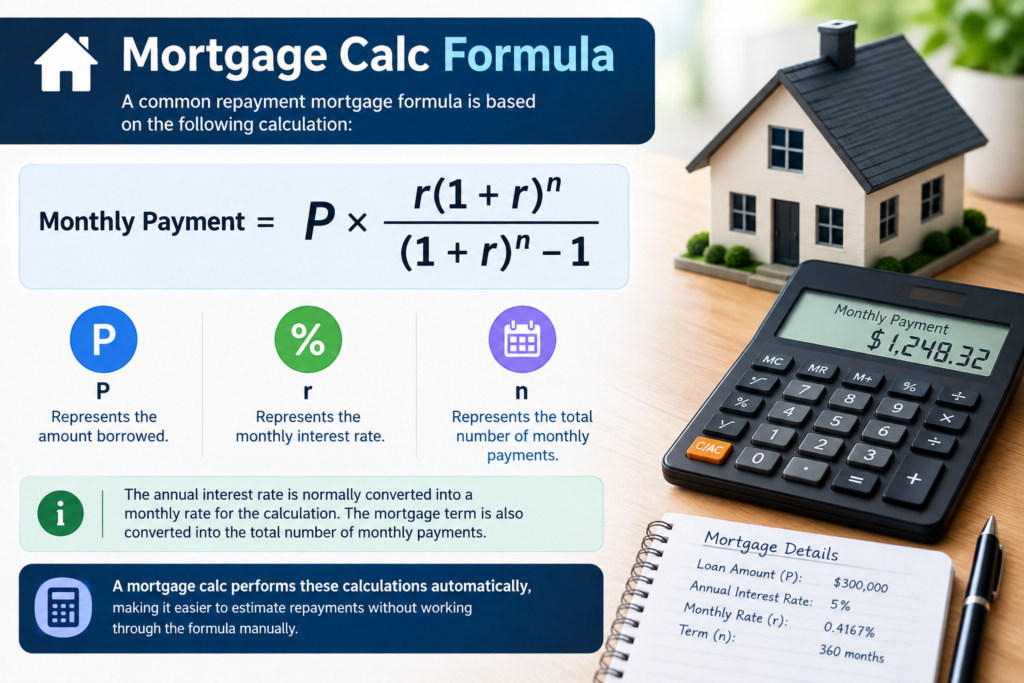
A common repayment mortgage formula is based on the following calculation:
Monthly Payment = P × [r(1 + r)ⁿ] ÷ [(1 + r)ⁿ − 1]
In this formula, P represents the amount borrowed. The letter r represents the monthly interest rate, while n represents the total number of monthly payments.
The annual interest rate is normally converted into a monthly rate for the calculation. The mortgage term is also converted into the total number of monthly payments.
A mortgage calc performs these calculations automatically, making it easier to estimate repayments without working through the formula manually.
What Information Do You Need for a Mortgage Calc?
The most important figure is the amount you plan to borrow. This can be estimated by subtracting your deposit from the property purchase price.
You also need an interest rate and mortgage term. A longer term usually spreads the borrowing across more payments, while a shorter term generally means fewer payments.
Some mortgage calculators also allow you to enter additional costs or overpayments. These features can provide a broader view of how your mortgage could develop over time.
How a Deposit Affects Your Mortgage
Your deposit can have a significant effect on the amount you need to borrow. A larger deposit means a smaller mortgage when the property price remains unchanged.
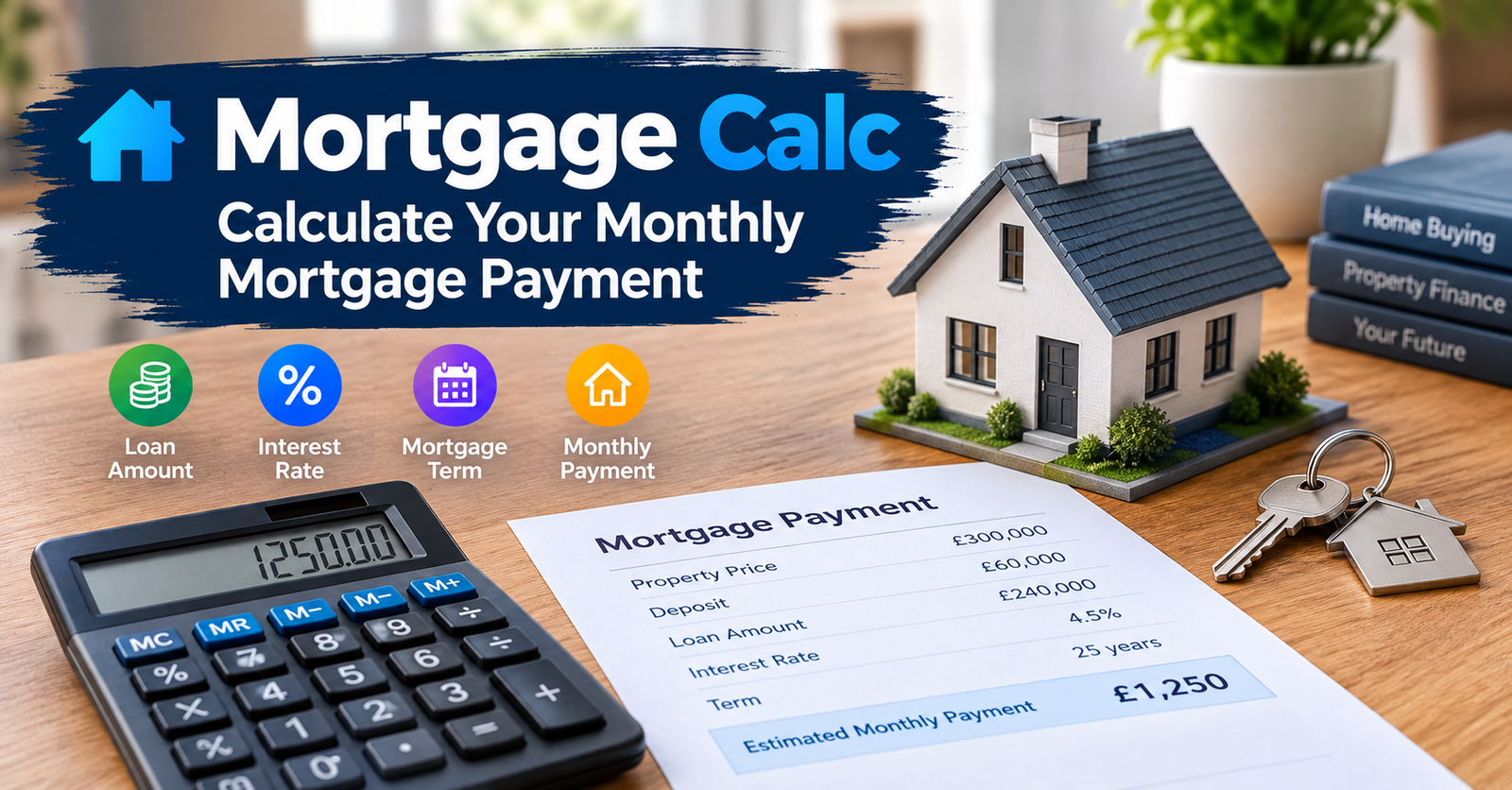
For example, a £300,000 property with a £60,000 deposit would require £240,000 of borrowing. Increasing the deposit to £90,000 would reduce the required borrowing to £210,000.
A lower loan amount can reduce the amount of interest charged over the mortgage term. The relationship between the mortgage and property value can also affect the loan-to-value ratio used by lenders.
How Interest Rates Affect Mortgage Payments
The interest rate is one of the most important factors in a mortgage calculation. Even a relatively small change can affect the monthly payment and total interest paid.
When the interest rate increases, the cost of borrowing generally increases. When the rate decreases, the calculated repayment may become lower, assuming the other figures remain unchanged.
This is why it can be useful to run several scenarios through a mortgage calc. You can see how your estimated payment changes under different interest rates rather than relying on one figure.
How the Mortgage Term Changes Your Costs
The mortgage term determines how long you have to repay the borrowing. Common mortgage terms can extend across several decades, depending on the borrower’s circumstances and lender criteria.
A longer mortgage term can reduce the required monthly payment because the balance is spread across more payments. However, paying interest for a longer period can increase the total amount paid over the life of the mortgage.
A shorter term can result in higher monthly payments but may reduce the total interest paid. A mortgage calc makes it easier to examine both scenarios.
Mortgage Calc for UK Home Buyers
A UK mortgage calc can be useful when estimating affordability before speaking with a lender or mortgage adviser. It can help you understand the relationship between property price, deposit and monthly repayments.
However, your actual mortgage costs can involve more than the basic loan repayment. Depending on the mortgage and circumstances, borrowers may also need to consider fees, insurance, taxes and other home-buying expenses.
Mortgage affordability also depends on personal circumstances. Income, existing debts, household expenses, credit history and lender criteria can all influence how much someone may be able to borrow.
Repayment Mortgage vs Interest-Only Mortgage
Mortgage calculations can differ depending on the type of mortgage. With a repayment mortgage, each payment generally covers interest and part of the amount borrowed.
An interest-only mortgage works differently. During the interest-only period, payments may cover the interest without reducing the original capital balance.
Because the repayment structures differ, it is important to use a calculator designed for the mortgage type you are considering. The monthly figures from one calculation should not automatically be applied to another type of mortgage.
Can a Mortgage Calc Tell You How Much You Can Borrow?
A mortgage calc can help estimate repayments, but it cannot guarantee how much a lender will approve.
Lenders assess individual financial circumstances before making a mortgage decision. They may consider income, regular expenditure, existing commitments, credit information and other affordability factors.
Therefore, the amount shown by a mortgage calc should be treated as a planning figure. It is not the same as an agreement in principle, mortgage approval or formal lending decision.
Why Use a Mortgage Calc Before Buying a Home?
Using a mortgage calc before viewing properties can help you establish a realistic budget. It allows you to explore different property prices and deposits without immediately committing to a mortgage application.
It can also help you understand the impact of interest rates and mortgage terms. This makes it easier to think about monthly affordability rather than focusing only on the purchase price.
The calculator can also be useful when considering overpayments or changes to your mortgage strategy. Small changes in the numbers can sometimes produce meaningful differences over many years.
What a Mortgage Calc Does Not Include
A basic mortgage calc normally focuses on the mortgage itself. It may not include every cost associated with buying and owning a property.
Home buyers may also need to consider costs connected with the purchase, moving, property maintenance and ongoing household expenses. Mortgage products can also have their own fees and conditions.
For this reason, a mortgage calculation should form part of a wider budget. It should not be used as the only measure of whether a property is affordable.
Common Mortgage Calculation Mistakes
One common mistake is focusing only on the monthly payment. A lower monthly figure does not necessarily mean the mortgage will cost less overall.
Another mistake is using an interest rate that does not reflect the mortgage product being considered. Calculator results can change substantially when the interest rate changes.
It is also easy to underestimate other household costs. Council tax, utilities, maintenance and other regular expenses can all affect the amount of money available for mortgage payments.
How to Use Mortgage Calc Results
The best way to use a mortgage calc result is as a planning estimate. Start with realistic figures for the property price, deposit, interest rate and mortgage term.
Then change one factor at a time. You can examine what happens if you increase the deposit, choose a different term or use another interest rate.
This approach gives you a better understanding of your potential mortgage costs. It also helps you prepare more informed questions for a lender or qualified mortgage adviser.
Conclusion
A mortgage calc is a practical way to estimate potential mortgage repayments before making a major financial commitment. By entering the borrowing amount, interest rate and mortgage term, you can see how different scenarios may affect your monthly payment.
For UK home buyers, the calculator can be particularly useful when planning a property budget and comparing borrowing options. However, the result remains an estimate and does not guarantee mortgage approval or a particular interest rate.
Use the figures as a starting point, consider your wider household budget and check the terms of any mortgage product carefully before making a decision.
FAQs
What is a mortgage calc?
A mortgage calc is a tool that estimates mortgage repayments using figures such as the amount borrowed, interest rate and mortgage term. It helps users understand potential monthly payments.
How accurate is a mortgage calc?
A mortgage calc can provide a useful estimate when accurate figures are entered. However, the final mortgage payment can differ because of the actual mortgage product, rate, fees and lender terms.
Can I use a mortgage calc in the UK?
Yes. A mortgage calc can be used by UK home buyers to estimate potential repayments. You should use figures that reflect the type of mortgage and interest rate you are considering.
Does a mortgage calc include interest?
A standard repayment mortgage calculation includes the effect of interest. The calculator uses the interest rate alongside the loan amount and repayment period to estimate the monthly payment.
Does a bigger deposit reduce mortgage payments?
A bigger deposit generally means you need to borrow less when the property price stays the same. A smaller mortgage can therefore result in a lower calculated monthly repayment.
Is a longer mortgage term cheaper?
A longer mortgage term can reduce the monthly payment because the borrowing is spread across more payments. However, the total interest paid can be higher because the mortgage remains outstanding for longer.