

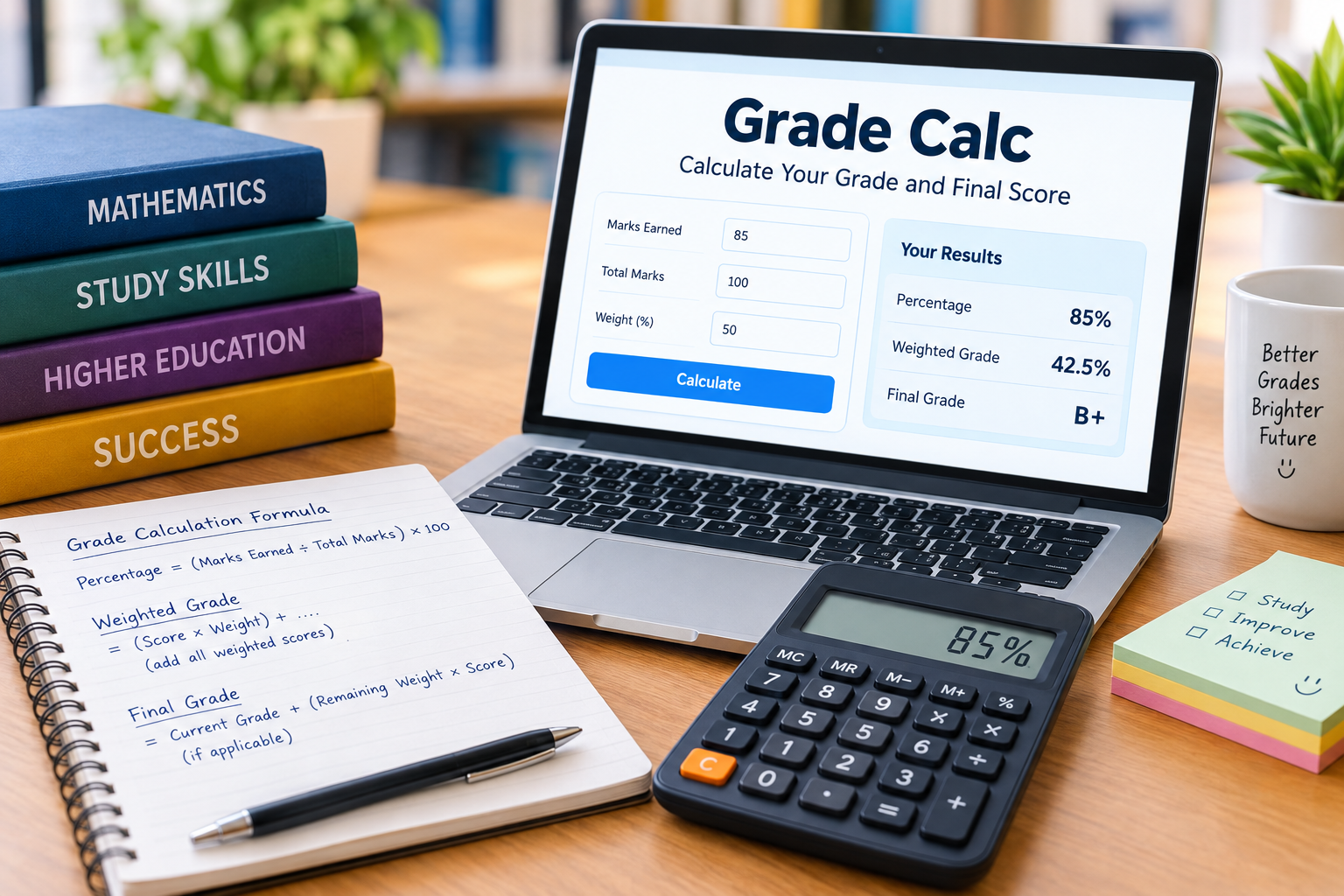
A grade calc makes it easier to understand your academic performance without working through complicated calculations by hand. Whether you want to convert marks into a percentage, calculate a current course grade, or estimate a final result, a grade calculator can save time.
Students often receive marks for tests, assignments, coursework, exams, quizzes and other assessments. Each result may contribute differently to the overall grade. Understanding how these marks combine can help you see where you currently stand and what score you may need to reach your target.
A grade calc can be particularly useful when your course uses weighted assessments. Instead of simply adding every mark together, you can calculate the contribution of each assessment based on its assigned percentage.
What Is a Grade Calc?
A grade calc is a tool that calculates an academic grade from marks, percentages or assessment results. Depending on the calculator, it may work out a percentage, letter grade, weighted average, current grade or final grade.
The basic calculation is straightforward when every assessment has the same value. You divide the marks earned by the total marks available and multiply the result by 100.
For example, if you score 42 marks out of 50, your percentage is 84%. A grade calc can perform this calculation instantly and reduce the chance of arithmetic mistakes.
More advanced calculations become useful when assessments have different weights. For instance, an exam worth 50% of your course grade should have a larger effect than an assignment worth 10%.
How Does a Grade Calc Work?
The method depends on the type of grade you want to calculate. For a simple percentage, the calculation uses your marks earned and the maximum marks available.
The formula is:
Percentage = (Marks Earned ÷ Total Marks) × 100
Suppose you earned 72 marks out of 90. Divide 72 by 90 to get 0.8. Multiply that result by 100, giving you a score of 80%.
A grade calc can then help you understand how that percentage relates to your grading system. However, letter-grade boundaries can differ between schools, colleges, universities and individual courses.
How to Calculate a Weighted Grade
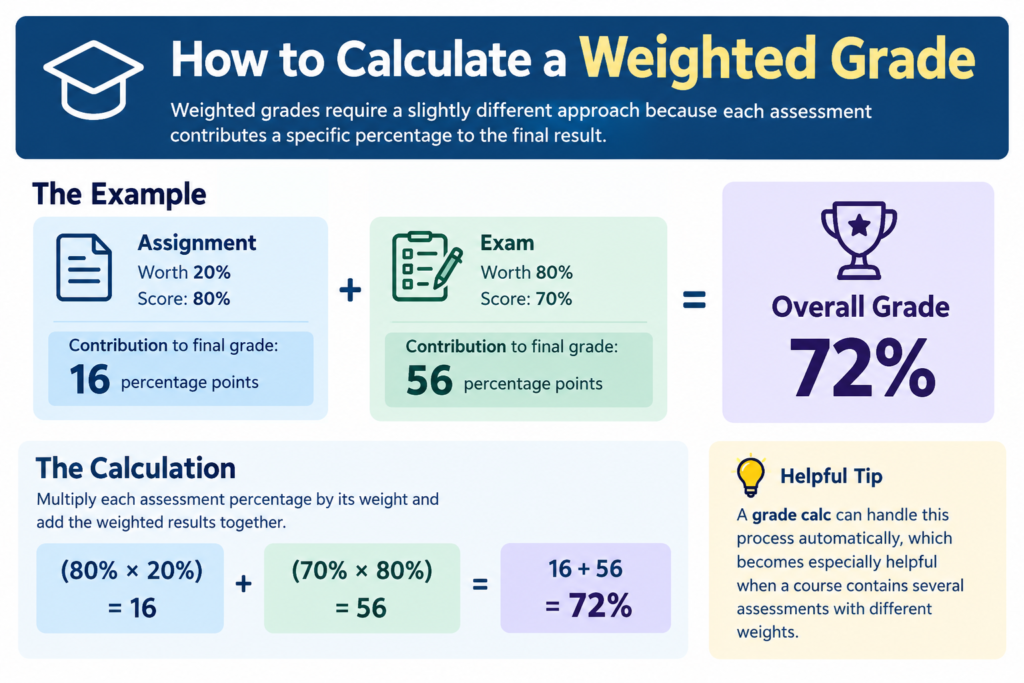
Weighted grades require a slightly different approach because each assessment contributes a specific percentage to the final result.
Imagine an assignment is worth 20% and you scored 80%. Your contribution to the overall grade is 16 percentage points.
If an exam is worth 80% and you score 70%, its contribution is 56 percentage points. Adding the two contributions gives an overall grade of 72%.
The general method is to multiply each assessment percentage by its weight and then add the weighted results together.
A grade calc can handle this process automatically, which becomes especially helpful when a course contains several assessments with different weights.
How to Calculate Your Current Grade
Your current grade depends on which assessments have already been completed and how much they contribute to the course.
For example, suppose you have completed two assignments worth 15% each. You scored 80% on the first and 70% on the second. Their contributions would be 12 and 10.5 percentage points.
Your completed assessments have therefore contributed 22.5 points towards the final course grade.
However, this does not necessarily mean your current percentage is 22.5%. The completed work represents only 30% of the full course. To calculate your average across completed assessments, you need to account for the weight that has already been completed.
This distinction is important when using a grade calc. Your current average and your contribution towards the final grade are not always the same thing.
How to Calculate the Grade You Need on a Final Exam
A grade calc can also help you determine what score you need on a remaining assessment.
Suppose you currently have a 75% average across work worth 60% of your final grade. You want an overall course grade of 70%, and the final exam is worth the remaining 40%.
Your completed work contributes 45 percentage points to the final result because 75% of 60% equals 45%.
You therefore need another 25 percentage points from the final exam to reach 70%. Since the exam is worth 40%, you would need 62.5% on the exam.
This type of calculation can be useful when planning study time. It shows how much your remaining assessments can affect your final result.
Grade Percentage vs Letter Grade
A percentage and a letter grade are not always interchangeable. The percentage tells you how many marks you achieved relative to the available marks.
A letter grade, on the other hand, depends on the grading scale used by your institution.
For example, one institution might assign a particular letter to an 80% result, while another may use different boundaries. University courses can also use classification systems rather than traditional letter grades.
For this reason, a grade calc should be used alongside the official grading rules for your course when you need an exact classification.
Why Students Use a Grade Calc
Students can use a grade calc to check their performance after receiving individual assessment results. It can also help them understand how much each assignment or exam affects their overall result.
The calculation is particularly useful when assessments have different weights. Manually calculating several weighted scores can become confusing, especially when there are many assignments.
A grade calc also makes it easier to experiment with possible results. You can estimate how a future exam score might affect your overall grade without repeatedly calculating everything yourself.
Common Mistakes When Calculating Grades
One common mistake is adding percentages together without considering the weight of each assessment. An 80% assignment worth 10% of a course should not have the same impact as an 80% exam worth 50%.
Another mistake is confusing marks with percentages. Scoring 40 out of 50 gives you 80%, not 40%.
Students can also use the wrong grading scale when converting a percentage into a letter grade. Always check the grading rules that apply to your particular course.
Finally, remember that rounding can affect results. A calculator may display several decimal places, while your institution may round grades according to its own rules.
Grade Calc for School, College and University
A grade calc can be useful across different levels of education. School students may use one to calculate test percentages or estimate overall marks.
College and university students often have more complex grading structures. Coursework, presentations, practical assessments, examinations and projects may each carry different weights.
The same basic mathematical principles still apply. The important part is entering the correct marks and assessment weights.
For university work, always check whether your course calculates grades by weighted average, credit weighting, module results or another institutional method.
Final Thoughts on Grade Calc
A grade calc provides a simple way to understand marks, percentages, weighted assessments and potential final results. It can save time and make complicated calculations easier to follow.
For a basic percentage, divide the marks earned by the total marks and multiply by 100. When assessments have different weights, calculate each assessment’s contribution before adding the results together.
The most important step is using the correct grading rules for your course. A calculator can perform the mathematics, but your school, college or university determines how the final result is interpreted.
Frequently Asked Questions
What is a grade calc?
A grade calc is a calculator that helps you work out academic grades, percentages, weighted marks or final scores. It can simplify calculations involving multiple assessments.
How do I calculate my grade percentage?
Divide the marks you earned by the total marks available, then multiply by 100. For example, 45 out of 50 equals 90%.
Can a grade calc calculate weighted grades?
Yes. A weighted grade calculation considers how much each assessment contributes to the overall course. Each percentage is multiplied by its assigned weight before the results are combined.
How do I calculate my final grade?
Calculate the contribution from each completed assessment and add those contributions together. If you have a remaining assessment, you can also calculate the score required to reach a specific final grade.
What grade is 80 percent?
The equivalent letter grade depends on the grading system used by your school or university. An 80% result can have different classifications under different grading scales.
Can I use a grade calc for university grades?
Yes. A grade calc can help with university assignments, exams, modules
For more updates visit: CALCIQ