

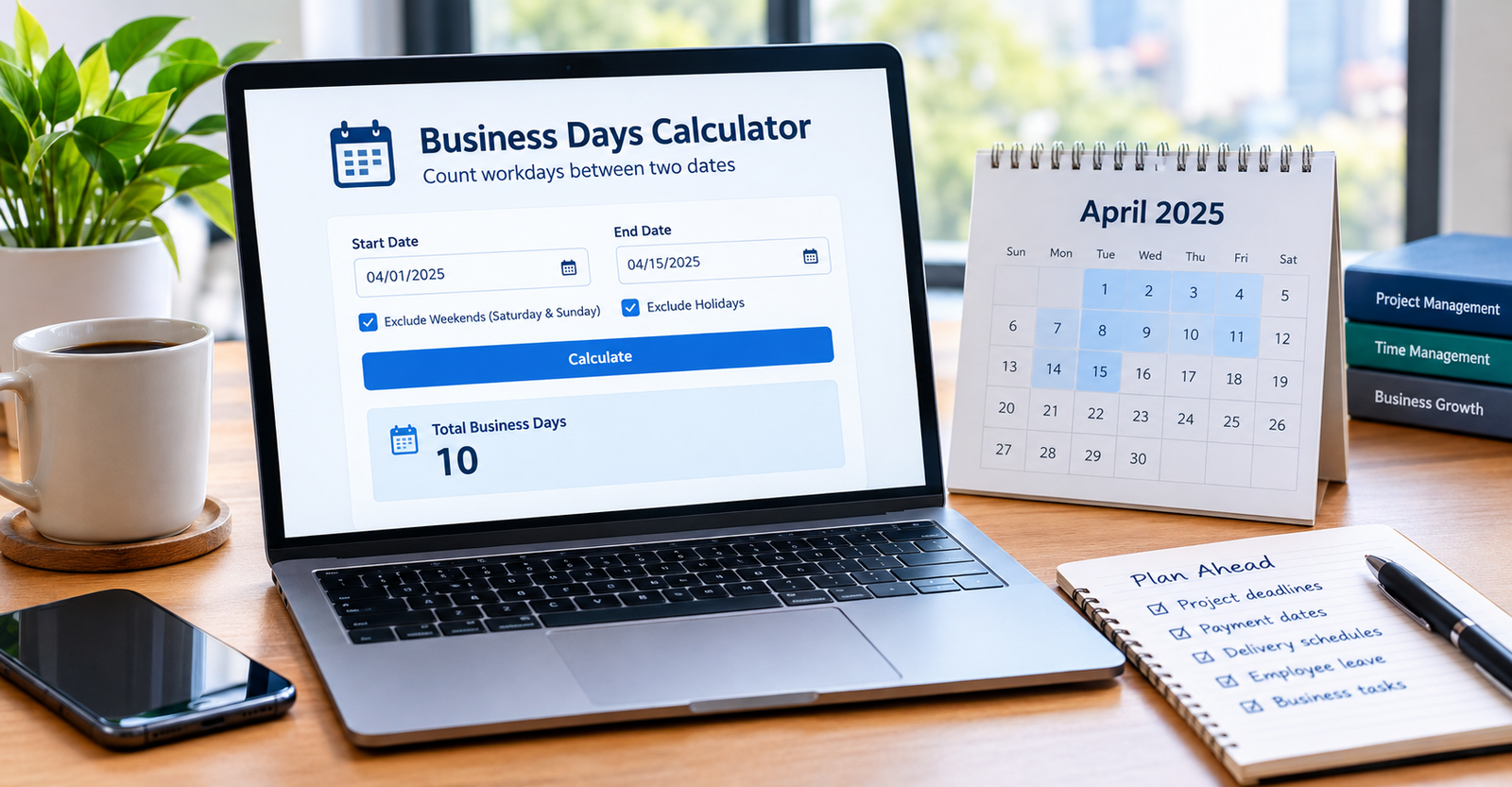
A business days calculator helps you find the number of working days between two dates. It removes weekends from the calculation and can also account for holidays.
This is useful when you need to estimate deadlines, delivery times, project schedules, or payment dates. Instead of counting each weekday by hand, you can get a quick result from a date-based calculator.
For most users, business days mean Monday through Friday. Saturday and Sunday usually do not count. However, holidays may also need to be excluded.
This guide explains how business days are counted, how holidays affect the result, and how to use a business days calculator correctly.
What Is a Business Days Calculator?
A business days calculator counts the working days between a selected start date and end date. It normally excludes Saturdays and Sundays from the total.
For example, suppose a task starts on Monday and ends on Friday. The period contains five weekdays. A calculator can count those days without requiring manual date checking.
The result can change when your date range includes a weekend. It can also change when a public holiday falls on a weekday.
Therefore, checking the calculator settings is important. Some calculators count weekdays only, while others allow you to exclude specific holidays.
How Does a Business Days Calculator Work?
A business days calculator checks every date within the selected period. It then determines which dates qualify as working days.
The basic process starts by identifying the start and end dates. The calculator then checks the days between them and removes weekends.
If holiday settings are available, the calculator can remove those dates as well. This gives you a more practical estimate of the actual working time.
For a standard Monday-to-Friday schedule, Saturday and Sunday are normally excluded. However, businesses with different schedules may need another method.
How to Count Workdays Between Two Dates
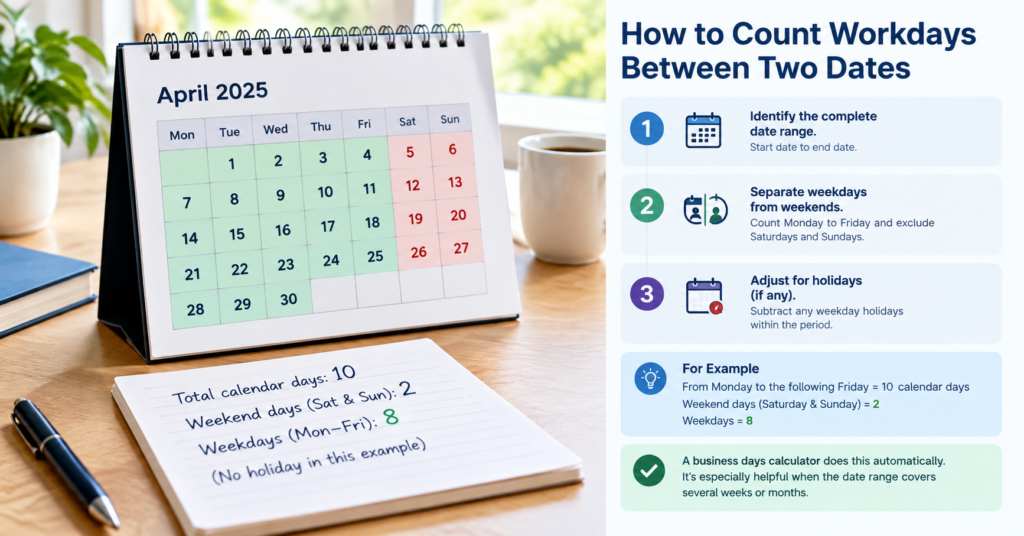
When you need to count workdays manually, start by identifying the complete date range. Then separate weekdays from weekends.
For instance, consider a period from Monday through the following Friday. There are ten calendar days in that range. Two of those days are Saturday and Sunday.
That leaves eight weekdays. If a weekday holiday occurs during the period, you would normally subtract that holiday as well.
A business days calculator performs this process automatically. It is especially helpful when the date range covers several weeks or months.
Business Days vs. Calendar Days
Calendar days include every day on the calendar. That means Monday, Tuesday, weekends, and holidays can all count.
Business days usually follow a different rule. They normally include weekdays from Monday through Friday and exclude Saturday and Sunday.
This difference matters when estimating deadlines. A task that takes ten calendar days may require more than ten business days, depending on the schedule.
For example, a five-day business period can span seven calendar days when a weekend falls between the start and end dates.
Do Holidays Count as Business Days?
Holidays depend on the rules used by the calculator and the organization involved. A standard weekday calculation may count a holiday because it only removes weekends.
However, many businesses do not operate on federal or public holidays. In that case, those holidays should not count as business days.
A more detailed business days calculator may let you enter or select holidays. The calculator can then remove those dates from the working-day total.
Always check which holidays apply to your situation. A company deadline may follow a different holiday calendar from another organization.
Why Start and End Dates Matter
The start and end dates can affect the final result. Some calculations include both dates, while others count the days after the starting date.
For example, if a project begins on Monday and ends on Friday, you may want all five weekdays included. Another calculation may treat Monday as day zero.
This difference can create unexpected results. Therefore, check whether the calculator uses an inclusive or exclusive date range.
The same issue can appear when calculating delivery times, notice periods, loan deadlines, or payment dates.
When Should You Use a Business Days Calculator?
A business days calculator can help with many everyday and professional tasks. Businesses often use workday calculations when planning projects or setting deadlines.
Employees may also use the tool to estimate leave periods or expected return dates. Customers can use it to understand processing and delivery timeframes.
The calculator can also help with invoices, contracts, applications, shipping estimates, and service requests. In each case, the goal is the same: find the number of working days in a date range.
Using a calculator can save time and reduce mistakes, especially when the period includes several weekends.
Business Days for Project Planning
Project deadlines often depend on working days rather than calendar days. A team may have ten business days to complete a task.
If the deadline starts on a Thursday, weekends will affect the final date. A simple calendar-day estimate could produce the wrong deadline.
Using a business days calculator makes the calculation easier. You can enter the relevant dates and determine the expected number of working days.
Project managers can then use that result when planning tasks, meetings, reviews, and delivery dates.
Business Days for Payments and Processing
Financial and administrative processes often use business-day timeframes. A payment may require several working days to process.
Banks and companies may also have rules that exclude weekends and certain holidays. As a result, the actual processing period may be longer than the number of calendar days suggests.
A workday calculation can provide a useful estimate. Still, you should follow the specific terms provided by the bank, company, or service provider.
Their business-day definition may not match a basic Monday-to-Friday calculation.
Common Mistakes When Counting Workdays
One common mistake is counting weekends as working days. This can increase the result when the date range covers several weeks.
Another mistake is ignoring holidays. A weekday holiday may not count toward a company’s working schedule.
People also sometimes forget to check whether the start date is included. This can create a one-day difference in the final answer.
Finally, some organizations operate on weekends or use different working weeks. A standard calculator may not reflect those schedules unless it supports custom settings.
How to Get an Accurate Result
Start with the correct start and end dates. Even a small date error can change the final result.
Next, confirm the working schedule. The common U.S. business week runs from Monday through Friday, but this is not universal.
Then check the holiday settings. If your calculation relates to a specific company or legal deadline, use the holiday rules that apply to that situation.
Finally, review whether the calculation includes the start and end dates. This helps prevent unexpected differences between your result and an official deadline.
Conclusion
A business days calculator provides a simple way to count workdays between two dates. It normally excludes Saturdays and Sundays and may also remove selected holidays.
The tool is useful for project planning, payment estimates, delivery schedules, employee leave, and administrative deadlines. It can also reduce the errors that come with manual date counting.
Remember that business-day rules can vary between organizations. Always check the relevant working schedule, holiday calendar, and date-counting method before using the result for an important deadline.
FAQs
What is a business days calculator?
A business days calculator counts working days between two dates. It normally excludes Saturdays and Sundays and may also exclude holidays.
How many business days are in a week?
A standard business week has five business days. These are usually Monday through Friday.
Does Saturday count as a business day?
Saturday usually does not count as a business day under a standard Monday-to-Friday schedule. However, some businesses operate on Saturdays.
Does Sunday count as a business day?
Sunday normally does not count as a business day. Most standard workday calculations exclude Sunday.
Do holidays count as business days?
It depends on the calculation rules. Many businesses exclude holidays, but a basic weekday calculator may not remove them automatically.
Does a business days calculator include the start date?
Some calculators include the start date, while others begin counting after it. Check the calculator’s date-counting method before relying on the result.
For more updates visit: CALCIQ