

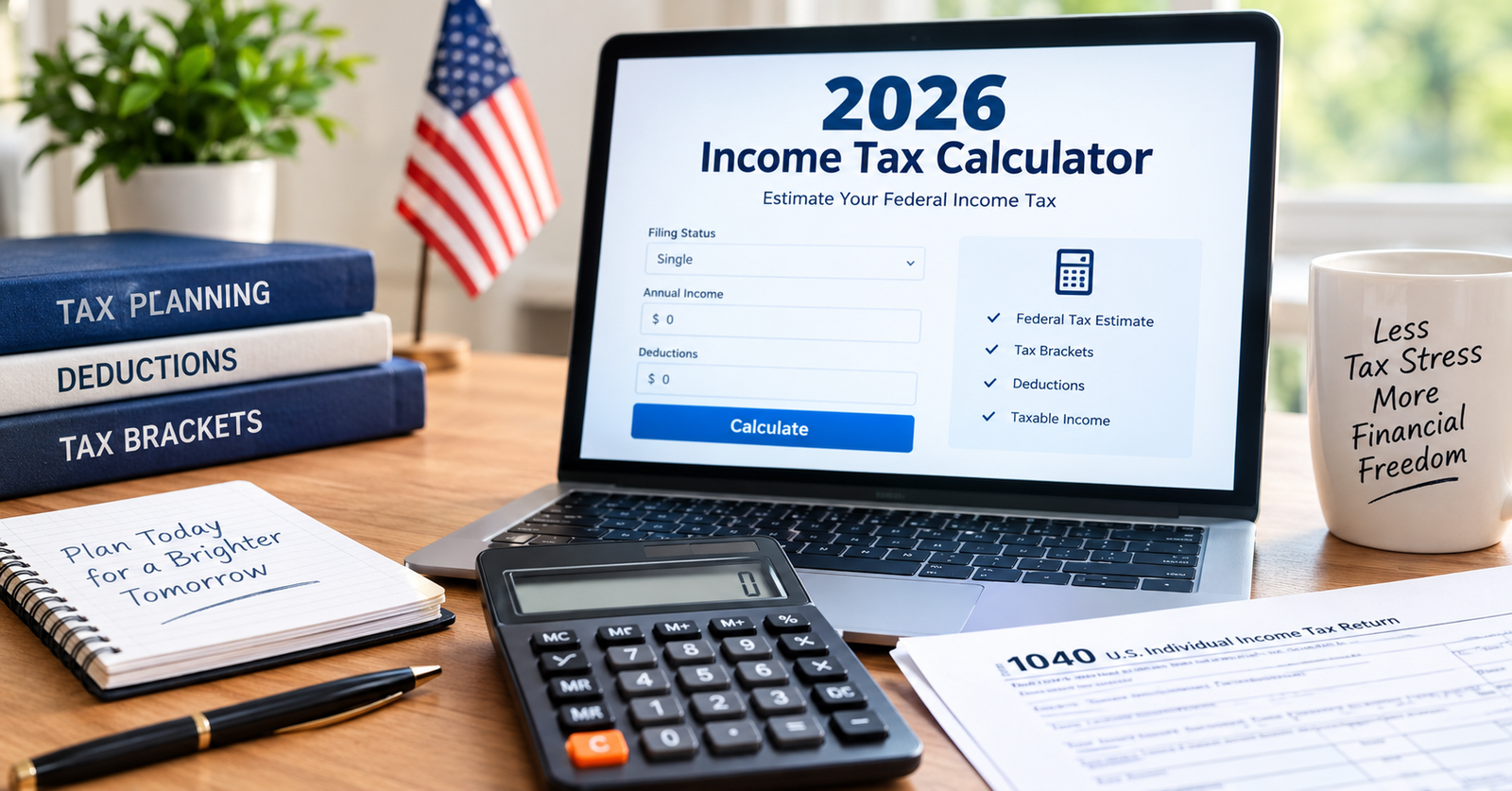
Estimating your federal income tax can make financial planning much easier. A 2026 income tax calculator helps you turn your income, filing status, deductions, and other details into a clearer estimate of your federal tax.
The calculation is based on taxable income rather than simply your total salary. Your filing status and eligible deductions can change the amount you owe. Therefore, using the correct information can give you a much more useful estimate.
For 2026, the federal tax brackets and standard deduction amounts have been adjusted. The IRS lists a standard deduction of $16,100 for single filers, $32,200 for married couples filing jointly, and $24,150 for heads of household.
What Is a 2026 Income Tax Calculator?
A 2026 income tax calculator is a tool that estimates your federal income tax for income earned during the 2026 tax year. It can help employees, self-employed workers, families, and other taxpayers understand their potential tax liability.
The calculator generally starts with your income. It then considers your filing status and applicable deductions. After determining taxable income, it applies the relevant federal tax rates.
This estimate can help you plan your budget, adjust withholding, or understand how much of your income may go toward federal income tax.
How Does the 2026 Income Tax Calculator Work?
The calculation begins with your total taxable income information. Depending on your situation, this may include wages, salary, self-employment income, investment income, or other taxable earnings.
Next, the calculation accounts for deductions. If you use the standard deduction, the amount depends on your filing status. For 2026, the standard deduction is $16,100 for single taxpayers and married taxpayers filing separately. It is $32,200 for married couples filing jointly and $24,150 for heads of household.
Your taxable income is then matched against the federal tax brackets. The United States uses a progressive tax system, so different portions of taxable income can fall into different tax brackets.
That means reaching a higher bracket does not mean your entire income gets taxed at that higher rate.
2026 Federal Income Tax Brackets
For 2026, federal individual income tax rates range from 10% to 37%. The rate that applies to each portion of taxable income depends on your filing status and income level.
For a single taxpayer, the 10% bracket applies to taxable income up to $12,400. The 12% bracket applies above that amount up to $50,400, while the 22% bracket extends up to $105,700.
Higher brackets include 24%, 32%, 35%, and 37%. For single filers, the top 37% rate begins above $640,600 of taxable income.
Married couples filing jointly have different thresholds. For example, the 10% bracket reaches $24,800, while the 37% rate begins above $768,700 of taxable income.
These brackets are important because they determine the federal income tax calculation after taxable income has been established.
Why Your Filing Status Matters
Your filing status can have a major effect on your federal tax estimate. The main federal filing statuses include single, married filing jointly, married filing separately, and head of household.
Each status has different tax bracket thresholds. Standard deduction amounts also vary.
For example, a married couple filing jointly receives a larger standard deduction than a single taxpayer. A head-of-household taxpayer also has a different deduction and tax bracket structure.
Because of these differences, entering the correct filing status is essential when using a 2026 income tax calculator.
Standard Deduction for 2026
The standard deduction reduces the amount of income subject to federal income tax. Many taxpayers use it instead of itemizing individual deductions.
For 2026, the standard deduction is $16,100 for single taxpayers and married individuals filing separately. Heads of household receive a $24,150 standard deduction, while married couples filing jointly receive $32,200.
Additional standard deduction amounts may apply to qualifying taxpayers who are age 65 or older or blind. The exact amount depends on filing status and circumstances.
A calculator can use these figures to help estimate taxable income before applying the federal tax brackets.
What Information Do You Need?
The more accurate your inputs, the more useful your estimate will be. Start with your expected income for 2026.
You may also need your filing status and information about deductions. Depending on the calculator, you might enter retirement contributions, other income, tax credits, or withholding information.
Employees can often use information from pay stubs to estimate annual earnings and federal withholding. Self-employed taxpayers may need to consider business income and other tax-related amounts.
Keep in mind that an income tax estimate is not the same as a completed tax return. Your final tax liability can depend on details that a simple calculator may not include.
Tax Credits Can Change Your Final Tax Bill
Deductions and tax credits work differently. A deduction generally reduces taxable income, while a tax credit can reduce the tax itself.
Your eligibility for credits depends on your personal and financial circumstances. Some credits may also have income limits or other requirements.
Therefore, a basic federal income tax estimate should not automatically be treated as your final amount due. A more detailed calculation may be necessary if you have several credits, multiple income sources, or complex deductions.
Federal Income Tax vs. Payroll Taxes
Federal income tax is only one part of the taxes that can appear on a paycheck.
Employees may also pay Social Security and Medicare taxes through payroll withholding. These taxes are separate from federal income tax and should not be confused with your federal income tax rate.
A paycheck calculator may combine federal income tax, payroll taxes, and possibly state taxes to estimate take-home pay. By contrast, an income tax calculator may focus primarily on federal income tax.
Understanding the difference helps prevent confusion when comparing your estimated tax with your actual paycheck deductions.
Can a 2026 Income Tax Calculator Estimate Your Refund?
It can provide an estimate, but the result depends on the information entered.
A refund generally depends on the difference between your total tax liability and the amount already paid through withholding or estimated payments. If you paid more than your final liability, you may receive a refund. If you paid less, you may have an amount due.
For that reason, a calculator needs more than your annual salary to estimate a potential refund accurately.
Why Use a 2026 Income Tax Calculator?
A calculator can give you a quick way to understand how federal taxes may affect your income. It can also help you plan ahead instead of waiting until tax filing season.
You can use an estimate when reviewing your salary, considering a job change, planning additional income, or checking whether your withholding seems reasonable.
It is especially useful when your income changes during the year. Even a rough estimate can help you understand how changes in taxable income may affect your federal tax.
Conclusion
A 2026 income tax calculator provides a convenient way to estimate your federal income tax using your income, filing status, deductions, and other relevant information.
The 2026 federal tax system uses rates from 10% through 37%, while standard deduction amounts have also increased for the year.
Remember that an estimate is not a substitute for a complete tax return. However, it can be a valuable planning tool. By entering accurate information and understanding how taxable income and tax brackets work, you can get a clearer picture of your potential federal tax position.
FAQs
What is the 2026 income tax rate?
Federal income tax rates for 2026 range from 10% to 37%. Your effective tax calculation depends on taxable income, filing status, deductions, and applicable tax provisions.
What is the standard deduction for 2026?
The 2026 standard deduction is $16,100 for single taxpayers and married individuals filing separately. It is $24,150 for heads of household and $32,200 for married couples filing jointly.
Does a higher tax bracket tax all of my income?
No. The federal tax system uses marginal brackets. Only the portion of taxable income that falls within a particular bracket is taxed at that bracket’s rate.
What is the 2026 tax bracket for single filers?
For single taxpayers, the 2026 brackets range from 10% to 37%. The 10% bracket covers taxable income up to $12,400, while the 37% rate begins above $640,600.
What is the 2026 tax bracket for married couples filing jointly?
For married couples filing jointly, the 10% bracket applies to taxable income up to $24,800. The highest 37% rate begins above $768,700.
Can I use a 2026 income tax calculator for my paycheck?
Yes, but a federal income tax calculator and a paycheck calculator serve different purposes. A paycheck calculator may also account for Social Security, Medicare, state taxes, and withholding.
For more updates visit: CALCIQ