

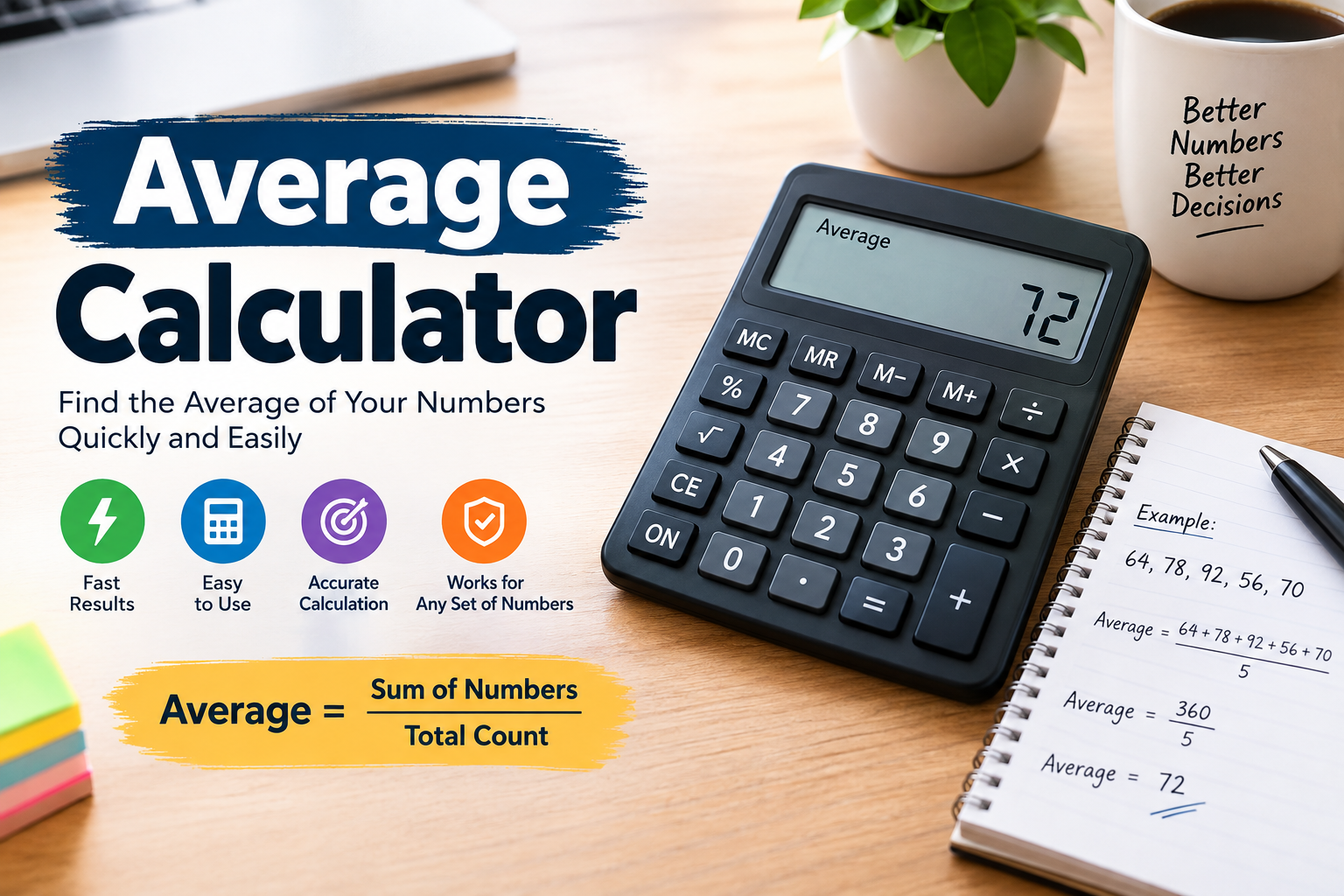
Calculating an average is one of the simplest ways to understand a group of numbers. However, doing the maths by hand can become difficult when you have many values or different weights.
An average calculator makes the process much faster. You can enter your numbers and quickly find their average without worrying about calculation errors. The basic method works for school marks, prices, measurements, business figures, and many other situations.
The standard average is also known as the arithmetic mean. It gives you one number that represents the typical value in a set of numbers. Depending on the situation, however, a simple average may not always be suitable. That is where weighted averages become useful.
What Is an Average Calculator?
An average calculator is an online tool that calculates the average value of a group of numbers. It normally adds all the values together and divides the total by the number of values.
For example, suppose your numbers are 10, 20, 30, and 40. Their total is 100. Since there are four numbers, you divide 100 by 4. The average is therefore 25.
This method is called the arithmetic mean. It is widely used because it is simple and easy to understand.
An average calculator can save time when you need to work with a large set of values. Instead of performing several calculations manually, you can enter the numbers and get the result quickly.
How Does an Average Calculator Work?
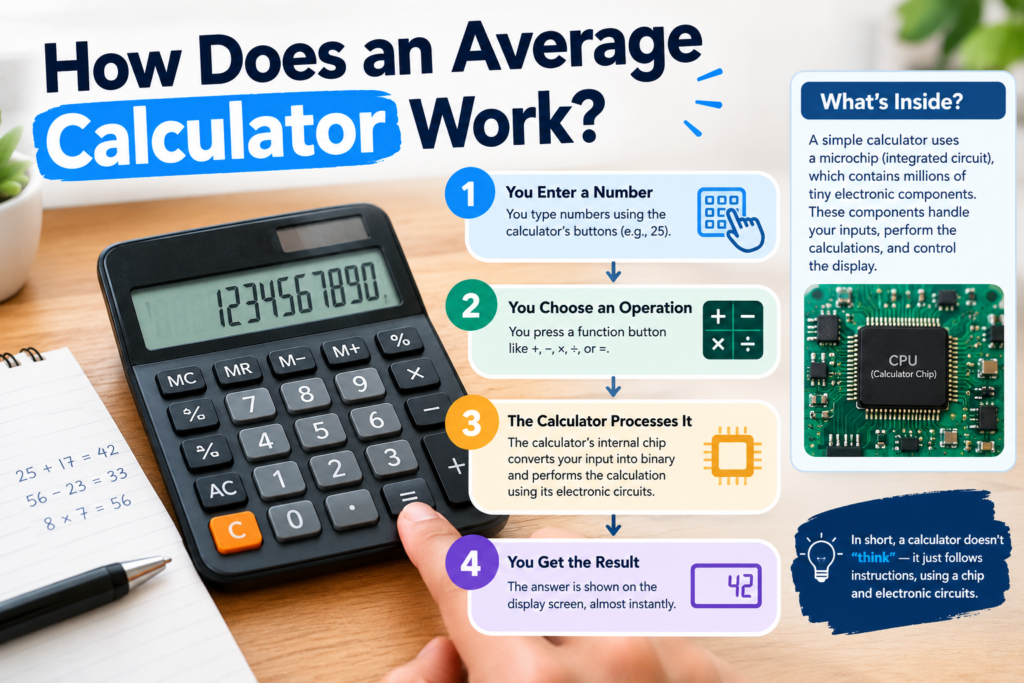
The standard average uses a straightforward formula. First, add every number in the data set. Next, count how many numbers you have. Finally, divide the total by the number of values.
The formula is:
Average = Sum of all values ÷ Number of values
Consider a set of five numbers: 12, 18, 20, 25, and 30.
Their sum is 105. There are five values, so you divide 105 by 5. The result is 21.
Therefore, the average of the five numbers is 21.
The same approach works whether you have five numbers or several hundred. A calculator simply makes the process quicker and reduces the chance of arithmetic mistakes.
When Should You Use an Average Calculator?
An average calculator can be useful in many everyday situations. Students can use one to calculate average test marks or assessment scores. Teachers can use averages when reviewing class results.
Businesses also rely on averages. For example, a company might calculate average sales, average order value, or average customer spending.
You can also use an average when comparing measurements. Average temperatures, travel times, prices, expenses, and monthly income are common examples.
However, you should always consider what the numbers represent. A simple average treats every value equally. That is not always appropriate when some values have greater importance than others.
What Is a Weighted Average?
A weighted average gives different importance to different values. Instead of treating every number equally, it considers the weight assigned to each value.
For example, imagine a course where an exam counts for 60% of the final grade and coursework counts for 40%. The two marks should not simply be averaged because they have different levels of importance.
A weighted average calculator can handle this type of calculation.
The basic formula is:
Weighted Average = Sum of (Value × Weight) ÷ Sum of Weights
Suppose you receive 80 in an exam with a weight of 60 and 70 in coursework with a weight of 40.
You multiply each score by its weight. Then, add those results together and divide by the total weight. This gives you the weighted result.
This method is particularly useful for grades, financial calculations, performance scores, and other situations where individual values have different importance.
How Is a Weighted Average Different From a Normal Average?
A normal average gives every value the same importance. A weighted average does not.
For example, if you scored 60 and 100, the normal average would be 80. Both numbers contribute equally.
With a weighted average, one number might contribute more than the other. If the score of 100 has a much higher weight, the final result will move closer to 100.
This distinction is important because using the wrong method can produce a misleading result. Before calculating an average, check whether all values should have equal importance.
What Is a Stock Average Calculator?
A stock average calculator is designed for situations where an investor buys the same stock at different prices.
For example, you might purchase shares at one price and later buy additional shares at another price. Your average purchase price depends on the number of shares purchased at each price.
A simple average of the two prices may not give the correct result because the quantities can differ.
Suppose you buy 10 shares at £20 each and later buy 30 shares at £24 each. The second purchase represents more shares, so it has a greater effect on your average cost.
A stock average calculator can account for both the purchase prices and quantities. This helps investors understand their average cost per share after multiple purchases.
Why Is the Average Useful?
An average turns several numbers into one easy-to-understand figure. This makes large sets of data easier to interpret.
For example, looking at twelve separate monthly expenses can make it difficult to understand your typical spending. An average monthly expense gives you a quick reference point.
The same idea applies to exam marks, product prices, sales figures, and measurements.
Still, an average does not tell you everything about a data set. Two groups can have the same average while having very different individual values.
For this reason, averages work best when you consider the wider data as well.
Common Mistakes When Calculating an Average
One common mistake is forgetting to count every value. If you add ten numbers but divide by nine, the result will be incorrect.
Another mistake happens when people include values that should not belong in the calculation. Always check your data before calculating the result.
Weighted averages can create another problem. Users sometimes calculate a normal average when the values actually have different weights. In that situation, the result may not represent the intended outcome.
Rounding too early can also affect the final answer. When possible, keep the original numbers during the calculation and round the final result.
Average Calculator for Everyday Calculations
You do not need to use an average calculator only for academic maths. It can help with many practical calculations.
You might use it to find the average price of several products, average weekly spending, average working hours, or average travel time.
Students can calculate average marks across several tests. Sports fans can calculate average scores or performance figures. Businesses can examine average sales across different periods.
The main benefit is convenience. Once you understand what the numbers represent, the calculation itself becomes much easier.
Average Calculator vs Weighted Average Calculator
The choice between the two depends on your data.
Use a standard average when every value has equal importance. This is suitable for a basic set of marks, measurements, prices, or other equally relevant numbers.
Use a weighted average calculator when different values contribute differently to the final result. This is common with academic grades, financial figures, portfolio calculations, and performance scores.
If you are unsure which method to use, look at the data first. Ask whether every number should have the same influence. If the answer is yes, a standard average is usually appropriate. If not, a weighted method may be better.
Benefits of Using an Average Calculator
An online calculator can make routine calculations quicker and easier. It also helps reduce mistakes caused by manual addition or division.
Another benefit is convenience. You can use the same basic calculation for many types of data without setting up a spreadsheet.
For larger data sets, the time savings can become significant. Instead of checking every calculation manually, you can focus on understanding the result.
However, the accuracy of the answer still depends on the numbers you enter. A calculator can process incorrect information correctly, so always check your inputs.
Conclusion
An average calculator provides a quick way to find the mean of a group of numbers. The standard calculation adds the values and divides the total by the number of values.
For situations where numbers have different levels of importance, a weighted average calculator is more suitable. Meanwhile, investors can use a stock average calculator to understand their average purchase cost after buying shares at different prices.
Understanding the difference between these methods helps you choose the right calculation. Whether you are studying, managing finances, analysing data, or checking everyday figures, the right average can turn complicated numbers into useful information.
FAQs
What is an average calculator?
An average calculator is a tool that finds the mean of a group of numbers. It normally adds the values together and divides the total by the number of values.
What is the formula for an average?
The basic formula is the sum of all values divided by the number of values. For example, if four numbers total 100, their average is 25.
What is the difference between average and mean?
In everyday mathematical use, average and arithmetic mean often refer to the same calculation. Both usually describe the sum of values divided by the number of values.
When should I use a weighted average calculator?
Use a weighted average calculator when different values have different levels of importance. Academic grades, financial calculations, and performance scores are common examples.
How do I calculate a weighted average?
Multiply each value by its weight, add the resulting figures, and divide that total by the sum of the weights.
What is a stock average calculator?
A stock average calculator helps determine the average purchase price of shares bought at different prices and quantities. It accounts for the number of shares purchased at each price.
For more updates visit: CALCIQ