

Working extra hours can make a noticeable difference to your payslip. However, calculating overtime by hand can become confusing when your hourly rate, extra hours, or overtime rate changes. An overtime calculator makes the process much easier.
An overtime calculator helps you estimate how much you could earn from additional working hours. You can enter your normal hourly rate, the number of overtime hours, and the overtime multiplier to get an estimated overtime amount.
For UK workers, it is also important to understand that overtime pay depends on the terms of your employment contract. Some employers pay the normal hourly rate, while others offer a higher rate for evenings, weekends, or additional hours.
What Is an Overtime Calculator?
An overtime calculator is a simple tool that estimates your earnings from hours worked beyond your normal schedule. It uses your regular hourly pay and the overtime rate to work out your additional earnings.
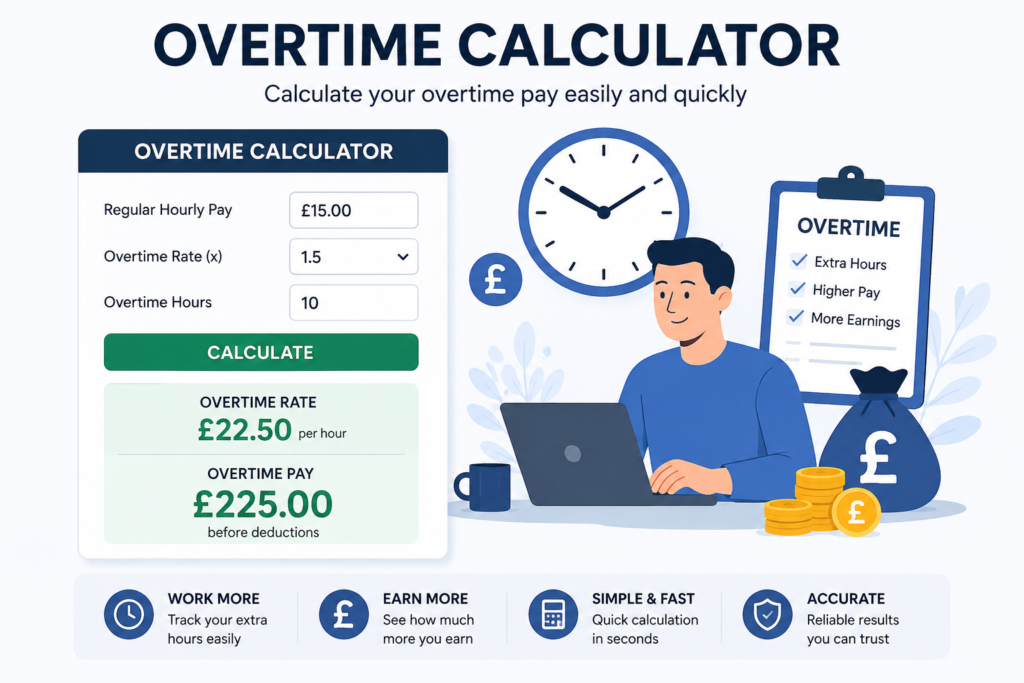
For example, if you earn £15 per hour and work 10 overtime hours at 1.5 times your normal rate, your overtime rate is £22.50 per hour. Ten extra hours would therefore produce £225 in overtime pay before deductions.
The calculator is useful for employees who want a quick estimate before checking their payslip. It can also help workers compare different overtime arrangements and understand the value of additional hours.
How Does an Overtime Calculator Work?
Most overtime calculators use three main figures: your normal hourly rate, your overtime hours, and your overtime multiplier. Once these figures are entered, the calculator applies a straightforward formula.
The basic formula is:
Overtime Pay = Overtime Hours × Overtime Hourly Rate
If your employer uses an overtime multiplier, you can calculate the overtime hourly rate first.
Overtime Hourly Rate = Normal Hourly Rate × Overtime Multiplier
Suppose your normal rate is £18 per hour and your employer pays overtime at 1.5 times the normal rate. Your overtime rate would be £27 per hour.
If you then work 8 overtime hours, your estimated overtime pay would be £216 before tax, National Insurance, pension contributions, or other deductions.
How to Calculate Overtime Pay
Calculating overtime pay is usually simple when you know the correct rate. Start by finding your normal hourly rate. If you are paid hourly, this figure is normally shown on your employment information or payslip.
Next, check the overtime rate in your employment contract or workplace policy. An employer might pay overtime at the normal rate, 1.25 times the normal rate, 1.5 times the normal rate, or another agreed amount.
Multiply your hourly rate by the overtime multiplier. Then multiply the resulting overtime rate by the number of overtime hours worked.
For example, an employee earning £14 per hour works 12 additional hours at 1.5 times the normal rate. The overtime rate is £21 per hour. The overtime earnings are therefore £252 before deductions.
How to Calculate an Hourly Rate From a Salary
Some employees receive an annual salary rather than an hourly wage. In that case, you may need to estimate an hourly rate before calculating overtime.
A common approach is to divide your annual salary by the number of paid working hours in a year. The result gives an estimated hourly rate based on your contracted working pattern.
For example, someone earning £35,000 per year with a 40-hour working week could estimate their annual working hours by multiplying 40 hours by the number of working weeks in their arrangement.
The exact calculation can vary because employees may have paid holidays, different weekly hours, unpaid breaks, or other contractual arrangements. Therefore, your employer’s stated overtime calculation method should take priority.
Is Overtime Pay Required in the UK?
UK law does not generally require employers to pay a higher rate simply because an employee works overtime. Overtime pay usually depends on the employment contract and the employer’s overtime policy.
Some employers offer enhanced overtime rates as an incentive for additional work. Others may pay overtime at the employee’s normal hourly rate. Your contract should explain how extra hours are treated.
However, employers must still follow applicable rules on working time and minimum wage. An overtime arrangement cannot be used to reduce a worker’s effective pay below the applicable minimum wage requirements.
What Is Time-and-a-Half Overtime?
Time-and-a-half means that an employee receives 1.5 times their normal hourly rate for eligible overtime hours.
For example, an hourly rate of £16 becomes £24 when paid at time-and-a-half. If the employee works 5 overtime hours at this rate, the additional gross pay would be £120.
Time-and-a-half is common in some industries and workplaces, but it is not automatically required for every UK employee. Always check the terms that apply to your employment.
What Is Double-Time Overtime?
Double-time overtime means that the overtime rate is twice the employee’s normal hourly rate.
For example, an employee earning £20 per hour would receive £40 per overtime hour at double time. Working 6 overtime hours would produce £240 in additional gross pay.
Double-time arrangements can appear in specific employment contracts or workplace agreements. They are not a universal legal requirement in the UK.
Overtime for Salaried Employees
Being paid a salary does not automatically mean that every additional hour qualifies for extra payment. Your contract may include specific working hours and explain how additional hours are handled.
Some salaried roles include reasonable additional hours within the normal responsibilities of the position. Other contracts provide a separate overtime payment when employees work beyond an agreed number of hours.
Because of these differences, salaried employees should check their contract before using an overtime calculator. The calculator can estimate the value of extra hours, but it cannot determine whether your employer owes you overtime.
Gross Overtime Pay vs Take-Home Pay
An overtime calculator normally shows gross overtime pay. This is the amount earned before deductions.
Your actual take-home amount may be lower because payroll can deduct income tax, National Insurance, pension contributions, student loan repayments, or other applicable deductions.
For this reason, an overtime calculation should be treated as an estimate of additional earnings rather than the exact amount that will reach your bank account.
Why Use an Overtime Calculator?
An overtime calculator saves time and reduces simple calculation errors. Instead of repeatedly multiplying hourly rates and overtime hours, you can calculate the estimated amount quickly.
It can also help when planning your monthly income. If you know how many extra hours you expect to work, you can estimate the additional gross earnings before deciding whether the extra hours are worthwhile.
The tool can also help you check your payslip. If your overtime payment appears different from your estimate, you can review the overtime rate, eligible hours, payroll period, and deductions before asking your employer for clarification.
Factors That Can Change Your Overtime Pay
Your overtime earnings can change when your hourly rate changes. They can also vary when an employer uses different rates for weekdays, nights, weekends, or public holidays.
Your contract may also specify when overtime begins. For example, additional payment might start after a particular number of hours in a day or week rather than immediately after your usual finishing time.
Some workplaces also use different rules for authorised and unauthorised overtime. Therefore, only use hours that qualify under your employer’s overtime policy when estimating your expected pay.
Overtime Calculator Example
Imagine that you earn £17 per hour and your employer pays eligible overtime at 1.5 times your normal rate.
Your overtime rate would be £25.50 per hour. If you work 9 overtime hours during the pay period, your gross overtime earnings would be £229.50.
This figure represents the additional gross pay from those overtime hours. Your final payslip could show a different net amount after normal payroll deductions.
Conclusion
An overtime calculator provides a quick way to estimate the extra money you could earn from additional working hours. By entering your normal hourly rate, overtime hours, and applicable overtime rate, you can calculate your estimated gross overtime pay in seconds.
For UK employees, the key is to use the overtime rate that applies to your employment contract. Once you understand your rate and eligible hours, calculating overtime becomes much easier. Remember that the final amount on your payslip may differ because of tax, National Insurance, pension contributions, and other deductions.
FAQs
What is an overtime calculator?
An overtime calculator estimates how much additional pay you can earn from overtime hours. It normally uses your hourly rate, overtime hours, and overtime multiplier.
How do I calculate overtime pay?
Multiply your overtime hours by your overtime hourly rate. If your employer uses a multiplier, multiply your normal hourly rate by that multiplier first.
Is overtime paid at a higher rate in the UK?
Not necessarily. UK overtime pay usually depends on the employment contract or workplace agreement. Some employers offer enhanced rates, while others pay the normal hourly rate.
What does time-and-a-half mean?
Time-and-a-half means receiving 1.5 times your normal hourly rate. For example, a £20 hourly rate becomes £30 per overtime hour.
What does double time mean?
Double time means receiving twice your normal hourly rate for eligible overtime. A £15 hourly rate would therefore become £30 per overtime hour.
Does overtime increase my tax?
Additional earnings from overtime can affect your overall taxable income. However, the amount of tax you pay depends on your total income and applicable tax circumstances.
For more updates visit: CALCIQ