
Table of Contents
- What Is a Monthly Savings Calculator?
- How to Use the Monthly Savings Calculator
- How Monthly Saving Grows Over Time
- Worked Example: $200 a Month for 10 Years
- How Much Difference Does the Monthly Amount Make?
- Where to Keep Your Monthly Savings
- Tips to Keep a Monthly Savings Habit Going
- Common Mistakes to Avoid
- FAQs
Saving a fixed amount every month is the simplest wealth-building habit there is, but it is hard to see what that habit is worth before you start. A small deposit can look too small to matter, yet over ten years deposits and interest stack up into a serious sum. The monthly savings calculator at the top of this page turns your starting amount, monthly deposit, interest rate and years into one clear future value, so you can test a plan in seconds. This guide explains the maths and walks through a full worked example.
Monthly Savings Calculator
| Future value | |
| Total you put in | |
| Interest earned |
Assumes interest is compounded monthly and the deposit is made every month. Results are estimates before tax and inflation.
What Is a Monthly Savings Calculator?
A monthly savings calculator projects how a savings pot grows when you add money every month and earn interest on the growing balance. You give it four numbers: how much you already have saved, how much you will deposit each month, the annual interest rate, and how many years you will keep going. It works month by month through the whole period, adding each deposit and crediting interest as it goes, and reports three results: the future value of the pot, the total you put in yourself, and how much of the final balance is interest rather than your own money.
That split matters. Two savers can reach the same balance in very different ways — one depositing a lot and earning little, the other depositing steadily and letting interest do more of the work. The results are estimates, not promises: they assume the rate stays the same throughout and are shown before tax and inflation.
How to Use the Monthly Savings Calculator
Enter your starting amount first. If you are beginning from nothing, enter 0 — the calculator works fine with no lump sum. Next, enter the amount you can realistically deposit every month. Be honest rather than hopeful: a smaller amount you actually pay beats a bigger one you abandon in March. Then add the annual rate your account pays, and the number of years you plan to save for.
Press Calculate Savings and the monthly savings calculator shows your future value, total contributions and interest earned. Try changing one number at a time: raise the deposit by $25, or add two years, and watch which change moves the balance more. That turns a vague intention like “save more” into a specific, affordable figure with a known result.
How Monthly Saving Grows Over Time
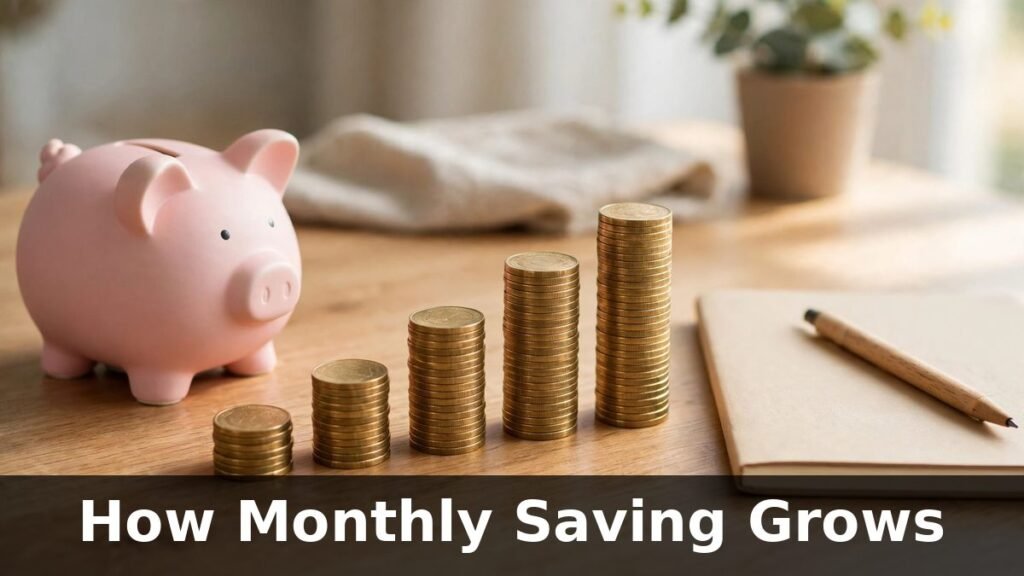
Monthly saving grows in two ways at once. The obvious way is your deposits: $200 a month is $2,400 a year, whatever interest rates do. The quieter way is compound interest. Each month, interest is calculated on everything in the pot — deposits plus all interest already added — so the interest itself starts earning interest. Early on this effect is tiny; later it becomes a real second engine alongside your deposits.
That is why time matters so much. In the worked example below, the first year’s interest is just $85.23, but by the tenth year the pot earns well over $1,000 of interest in a single year, without you depositing a cent extra. To see compounding on a lump sum with no monthly deposits, our compound interest calculator isolates that effect. The compound interest calculator on Investor.gov, the investor education site of the U.S. Securities and Exchange Commission, lets you cross-check the same maths.
One honest caveat: real-life growth is not a straight line. Savings rates move, and inflation reduces what the final sum will buy, so treat the projection as a planning guide, not a guarantee.
Worked Example: $200 a Month for 10 Years

Suppose you start with $1,000 saved, deposit $200 every month, earn 4% a year compounded monthly, and keep going for 10 years. Type those numbers into the monthly savings calculator and you get a future value of $30,940.79. Of that, $25,000.00 is money you put in yourself — the $1,000 start plus 120 deposits of $200 — and $5,940.79 is interest earned along the way.
The formula is FV = P(1 + r)^n + PMT × (((1 + r)^n − 1) / r), where P is the starting amount, PMT the monthly deposit, r the monthly rate (0.04 ÷ 12), and n the number of months (120). The first part grows your lump sum; the second grows the stream of deposits. The table shows the same plan at each year end.
| End of year | Balance | You have put in | Interest earned |
|---|---|---|---|
| 0 | $1,000.00 | $1,000.00 | $0.00 |
| 1 | $3,485.23 | $3,400.00 | $85.23 |
| 2 | $6,071.72 | $5,800.00 | $271.72 |
| 3 | $8,763.58 | $8,200.00 | $563.58 |
| 4 | $11,565.12 | $10,600.00 | $965.12 |
| 5 | $14,480.79 | $13,000.00 | $1,480.79 |
| 6 | $17,515.25 | $15,400.00 | $2,115.25 |
| 7 | $20,673.35 | $17,800.00 | $2,873.35 |
| 8 | $23,960.10 | $20,200.00 | $3,760.10 |
| 9 | $27,380.77 | $22,600.00 | $4,780.77 |
| 10 | $30,940.79 | $25,000.00 | $5,940.79 |
Notice the pattern: across the full ten years, interest supplies almost a fifth of the final balance — the pot simply got big enough for 4% to mean real money.
How Much Difference Does the Monthly Amount Make?
The monthly deposit is the lever you control most directly. The table below keeps the same $1,000 start, 4% rate and 10-year term, and changes only the monthly deposit.
| Monthly deposit | Balance after 10 years | You put in | Interest earned |
|---|---|---|---|
| $100 | $16,215.81 | $13,000.00 | $3,215.81 |
| $200 | $30,940.79 | $25,000.00 | $5,940.79 |
| $300 | $45,665.77 | $37,000.00 | $8,665.77 |
| $500 | $75,115.74 | $61,000.00 | $14,115.74 |
Doubling the deposit from $100 to $200 does not quite double the ending balance, because the starting $1,000 stays the same — but it comes close, and the interest nearly doubles too, since every extra deposit compounds from the month it lands. Run your own figures through the monthly savings calculator first: the right deposit is the largest one you can sustain every month.
Where to Keep Your Monthly Savings
For most goals, a straightforward savings account you can automate is the right home. The Consumer Financial Protection Bureau’s guide to building an emergency fund makes the same point this calculator assumes: small, regular deposits into a separate account are how a starter fund of a few hundred dollars becomes a cushion of a few thousand. Keep savings separate from your spending account, so the growing balance is not quietly spent.
Once your cushion is in place, compare what different homes pay. A certificate of deposit usually pays a higher fixed rate for locking money away for a set term — our CD interest rate calculator shows what a lump sum earns at CD rates. Higher is not automatically better, though: check withdrawal penalties, whether the rate is fixed or variable, and deposit insurance cover first.
Tips to Keep a Monthly Savings Habit Going
Automate the deposit for the day after payday, so saving happens before spending rather than with whatever is left over. Left-over saving rarely survives the month; payday saving usually does. Start with an amount that feels almost too easy, then raise it by $10 or $25 every few months or after each pay rise. You will barely notice the increases, but the calculator shows what they are worth over a decade.
Give the pot a job. A named goal — an emergency fund, a house deposit, or a boat bought without a loan, where our boat loan calculator shows what borrowing instead would cost — is far easier to protect than a vague pile of money. Finally, review the plan yearly: rerun your numbers, check your account’s current rate, and adjust the deposit if your income has changed.
Common Mistakes to Avoid
The most common mistake is entering a rate your account does not really pay. A headline rate might apply only to part of the balance, or only for an introductory few months; use the rate you expect to average over the whole period, or the projection will flatter you. A second mistake is forgetting tax and inflation. The result is a before-tax estimate, and a dollar in ten years will buy less than a dollar today, so aim a little higher than the bare figure suggests.
People also trip over timing. This calculator assumes deposits land monthly and interest compounds monthly, which matches most savings accounts; if yours compounds daily, your real balance will differ slightly. And do not count irregular windfalls in the monthly deposit: a bonus belongs in the starting amount when it arrives, not in a projection built on money you do not yet have.
FAQs
How does a monthly savings calculator work?
It steps through your plan month by month. Each month it adds your deposit, then applies one month of interest — the annual rate divided by twelve — to the whole balance. Repeating that for every month of your term produces the future value, and the tool separates out your contributions so you can see how much of the pot is interest.
How much should I save each month?
There is no single right figure. A common starting point is an emergency fund covering three to six months of essential spending, beginning with a smaller starter target if that feels far away. What matters most is that the amount fits your budget every month, because missed deposits cost more in lost compounding than a smaller deposit does.
What interest rate should I enter?
Enter the annual rate your savings account currently pays. If the rate is variable, use a cautious average of what you expect over the term rather than today’s best headline figure. If your account pays no interest, enter 0 — the calculator then simply adds up your starting amount and deposits.
Are the results guaranteed?
No. The result is an estimate based on the rate staying unchanged for the whole period, with no withdrawals, fees or missed deposits. Real accounts change their rates, and your circumstances may change too. Use the projection for planning, and recheck it whenever your rate or deposit changes.
What is the difference between saving monthly and saving a lump sum?
A lump sum is saved all at once, so every dollar compounds for the full term. Monthly saving spreads the money out, so later deposits compound for less time — but it fits how most people actually earn, and builds the balance without needing a windfall first. Many savers combine both: a lump sum to start, then monthly deposits on top.
Does the calculator include tax or inflation?
No. Results are shown before tax and before inflation, because both depend on your personal circumstances and on future prices nobody can know in advance. If tax applies to your interest, your real growth will be lower, and inflation means the final balance will buy less than the same amount would today.
For more updates visit: CALCIQ