

Table of Contents
- What Is Cumulative GPA?
- How to Use the Cumulative GPA Calculator
- The 4.0 Scale and Grade Points
- Worked Example: Combining Semesters Step by Step
- Cumulative GPA vs Term GPA
- How to Raise Your Cumulative GPA
- Common Mistakes to Avoid
- FAQs
Your cumulative GPA is the single number colleges, scholarship committees and many employers look at first, yet it is rarely obvious how one more semester will move it. The cumulative gpa calculator at the top of this page does the weighted maths for you: enter your current GPA and credits, add this term’s grades, and see your new overall figure. This guide explains what the number means, how it is built, and how to use it to plan ahead.
Cumulative GPA Calculator
This term’s courses
| Term GPA | |
| New cumulative GPA | |
| Term credits | |
| Total credits |
Grade points: A 4.0, A- 3.7, B+ 3.3, B 3.0, B- 2.7, C+ 2.3, C 2.0, C- 1.7, D+ 1.3, D 1.0, F 0.0. Leave a course row blank if you are not using it.
What Is Cumulative GPA?
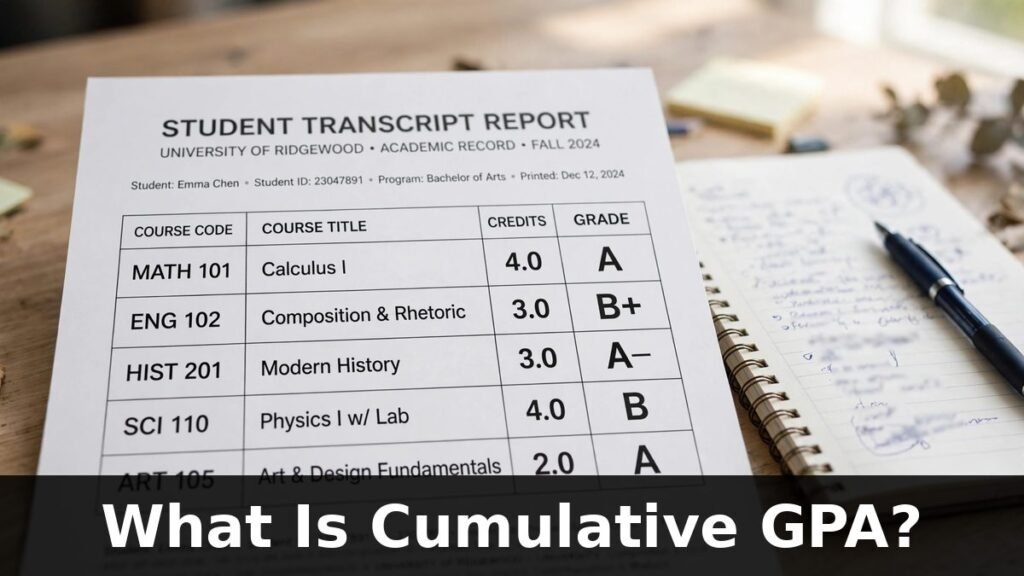
Cumulative GPA is the average of every graded course you have completed so far, weighted by the credits each course carries. It is different from a term GPA, which covers one semester or quarter only. Your cumulative figure rolls every term together: a first-year course still counts alongside last week’s course, if both were graded at the same institution.
The weighting matters. A four-credit course influences the average twice as much as a two-credit course with the same grade. That is why you cannot find your cumulative GPA by averaging your semester GPAs unless every semester carried the same number of credits. Students who want the figure for a single term first can use our semester grade calculator and then bring that result here.
Most schools report the cumulative figure on your transcript and update it each term. It is the number used for academic standing, scholarship renewals and college applications. If you are still at school rather than university, our high school GPA calculator covers most high school credit patterns.
How to Use the Cumulative GPA Calculator
The cumulative gpa calculator needs two groups of information: what you have already earned, and what you have just finished this term.
First, enter your current cumulative GPA and the total credits completed so far. Both are on your latest transcript or student portal. If this is your first term, leave both fields blank or enter zero, and the tool will use your term GPA as your starting cumulative figure.
Next, fill in up to six course rows. For each course, choose the letter grade and type the number of credits. Leave any rows you do not need blank, because rows with no credits are ignored. Then press Calculate Cumulative GPA. You will see four results: this term’s GPA, your new cumulative GPA, the credits from this term, and your new total credits. Try changing one grade at a time to test targets. College students who only need a single-semester figure can also check our GPA calculator for college, which uses the same grade points.
The 4.0 Scale and Grade Points
Every calculation starts by turning letter grades into grade points. On the standard unweighted scale, an A is worth 4.0 and an F is worth 0.0, with plus and minus grades in between. The College Board’s BigFuture guide to calculating GPA on a 4.0 scale shows the broad bands most schools share: an A covers roughly 90 to 100 percent for 4.0 points, a B covers 80 to 89 percent for 3.0 points, a C covers 70 to 79 percent for 2.0 points, a D covers 66 to 69 percent for 1.0 point, and anything below 65 percent scores 0.0. Schools set their own exact cutoffs, so check your school’s scale if a grade sits near a boundary.
The plus and minus steps used here match the scale published by the University of Richmond Registrar, where an A minus is worth 3.7 and a B plus is worth 3.3.
| Letter grade | Grade points | Typical percent band |
|---|---|---|
| A | 4.0 | 93–100 |
| A- | 3.7 | 90–92 |
| B+ | 3.3 | 87–89 |
| B | 3.0 | 83–86 |
| B- | 2.7 | 80–82 |
| C+ | 2.3 | 77–79 |
| C | 2.0 | 73–76 |
| C- | 1.7 | 70–72 |
| D+ | 1.3 | 67–69 |
| D | 1.0 | 65–66 |
| F | 0.0 | Below 65 |
Quality points link this table to your GPA. For each course, multiply the grade points by the credits: an A in a three-credit course earns 12 quality points. Add every course’s quality points and divide by the total credits, and you have the GPA.
Worked Example: Combining Semesters Step by Step

Suppose you have finished 60 credits with a cumulative GPA of 3.40, and you have just completed a 15-credit term with five courses. Here is what the cumulative gpa calculator does with those numbers.
| Course | Grade | Points | Credits | Quality points |
|---|---|---|---|---|
| Course 1 | A | 4.0 | 3 | 12.0 |
| Course 2 | B+ | 3.3 | 3 | 9.9 |
| Course 3 | A- | 3.7 | 4 | 14.8 |
| Course 4 | B | 3.0 | 3 | 9.0 |
| Course 5 | A | 4.0 | 2 | 8.0 |
| Term total | 15 | 53.7 |
Step 1: work out the term GPA. Divide the quality points by the term credits: 53.7 divided by 15 equals 3.58. That is a strong term, well above your previous average.
Step 2: turn your old GPA back into quality points. Your previous 3.40 over 60 credits represents 3.40 multiplied by 60, which is 204 quality points already banked.
Step 3: combine and divide. Add old and new quality points, 204 plus 53.7 equals 257.7, and divide by the new total of 75 credits. The result is 3.436, which rounds to a new cumulative GPA of 3.44.
Notice the lesson in the numbers. A 3.58 term only moved the cumulative figure from 3.40 to 3.44, because those 15 credits were added to 60 credits of history. The further into your studies you are, the harder each term must work to move your average. It cuts both ways: a bad term later on also does less damage.
Cumulative GPA vs Term GPA
These two figures answer different questions, and mixing them up causes real confusion.
| Figure | What it covers | What it is used for |
|---|---|---|
| Term GPA | One semester or quarter only | Term honours, spotting a good or bad term |
| Cumulative GPA | Every graded term so far, credit-weighted | Standing, scholarships, applications, honours |
A weighted GPA is a third, separate idea. Some high schools add extra points for honours or advanced courses, which can push a weighted figure above 4.0. This calculator uses the unweighted 4.0 scale, the version colleges most often recalculate for themselves. If a course is still in progress and you need the grade required on the final to protect your average, our final grade calculator works that target out for you.
How to Raise Your Cumulative GPA
Because the maths is weighted, there is no shortcut, but there is a strategy. Use the cumulative gpa calculator as a planning tool. Enter the grades you realistically expect this term, then test what changes if one borderline course improves by a single grade step. That tells you where extra study time earns the most.
Credit load matters too. More credits move your average further in whichever direction your grades point, so a heavy term is an opportunity when you are prepared and a risk when you are not. Retaking a course can help at schools that replace the original grade, but policies differ: some average both attempts, some count only the newest. Check your school’s policy first.
Finally, protect the base. One F in a high-credit course does lasting damage: it adds credits with zero quality points, and those credits stay in the denominator for every future calculation. Steady B plus and A minus grades raise your average more reliably than one brilliant result among weak ones.
Common Mistakes to Avoid
The most common error is averaging semester GPAs directly. Three terms at 3.2, 3.6 and 3.8 do not average to a 3.53 cumulative figure unless each term had identical credits. Always combine quality points and credits, as the worked example shows, rather than averaging averages.
A second mistake is forgetting how schools treat awkward courses. Repeated courses, summer courses and transfer credits are handled differently by different schools, and many transcripts exclude transfer grades entirely. Start from the credits and GPA printed on your own transcript.
Students also round too early. If you round each course’s points or your starting GPA before combining, small errors compound. Keep full precision until the final answer, then round to two decimal places. Pass or fail courses, audits and withdrawals normally carry no grade points, so leave them out of the calculator.
FAQs
What is a good cumulative GPA?
It depends on your goals. A 3.0 is the common minimum for good academic standing and many scholarships, a 3.5 or above is strong for graduate school applications, and a 3.7 or above is highly competitive. Finally, compare your figure with the requirements of the programmes you actually want.
How do I use a cumulative gpa calculator if I have no previous GPA?
Leave the previous GPA and previous credits fields blank, or enter zero in both. The tool treats this term as your starting point, so your term GPA becomes your first cumulative GPA. From next term onwards, enter that result and your total credits as the starting figures.
Does one bad semester ruin my cumulative GPA?
No, but it leaves a mark that takes time to fade. An F or a run of low grades adds credits with few quality points, and later terms must outweigh them credit by credit. The earlier it happens, the easier recovery is, because fewer credits sit behind your average. Use the calculator to model how many strong credits you need to return to your target.
Do transfer credits count towards cumulative GPA?
At most colleges, no. Transfer courses usually count towards your degree credits, but their grades are excluded from the GPA your new school calculates, which covers only courses taken there. Enter only the GPA and credits shown on your current institution’s transcript when you use any cumulative gpa calculator, including this one.
What GPA do I need this term to reach my target?
Work backwards. Multiply your target GPA by the total credits you will have after this term, subtract the quality points already banked, and divide what remains by this term’s credits. If the answer is above 4.0, the target cannot be reached in one term, so spread the goal over two or more terms.
Is cumulative GPA the same as overall GPA?
Yes, in everyday use the two terms mean the same thing: the credit-weighted average of all your graded courses so far. Transcripts print the cumulative figure as the overall record. Weighted versions, which add points for advanced courses, are the exception.
For more updates visit: CALCIQ