
Table of Contents
- What Is Surface Area?
- How to Use the Surface Area Calculator
- Surface Area Formulas for Six Shapes
- Worked Examples
- Where Surface Area Shows Up in Real Life
- Common Mistakes to Avoid
- FAQs
Surface area is the total area covered by the outside of a three-dimensional shape — every face, lid and curved wall added together. It decides how much paint covers a tank, how much cardboard makes a box and how much wrapping paper a gift needs. Work it out by hand and each shape has its own formula to remember; use the surface area calculator at the top of this page and you only need the measurements. Pick your shape, type in the dimensions, and the tool applies the right formula for you. This guide explains what surface area means, lists the formula for each of the six shapes covered, and walks through a worked example for every one of them.
Surface Area Calculator
Use the same unit for every measurement. The answer is given in square units, for example square centimetres if you measured in centimetres.
What Is Surface Area?
Imagine unfolding a cardboard box flat. The flat pattern you get, called a net, is made of rectangles, and the area of that whole pattern is the box’s surface area. Curved shapes work the same way in principle: a cylinder unrolls into two circles and a rectangle, and a cone unrolls into a circle and a sector. As Wolfram MathWorld’s surface area page puts it, surface area is the area of the surface of a solid object — the complete outer skin, measured in square units such as square centimetres or square metres.
Surface area is not the same as volume. Volume measures the space inside a shape, in cubic units, while surface area measures only the skin. A flat, thin box needs far more cardboard than a cube-shaped box of the same volume. Mixing the two up is the most common error in this topic — the FAQs return to it.
One more distinction is worth knowing. The total surface area counts every face, including the base the shape sits on. Sometimes you only want the lateral surface area — the sides without the top and bottom — for example when painting the walls of a round tank but not its lid. Adding up every face is exactly what a surface area calculator does, and the total is what most homework, packaging and material questions ask for.
How to Use the Surface Area Calculator
Choose your shape from the drop-down list: cube, rectangular prism (box), sphere, cylinder, cone or square pyramid. The form then shows only the measurements that shape needs, so a sphere asks just for its radius while a box asks for length, width and height. Type in your measurements, press Calculate Surface Area, and you will see the result in square units, with the exact formula that was used written underneath it.
Use the same unit for every measurement: if a box is 40 cm long, measure its width and height in centimetres too, and the answer comes out in square centimetres. Mixing units inside one calculation is the fastest way to a wildly wrong answer. You also need the radius, not the diameter, for round shapes — halve a diameter first. The tool checks your entries and asks for positive numbers if a field is empty, zero or negative.
Surface Area Formulas for Six Shapes
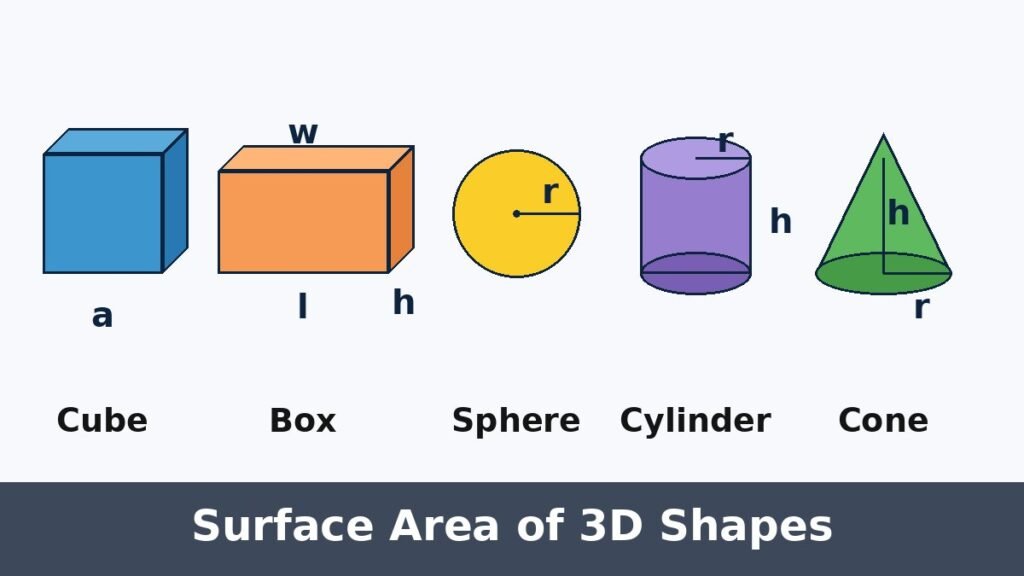
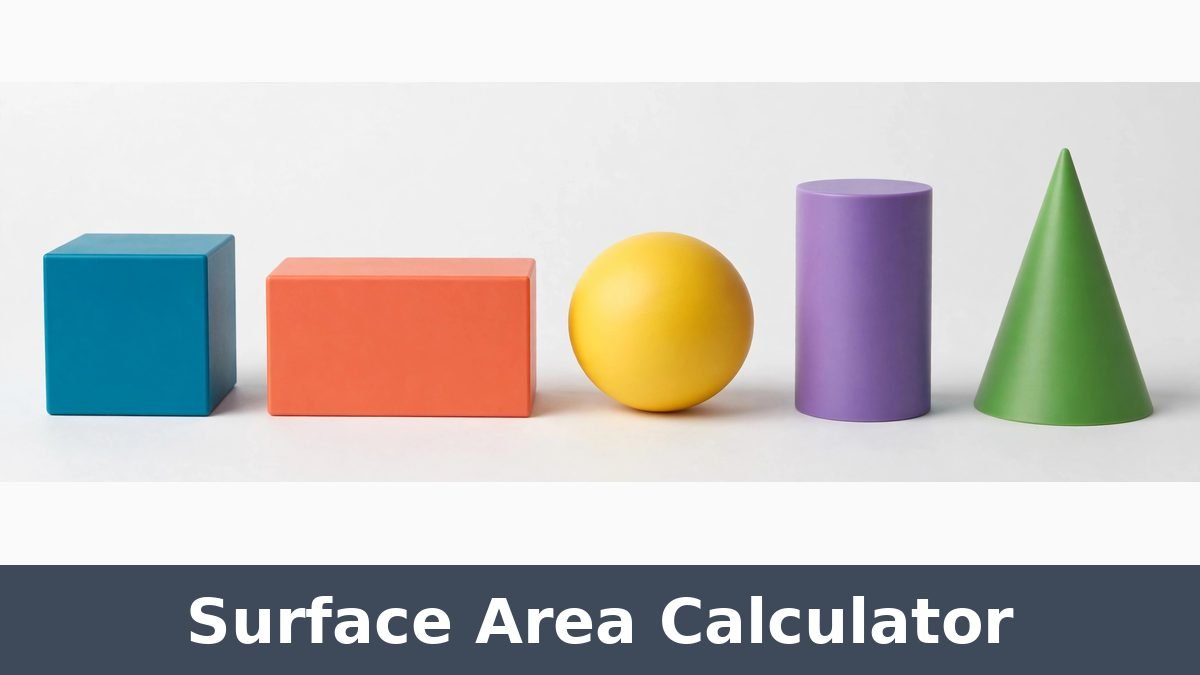
Every formula below builds the total from the shape’s parts. A cube has six identical square faces, so its area is six times one face. A box has three pairs of matching rectangles. Round shapes involve pi (π, about 3.14159), and the cone and pyramid need a slant height — the slope length up the side — which the calculator finds from the height using Pythagoras’ theorem. If the square roots in those formulas look heavy, our square root calculator shows how root values are worked out.
| Shape | Measurements needed | Formula |
|---|---|---|
| Cube | Side a | SA = 6a² |
| Rectangular prism (box) | Length l, width w, height h | SA = 2(lw + lh + wh) |
| Sphere | Radius r | SA = 4πr² |
| Cylinder | Radius r, height h | SA = 2πr² + 2πrh |
| Cone | Radius r, height h | SA = πr² + πr√(r² + h²) |
| Square pyramid | Base edge a, height h | SA = a² + 2a√((a/2)² + h²) |
The sphere is the elegant one: its surface is exactly four times the area of its centre circle, a result Wolfram MathWorld’s sphere page traces back to Archimedes. The cylinder splits neatly into two circle ends plus the curved wall, which unrolls into a rectangle whose width is the circumference — MathWorld’s cylinder page shows the same split. Flat-faced shapes lean on rectangle and triangle areas, and if you ever need one triangular face on its own, our area of a triangle calculator handles it directly.
Worked Examples
The six examples below are the same six the surface area calculator was tested with, one per shape, so you can type each into the tool and check your answer. Watch the cone and pyramid: both hide a 3-4-5 right triangle inside them, which makes their slant heights come out as the neat number 5.
| Shape | Measurements | Working | Surface area |
|---|---|---|---|
| Cube | a = 5 | 6 × 5 × 5 | 150.00 |
| Box | l = 4, w = 3, h = 2 | 2 × (12 + 8 + 6) | 52.00 |
| Sphere | r = 3 | 4π × 3 × 3 = 36π | 113.10 |
| Cylinder | r = 2, h = 5 | 2π × 4 + 2π × 2 × 5 = 28π | 87.96 |
| Cone | r = 3, h = 4, slant = 5 | π × 9 + π × 3 × 5 = 24π | 75.40 |
| Square pyramid | a = 6, h = 4, slant = 5 | 36 + 2 × 6 × 5 | 96.00 |
Take the box slowly, because it teaches the pattern. Its faces are a 4 × 3 base and lid (12 each), 4 × 2 front and back (8 each) and 3 × 2 ends (6 each). Adding one of each and doubling gives 2 × (12 + 8 + 6) = 52. For the cone, the slant height comes first: √(3² + 4²) = √25 = 5. The base is π × 3² = 28.27 and the curved side is π × 3 × 5 = 47.12, adding to 75.40. The pyramid works the same way: slant height √((6/2)² + 4²) = 5, so its triangular faces total 2 × 6 × 5 = 60, plus the 36 of the base, giving 96.00.
Where Surface Area Shows Up in Real Life
Packaging is the everyday home of this maths. A box maker choosing cardboard and a gift wrapper with one sheet left are both solving surface area problems, whether they call them that or not. Paint comes next: coverage is printed on the tin in square metres per litre precisely because walls, tanks and fences are painted by area, not by volume.
Building work runs on the same sums at a larger scale. Estimating tiles, cladding or insulation panels starts from the area of a structure’s outer surfaces, and roofers do a version of it whenever they measure a roof — our roof square footage calculator turns roof dimensions into that area directly. Surface area also explains some science: crushed ice cools a drink faster than one big cube because crushing hugely increases the surface touching the liquid, and radiators are folded and finned to maximise the surface that can shed heat.
Common Mistakes to Avoid
The classic error is using the diameter where the formula wants the radius. Because the radius is squared in the sphere and cylinder formulas, doubling it by accident makes the answer four times too big, not two. Second is forgetting a face: a closed cylinder has two ends, a box has six faces, and a pyramid’s base still counts even though it sits on the ground — unless the question clearly describes an open container. Third is mixing units: convert everything to one unit before you start, and remember that converting square centimetres to square metres means dividing by 10,000, not 100.
Rounding pi too early causes quieter errors. Keep π as a symbol, or use the full value your calculator stores, until the final step — the worked examples above keep answers like 36π exact until the last line for this reason. Finally, cones and pyramids trip people up with height: the formulas need the vertical height, then derive the slant height from it. If a question hands you the slant height directly, use it as the slant straight away. A surface area calculator sidesteps most of these traps, but the unit and radius checks are still yours to make.
FAQs
What is the difference between surface area and volume?
Surface area is the total area of a shape’s outer skin, measured in square units like cm². Volume is the space the shape holds inside, measured in cubic units like cm³. A shape can gain surface area without gaining volume — flattening a ball of clay into a pancake does exactly that — so the two numbers answer different questions.
How do you find the surface area of a cube?
Multiply the side length by itself to get one face, then multiply by six for the six identical faces: SA = 6a². A cube with sides of 5 has faces of 25, so its surface area is 6 × 25 = 150 square units. It is the quickest of all the formulas, and a good first check whenever you use a surface area calculator on any other shape.
Why do the cone and pyramid formulas contain a square root?
Because both need the slant height — the distance up the sloping side — while questions usually give the vertical height instead. The slant height is the hypotenuse of a right triangle, so Pythagoras’ theorem finds it with a square root: √(r² + h²) for a cone, √((a/2)² + h²) for a pyramid. The calculator performs that step for you.
What if I only know the diameter of a sphere or cylinder?
Halve it. The radius is half the diameter, and every round-shape formula is written in terms of the radius. A ball with a diameter of 10 has a radius of 5, so its surface area is 4π × 25 = 314.16 square units. Entering the diameter as if it were the radius would give an answer four times too large.
Does the calculator include the base of the shape?
Yes. It works out the total surface area, which counts every face including the base and, for a cylinder, both circular ends. If you are costing an open-top box or a tank with no lid, work out the total first and then subtract the area of the missing face — one rectangle for the box, or πr² for the cylinder’s lid.
How do I convert a surface area between square units?
Work out how many small units fit along one edge, then square it. One metre is 100 centimetres, so one square metre is 100 × 100 = 10,000 square centimetres. To turn 52,000 cm² into square metres, divide by 10,000 to get 5.2 m².
For more updates visit: CALCIQ