


A compound interest calculator helps you estimate how your money could grow when interest earns further interest. This can make a major difference when you save or invest over a long period.
The calculation depends on several factors. These include your starting amount, interest rate, compounding frequency, and investment period. Regular contributions can also increase the final value.
Understanding compound growth can help you make better financial decisions. It also shows why starting early can matter when building long-term savings.
What Is Compound Interest?
Compound interest means you earn interest on your original money and on interest already added to the balance.
For example, imagine you save £1,000 at an annual interest rate of 5%. After one year, the balance becomes £1,050. If the interest compounds annually, the next year’s interest applies to £1,050 rather than the original £1,000.
Over time, this creates a compounding effect. Your balance can grow faster because each period builds on the previous one.
The effect becomes stronger over longer periods. It can also change depending on how often the interest compounds.
How Does a Compound Interest Calculator Work?
A compound interest calculator uses your starting balance, interest rate, compounding frequency, and time period. It then applies the compound interest formula to estimate the future value.
The standard formula is:
A = P(1 + r/n)^(nt)
Here, A represents the final amount. P represents the starting principal. The letter r represents the annual interest rate as a decimal.
The letter n shows how many times interest compounds each year. Finally, t represents the number of years.
For example, suppose you invest £2,000 at 5% annual interest for 10 years. If interest compounds annually, the calculation becomes:
£2,000 × (1 + 0.05/1)^(1 × 10)
The estimated balance would be about £3,258. The actual return on a savings account or investment can differ because rates, fees, taxes, and other factors may change.
Why Does Compounding Frequency Matter?
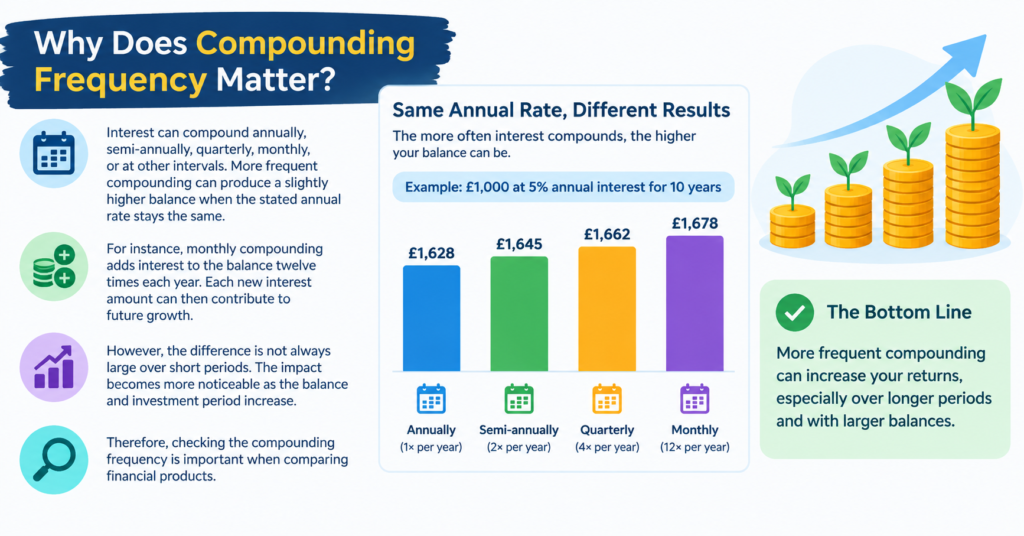
Interest can compound annually, semi-annually, quarterly, monthly, or at other intervals. More frequent compounding can produce a slightly higher balance when the stated annual rate stays the same.
For instance, monthly compounding adds interest to the balance twelve times each year. Each new interest amount can then contribute to future growth.
However, the difference is not always large over short periods. The impact becomes more noticeable as the balance and investment period increase.
Therefore, checking the compounding frequency is important when comparing financial products.
Monthly Compound Interest Calculator
A monthly compound interest calculator is useful when interest compounds every month. It can help you estimate savings growth based on monthly compounding.
For monthly compounding, the formula uses 12 as the number of compounding periods per year.
The calculation becomes:
A = P(1 + r/12)^(12t)
Suppose you deposit £5,000 and earn 4% annual interest for five years. With monthly compounding, the estimated future value is around £6,105 before any taxes, fees, or changes in the interest rate.
This example shows how regular compounding affects growth. It does not mean every savings account will produce the same result.
What Factors Affect Compound Interest?
Several factors can change the final result. The starting balance has an obvious effect because a larger principal gives interest more money to work with.
The interest rate also matters. A higher rate generally creates greater growth when other factors remain unchanged.
Time is another important factor. Compound growth can accelerate over longer periods because previously earned interest remains in the account.
Compounding frequency can also affect the result. Monthly compounding may produce a different outcome from annual compounding.
Regular deposits can make an even bigger difference. Adding money consistently increases the amount available to earn future interest.
Compound Interest With Regular Contributions
Some calculators allow you to include regular deposits. This can make the estimate more useful for long-term saving.
For example, someone might start with £1,000 and add £100 every month. Each contribution increases the balance and may earn interest during the remaining period.
The final amount therefore depends on more than the original deposit. It also reflects the timing and size of additional contributions.
A calculator with a regular contribution option can help you explore different saving strategies.
Compound Interest vs Simple Interest
Compound interest and simple interest work differently.
Simple interest calculates interest on the original principal. Compound interest also considers interest that has already accumulated.
As a result, compound interest can create stronger growth over long periods. The difference becomes larger when you leave the money invested for many years.
For short periods, the difference may seem small. Over decades, however, the effect can become much more significant.
Can You Use an Investor.gov Compound Interest Calculator?
An Investor.gov compound interest calculator is another tool people may use to explore long-term growth. Investor.gov provides financial education resources and calculators for investors.
However, different calculators can use different settings. Before comparing results, check the interest rate, compounding frequency, contribution amount, and time period.
For UK users, it is also important to consider the type of financial product being assessed. Savings accounts, investments, and pensions can have different tax rules and charges.
A calculator provides an estimate rather than a guaranteed financial outcome.
How to Use Compound Interest for Saving
Compound growth works best when you give your money enough time. Starting earlier can allow interest to build on previous interest for longer.
Regular saving can also support long-term growth. Even modest contributions may become meaningful when they continue for many years.
At the same time, you should consider inflation. A growing account balance does not always mean your purchasing power grows at the same rate.
Interest rates can also change. Therefore, calculator results should be treated as projections rather than promises.
Common Mistakes When Calculating Compound Interest
One common mistake is entering the interest rate as a whole number instead of a decimal. For example, 5% should be entered as 0.05 in the formula.
Another mistake involves choosing the wrong compounding frequency. Monthly compounding requires 12 periods per year, while annual compounding uses one.
People can also overlook regular contributions. Adding money can substantially change the final balance.
Finally, remember that real financial products may include fees, taxes, changing rates, or other conditions. A basic calculation may not account for these factors.
Conclusion
A compound interest calculator makes it easier to understand how money can grow over time. It considers the starting balance, interest rate, compounding frequency, and investment period.
A monthly compound interest calculator can provide a more specific estimate when interest compounds each month. Adding regular contributions can also make the projection more realistic for saving plans.
Compound interest is most powerful when you combine time, consistent saving, and a suitable return. Still, calculator results remain estimates. Always consider the actual terms of the account or investment before making financial decisions.
FAQs
What is a compound interest calculator?
A compound interest calculator estimates how money may grow when interest is added to the balance and future interest applies to the increased amount.
How is compound interest calculated?
The standard formula is A = P(1 + r/n)^(nt). It uses the principal, annual interest rate, compounding frequency, and investment period.
What is a monthly compound interest calculator?
It is a calculator designed to estimate growth when interest compounds every month. The formula uses 12 compounding periods per year.
Is monthly compounding better than annual compounding?
When the stated annual rate is the same, more frequent compounding can produce a slightly higher final balance. The difference depends on the rate and time period.
Can compound interest grow my savings?
Yes. Interest can earn further interest when it remains in the account. The effect becomes more noticeable over longer periods.
Does compound interest include monthly deposits?
Some calculators include regular contributions. If yours does, the final estimate can account for additional money added during the saving period.
For more updates visit: CALCIQ