
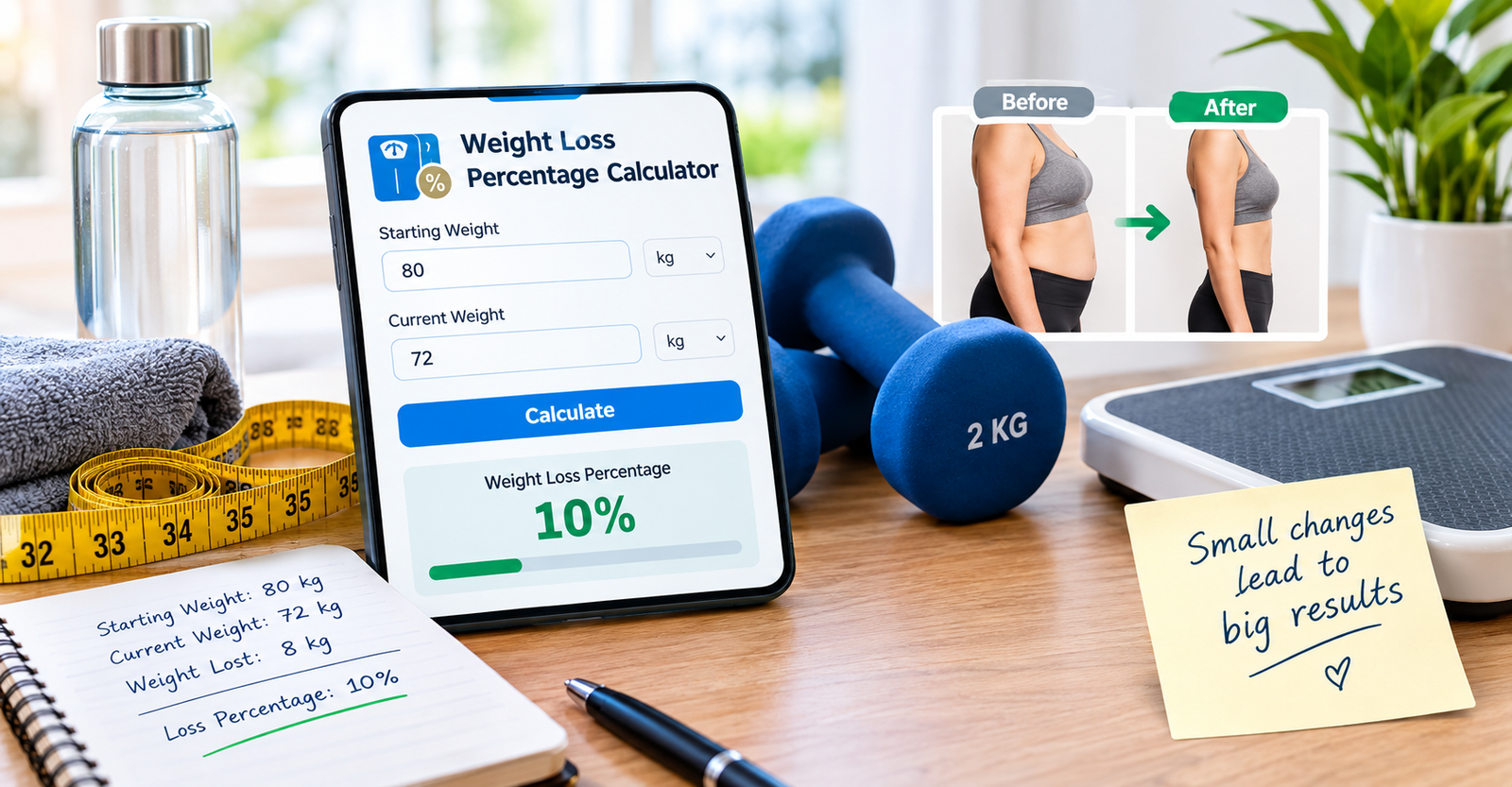
Losing weight is often measured by the number on the scales. However, the number of kilograms lost does not always show the full picture. A percentage can make your progress easier to understand, especially when comparing changes over time.
A weight loss percentage calculator helps you work this out quickly. You only need your starting weight and current weight. The calculator then shows what percentage of your original body weight you have lost.
This guide explains how the calculation works, how to use the result, and why percentage weight loss can be more useful than looking at kilograms alone.
What Is a Weight Loss Percentage Calculator?
A weight loss percentage calculator measures the amount of weight you have lost as a percentage of your starting weight. It gives you a simple way to understand how much your body weight has changed.
For example, imagine you started at 90 kg and now weigh 81 kg. You have lost 9 kg. Your percentage weight loss is 10%.
This approach puts weight change into context. Losing 5 kg means something different for a person who started at 100 kg than for someone who started at 60 kg.
A percentage therefore gives you another way to track progress alongside your actual weight.
How Does the Calculator Work?
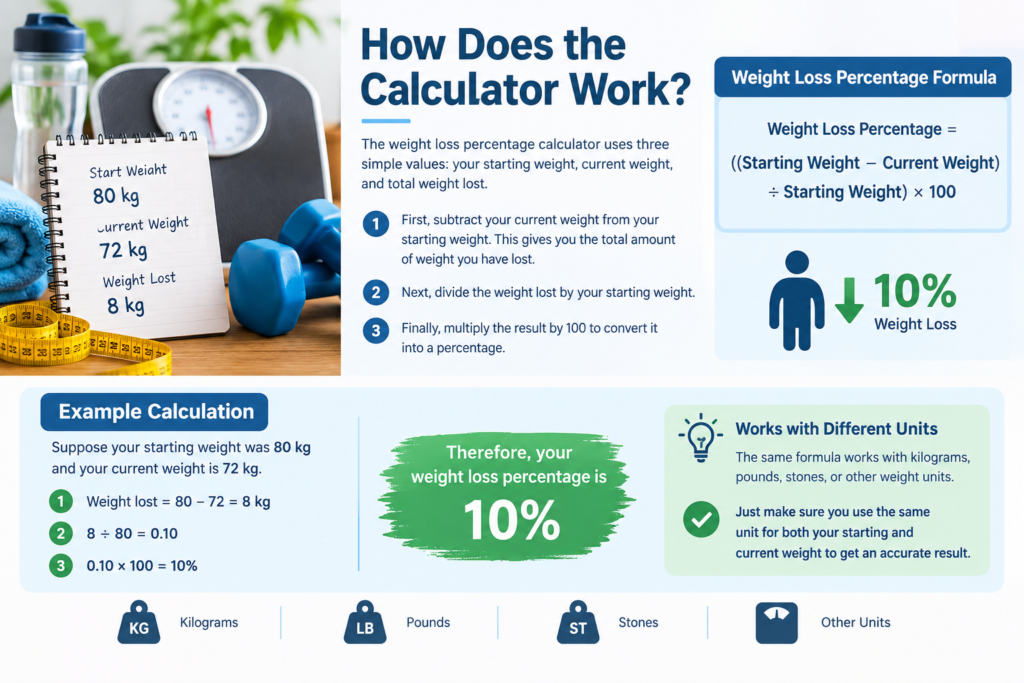
The calculation uses three basic values. You need your starting weight, your current weight, and the amount of weight you have lost.
First, subtract your current weight from your starting weight. This gives you the total weight loss.
Next, divide the weight lost by your starting weight. Finally, multiply the result by 100 to convert it into a percentage.
The formula is:
Weight Loss Percentage = ((Starting Weight − Current Weight) ÷ Starting Weight) × 100
For example, suppose your starting weight was 80 kg and your current weight is 72 kg.
You have lost 8 kg. Divide 8 by 80, which gives 0.10. Multiply that by 100, and your weight loss percentage is 10%.
The same formula works with pounds, stones, or other weight units, provided you use the same unit for both weights.
How to Use a Weight Loss Percentage Calculator
Using a weight loss percentage calculator is straightforward. Enter the weight you had when you started your weight-loss journey. Then enter your current weight.
The calculator compares these two figures and calculates the difference. It then expresses that difference as a percentage of your original weight.
For the most accurate result, use measurements taken under similar conditions. Your weight can change during the day because of food, fluids, clothing, and other normal factors.
Therefore, one measurement should not define your progress. Looking at the wider trend can give you a more useful picture.
Body Weight Loss Percentage Calculator Example
A body weight loss percentage calculator can be useful when you want to understand your progress relative to your starting size.
Consider someone who started at 100 kg and now weighs 85 kg. The person has lost 15 kg.
Using the formula, divide 15 by 100 and multiply by 100. The result is 15%.
Now consider someone who started at 75 kg and lost 7.5 kg. That person has also lost 10% of their starting weight.
This shows why percentages can provide helpful context. Two people can lose the same number of kilograms but have different percentage changes.
Why Calculate Weight Loss as a Percentage?
Tracking percentage weight loss can make progress easier to compare. It can also help you focus on change rather than a single scale reading.
For instance, losing 10 kg may sound impressive, but the percentage gives additional context. Someone starting at a higher weight may need to lose more kilograms to achieve the same percentage change.
Percentage tracking can also be useful when monitoring long-term progress. Instead of focusing only on today’s weight, you can compare your current measurement with your starting point.
However, weight is only one measure of health and fitness. Changes in body composition, strength, fitness, waist measurements, and overall wellbeing can also matter.
Weight Loss Percentage in Kilograms, Pounds and Stones
You can calculate percentage weight loss using kilograms, pounds, or stones. The important rule is to keep the same unit for both measurements.
For example, if your starting weight is 14 stone and your current weight is 12 stone 7 pounds, you should convert the measurements into the same unit before calculating the percentage.
The same principle applies to pounds and kilograms. Do not mix kilograms with pounds in the formula unless you first convert one measurement.
A consistent unit prevents incorrect results and makes your progress easier to track.
What Does Your Weight Loss Percentage Mean?
The percentage tells you how much of your starting body weight has been lost. It does not, on its own, tell you whether your weight is healthy or whether you should continue losing weight.
Your appropriate weight goals can depend on several factors. These include your height, age, body composition, medical history, lifestyle, and individual circumstances.
For that reason, treat the calculator as a measurement tool rather than a medical assessment.
If you have concerns about your weight or want to make a major change to your diet or exercise routine, speaking with a qualified healthcare professional can help you choose an appropriate approach.
Common Mistakes When Calculating Weight Loss
One common mistake is using the wrong starting weight. Your starting figure should represent the weight you are using as the beginning of the period you want to measure.
Another mistake is mixing measurement units. Using kilograms for one value and pounds for another will produce an incorrect percentage.
Daily fluctuations can also cause confusion. Your weight may rise or fall even when your longer-term trend is moving in the desired direction.
For a clearer picture, compare measurements over a consistent period rather than reacting to every small change.
Weight Loss Percentage vs Weight Lost
These two measurements are related but provide different information.
Weight lost tells you the absolute amount of weight you have reduced. For example, you may have lost 8 kg.
Weight loss percentage shows that reduction in relation to your starting weight. If you started at 80 kg, losing 8 kg represents 10%.
Using both figures can give you a better understanding of your progress. The kilogram figure shows the actual change, while the percentage provides context.
How Often Should You Track Your Progress?
There is no single schedule that works for everyone. Some people prefer regular weigh-ins, while others find less frequent measurements easier to manage.
The important part is consistency. Try to measure yourself under similar conditions so that changes are easier to interpret.
You can also record your results over time. A longer-term trend is usually more informative than one isolated measurement.
Remember that normal fluctuations are expected. A small change from one day to another does not necessarily represent a real change in body fat.
Conclusion
A weight loss percentage calculator offers a simple way to understand changes in body weight. By comparing your starting weight with your current weight, you can see how much of your original weight you have lost.
The calculation is easy: subtract your current weight from your starting weight, divide the result by your starting weight, and multiply by 100.
Whether you use kilograms, pounds, or stones, always keep your measurements in the same unit. Most importantly, use percentage weight loss as one progress measure rather than the only measure of health.
When viewed alongside other factors, your weight trend can give you a clearer and more balanced picture of your progress.
FAQs
How do I calculate my weight loss percentage?
Subtract your current weight from your starting weight. Divide the amount lost by your starting weight and multiply the result by 100. The final number is your percentage weight loss.
What is the formula for percentage weight loss?
The formula is ((Starting Weight − Current Weight) ÷ Starting Weight) × 100. You can use this formula with kilograms, pounds, or stones as long as both weights use the same unit.
Can I use pounds in a weight loss percentage calculator?
Yes. A weight loss percentage calculator can use pounds. Enter your starting and current weights in pounds, and the percentage will be calculated from those values.
Can I calculate weight loss using kilograms?
Yes. Kilograms work in exactly the same way. Enter both your starting weight and current weight in kilograms before applying the formula.
What is a body weight loss percentage calculator used for?
A body weight loss percentage calculator shows how much of your original body weight you have lost. It provides more context than simply looking at the number of kilograms or pounds lost.
Does daily weight change affect the percentage?
Yes. Body weight naturally changes because of factors such as fluid levels, food intake, and other daily variations. For this reason, one measurement may not represent your longer-term progress.
For more updates visit: CALCIQ