A Roth conversion calculator helps you estimate the tax impact of moving money from a traditional IRA to a Roth IRA. This strategy can affect how much tax you pay today and how you manage your retirement savings in the future.
A traditional IRA generally offers tax advantages when you contribute, while a Roth IRA can provide tax-free qualified withdrawals in retirement. However, converting pre-tax retirement funds into a Roth IRA usually creates taxable income in the year of conversion.
Before making a decision, it is important to understand the potential tax bill, your current income, and your expected retirement tax position. A Roth conversion calculator can help you compare these factors and explore whether a conversion may suit your long-term financial plans.
What Is a Roth Conversion Calculator?
A Roth conversion calculator is a retirement planning tool that estimates the potential tax cost of converting money from a traditional Individual Retirement Account (IRA) into a Roth IRA. It can help you understand how a conversion may affect your current taxes and future retirement income.
The calculator typically uses your conversion amount, taxable income, filing status, and estimated tax rate. Some calculators also consider future investment growth, retirement age, and expected withdrawal periods.
For example, suppose you convert £10,000 worth of retirement savings held in a US traditional IRA. If the entire amount is taxable, the conversion generally adds £10,000 to your taxable income for illustration purposes. However, Roth IRAs are US retirement accounts, and actual conversions and taxes are governed by US tax rules and US dollars.
The amount of tax you owe depends on your individual circumstances. Your existing income, other deductions, account basis, and applicable tax rules can all affect the result.
How Does a Roth Conversion Calculator Work?
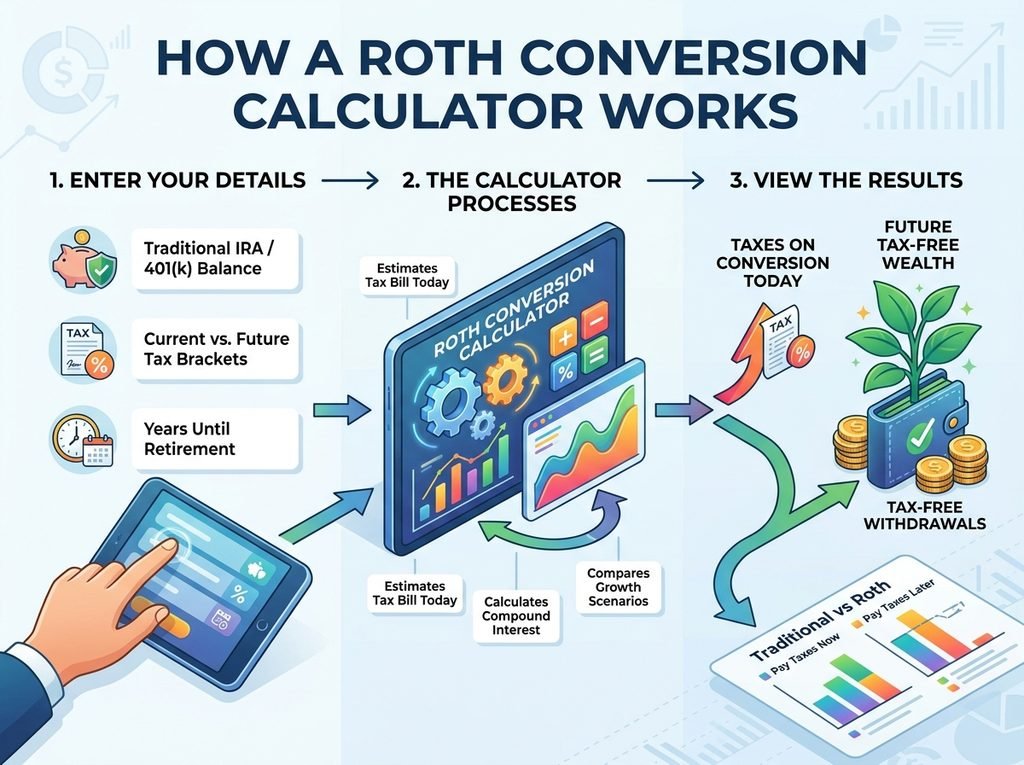
A Roth conversion calculator estimates the additional income tax that may arise when you convert eligible traditional IRA funds into a Roth IRA. It compares your estimated tax position before and after the conversion.
You usually enter the amount you want to convert, your annual taxable income, and your tax filing status. The calculator then estimates how the additional taxable income could affect your tax bill.
Some tools also estimate the potential long-term benefits of holding investments in a Roth IRA. These projections may assume a particular investment return, number of years until retirement, or future tax rate.
Keep in mind that the result is an estimate rather than a guaranteed tax bill. A calculator cannot always account for every deduction, credit, state tax, or special rule that applies to your situation.
Roth Conversion Tax Formula
The basic approach to estimating conversion tax is to calculate the additional tax caused by the conversion.
Estimated additional conversion tax = Tax after conversion − Tax before conversion
For a simplified example, imagine your estimated federal income tax is $12,000 before a conversion and $15,000 after converting traditional IRA funds.
The estimated additional federal tax would be:
$15,000 − $12,000 = $3,000
In this example, the conversion adds an estimated $3,000 to your federal income tax. It does not necessarily mean you will owe exactly $3,000 when you file your return, because your final liability depends on your complete tax circumstances.
A quick calculation using a single tax rate can provide a rough estimate. For instance, a $10,000 taxable conversion at an assumed 22% marginal rate would produce an estimated $2,200 in additional tax if the entire conversion were taxed at that rate.
However, the US federal income tax system uses progressive tax brackets. A conversion may fall across more than one bracket, so applying one rate to the entire amount can give a misleading result.
What Information Do You Need for a Roth Conversion Calculator?
The accuracy of a Roth conversion estimate depends on the information you enter. Before using a calculator, gather details about your retirement account and current tax position.
Conversion Amount
The conversion amount is the money you plan to move from your traditional IRA into your Roth IRA. You might consider converting a small portion of your account or a larger amount.
A larger conversion can create more taxable income in the current year. Therefore, comparing several conversion amounts can help you understand how the tax cost changes.
Current Taxable Income
Your current taxable income helps determine which federal income tax brackets may apply. Include your expected income from employment, self-employment, investments, and other taxable sources as appropriate.
Your income before conversion matters because the conversion is generally added to your other taxable income. This may push part of your income into a higher tax bracket.
Filing Status
US tax filing status affects your standard deduction and income tax brackets. Common statuses include single, married filing jointly, married filing separately, and head of household.
Select the status that applies to your circumstances. Choosing the wrong option can produce an inaccurate estimate.
State and Local Taxes
Some US states tax retirement account conversions, while others have different rules or no individual income tax. A calculator that estimates federal tax alone may not show the full cost.
Check whether the tool includes state taxes. If it does not, you may need a separate estimate for your state.
Traditional IRA vs Roth IRA Conversion
A traditional IRA and a Roth IRA have different tax treatments. Understanding these differences can help you decide whether a conversion deserves further consideration.
With a traditional IRA, eligible contributions may receive an upfront tax deduction, depending on your circumstances. Investment growth generally accumulates without annual income tax, while withdrawals are usually taxable to the extent they represent pre-tax funds.
A Roth IRA generally uses after-tax contributions. Qualified withdrawals, including eligible investment earnings, can be tax-free under US rules.
A Roth conversion moves eligible assets from a traditional IRA into a Roth IRA. You usually pay income tax on the taxable portion of the converted amount in the year of conversion. In return, the funds may benefit from Roth IRA tax treatment in the future.
A conversion does not automatically save money. Its value depends on factors such as your current tax rate, future tax rate, investment horizon, and ability to pay the conversion tax.
When Does a Roth Conversion Make Sense?
A Roth conversion may be worth considering when you expect your future tax rate to be similar to or higher than your current rate. Paying tax now could be beneficial if qualified Roth withdrawals later avoid a higher rate.
It may also suit people who have several years before retirement. A longer investment period can give converted assets more time to grow, although investment returns are never guaranteed.
Another factor is how you will pay the conversion tax. Paying it from funds outside your retirement account may allow more money to remain invested in the Roth IRA. Using retirement funds to cover the tax can reduce the amount that continues growing in the account and may create additional tax consequences.
Some people also consider conversions during years when their income is unusually low. A temporary drop in income may leave room for a conversion without pushing all the converted funds into higher tax brackets.
However, there is no universal best time to convert. Review your full financial position before making a decision.
Benefits of Using a Roth Conversion Calculator
A Roth conversion calculator helps you compare possible outcomes before moving retirement funds. It can make a complex decision easier to evaluate.
One major benefit is understanding the immediate tax cost. Instead of guessing, you can estimate how different conversion amounts might affect your tax bill.
The calculator can also help you compare multiple scenarios. For example, you could evaluate converting $5,000, $15,000, or $25,000 and compare the estimated additional tax for each amount.
Long-term projections may help you consider future tax-free qualified withdrawals and investment growth. Still, these projections rely on assumptions about returns, future tax rates, and your retirement timeline.
Most importantly, the calculator gives you a starting point for informed planning. It should support your decision rather than replace personalised tax advice.
Common Mistakes to Avoid When Calculating Roth Conversion Tax
One common mistake is assuming the entire conversion will always be taxable. If you have after-tax basis in your traditional IRA, special tax rules may affect how much of the conversion is taxable. The pro-rata rule can apply when you hold certain pre-tax and after-tax IRA funds.
Another mistake is ignoring the effect on other taxes and benefits. Higher adjusted gross income may affect Medicare income-related monthly adjustment amounts, taxation of Social Security benefits, or eligibility for certain deductions and credits.
You should also avoid assuming that your current marginal tax rate applies to every dollar converted. Because federal income tax brackets are progressive, the conversion may span several rates.
Finally, do not treat a calculator’s future projections as guarantees. Investment performance, tax legislation, inflation, and personal circumstances can change over time.
Roth Conversion Rules to Understand
Roth conversions are subject to US tax rules. A taxable conversion generally counts as income for the tax year in which it occurs, even though you may not receive the money as ordinary spending cash.
The rules for withdrawing converted funds differ from the rules for withdrawing regular Roth IRA contributions. Depending on your age, the timing of the conversion, and other circumstances, withdrawing converted amounts early may trigger additional tax consequences.
Required minimum distribution rules can also affect planning. You generally cannot convert a required minimum distribution itself into a Roth IRA. If you are subject to these rules, check the applicable requirements before planning a conversion.
US tax rules can change, and individual circumstances matter. Consider speaking with a qualified US tax professional or financial adviser before converting a significant amount.
Is a Roth Conversion Calculator Relevant in the UK?
A Roth conversion calculator is primarily designed for US retirement accounts and US tax rules. A Roth IRA is a US retirement savings arrangement, not a standard UK pension account.
UK residents who hold US retirement accounts may face cross-border tax questions. The treatment can depend on residency, account type, the relevant tax treaty, and the circumstances of the conversion.
A US calculator may not reflect UK income tax, pension rules, or international tax considerations. Therefore, UK residents should not rely on a standard calculator alone when making a cross-border retirement decision.
If you live in the UK and hold a US IRA, seek advice from a professional who understands both US and UK tax rules. This can help you assess the potential consequences before moving funds.
Conclusion
A Roth conversion calculator helps estimate the additional tax that may arise when you move eligible funds from a traditional IRA into a Roth IRA. It can also help you compare conversion amounts and explore possible long-term retirement benefits.
However, the best decision depends on your current income, future tax expectations, account details, and financial goals. Remember that a conversion can increase your taxable income and affect other tax calculations.
Use the calculator to compare scenarios, check the assumptions, and estimate the potential cost. Before completing a conversion, consider professional tax advice, especially if you live in the UK or have cross-border financial arrangements.
FAQs
What Is a Roth Conversion Calculator?
A Roth conversion calculator estimates the potential tax impact of transferring money from a traditional IRA into a Roth IRA. It uses details such as your conversion amount, taxable income, and filing status to estimate the additional tax.
How Much Tax Will I Pay on a Roth Conversion?
The tax depends on the taxable portion of your conversion and your overall income. The converted amount generally counts as ordinary income to the extent it represents taxable funds. Your federal and state tax circumstances determine the final amount.
Is a Roth Conversion Always Taxable?
No. The taxable amount depends on the funds being converted and your IRA tax basis. Pre-tax funds are generally taxable when converted, while after-tax basis may affect the calculation. Special rules, including the pro-rata rule, can apply.
Can I Convert My Entire Traditional IRA to a Roth IRA?
You can generally convert eligible traditional IRA funds, but converting the entire account may create a substantial tax bill. Use a Roth conversion calculator to compare the estimated cost of a full conversion with smaller conversions.
Does a Roth Conversion Increase My Taxable Income?
Yes, the taxable portion of a Roth conversion generally increases your income for the year. This may affect your marginal tax rate and other income-related tax calculations, depending on your circumstances.
When Is the Best Time to Convert to a Roth IRA?
The best time depends on your income, expected future tax rate, retirement timeline, and available cash to pay the tax. Some people consider conversions during lower-income years, but personalised analysis is important.
For more updates visit: CALCIQ