

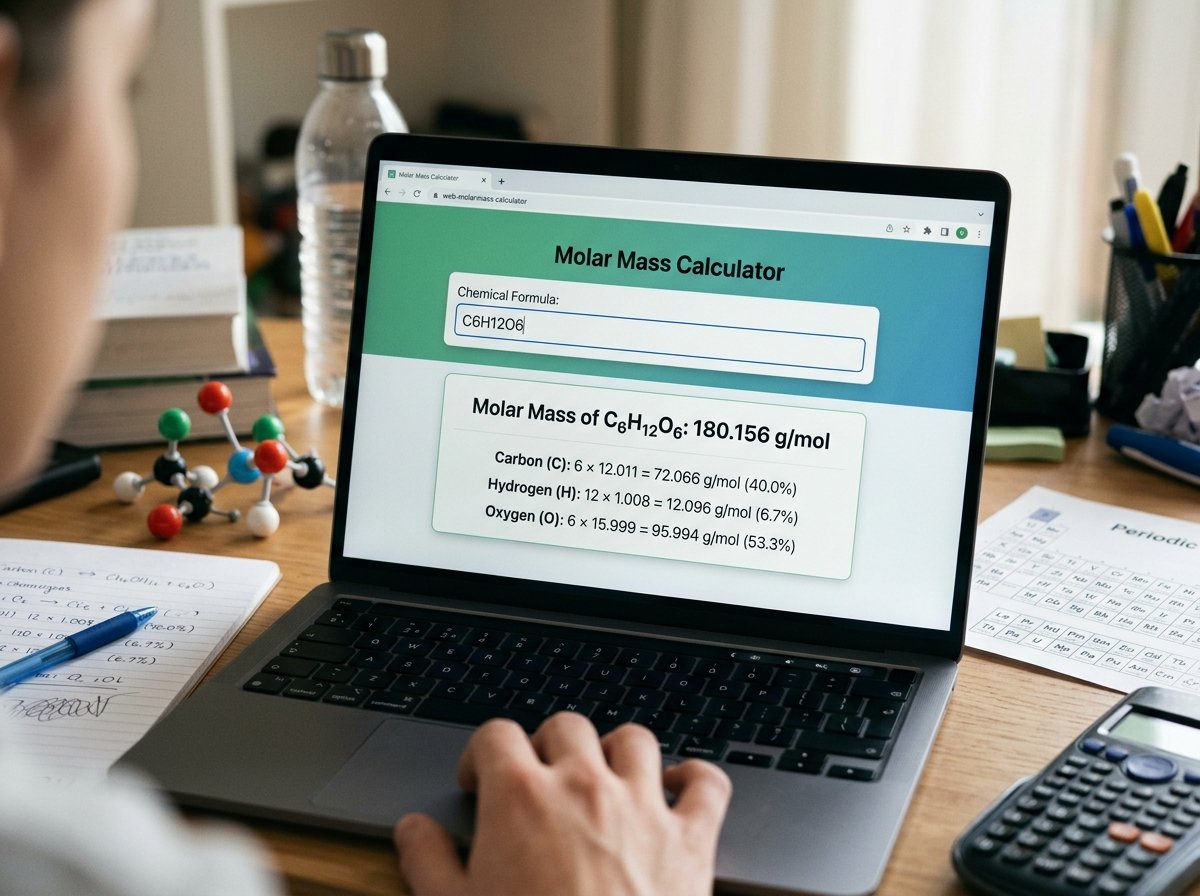
A molar mass calculator helps you determine the molar mass of a chemical element or compound using its chemical formula. Enter a formula such as H₂O, CO₂, or NaCl, and the calculator can help you find the mass of one mole of that substance in grams per mole (g/mol). This makes chemistry calculations easier, especially when working with chemical equations, laboratory measurements, and mole conversions. Understanding molar mass also helps you calculate how much of a substance you need for a particular reaction. Whether you are studying chemistry at school, preparing for an exam, or completing a laboratory task, learning how molar mass works can make these calculations more accurate and straightforward.
What Is a Molar Mass Calculator?
A molar mass calculator is a chemistry tool that calculates the molar mass of a substance from its chemical formula. It uses the atomic masses of the elements in that formula and adds their contributions together. The result tells you the mass of one mole of the substance.
For example, water has the chemical formula H₂O. Each water molecule contains two hydrogen atoms and one oxygen atom. Adding the atomic masses of these atoms gives water a molar mass of approximately 18.02 g/mol.
You can use a molar mass calculator for individual elements, simple compounds, and more complex chemical substances. Depending on the tool, it may also recognise brackets, subscripts, and repeated groups of atoms.
This calculation is important because chemists often measure substances by mass but use moles to describe the amounts involved in chemical reactions.
What Is Molar Mass?

Molar mass is the mass of one mole of a substance. Scientists express it in grams per mole, written as g/mol. A mole represents a fixed number of particles: approximately 6.022 × 10²³ entities.
These particles might be atoms, molecules, ions, or other specified entities. For example, one mole of carbon atoms contains approximately 6.022 × 10²³ carbon atoms. One mole of water contains the same number of water molecules.
Molar mass connects the microscopic world of atoms and molecules with measurable quantities in the laboratory. You cannot normally count individual atoms when preparing a chemical sample. However, you can weigh a sample and use its molar mass to calculate the amount of substance it contains.
It is also useful to understand the difference between atomic mass, molecular mass, and molar mass. Atomic mass describes the mass of an atom, while molecular mass describes the mass of a molecule. Molar mass expresses the mass of one mole of a substance. Their numerical values are often similar when atomic or molecular masses are expressed in unified atomic mass units and molar mass is expressed in g/mol.
How to Use a Molar Mass Calculator
Using a molar mass calculator is straightforward when you know the correct chemical formula. Start by identifying the substance you want to calculate. Then enter its chemical formula into the calculator.
For example, if you want to calculate the molar mass of carbon dioxide, enter CO₂. The subscript 2 indicates that each molecule contains two oxygen atoms. The calculator should count one carbon atom and two oxygen atoms before adding their atomic masses.
Check that the formula is correct before accepting the result. Chemical formulas are case-sensitive in the sense that uppercase and lowercase letters identify different symbols or combinations. For instance, Co represents cobalt, whereas CO represents carbon monoxide.
Once the calculator displays the result, check the unit. Molar mass is generally reported in g/mol. You can then use that value to convert between mass and moles or to support other chemistry calculations.
For complicated compounds, confirm that the calculator handles parentheses and nested groups correctly. These features are essential when a formula contains several atoms within a repeated group.
Molar Mass Formula Explained
The molar mass formula is based on the atomic masses of all the elements in a chemical formula.
Molar mass = Sum of the atomic masses of all atoms in the chemical formula
To apply this formula, identify every element in the compound, count how many atoms of each element appear, and multiply each atomic mass by its atom count. Add the results to obtain the molar mass.
Consider water, H₂O. Hydrogen has an average atomic mass of approximately 1.008, while oxygen has an average atomic mass of approximately 16.00. Water contains two hydrogen atoms and one oxygen atom.
Therefore, its molar mass is approximately (2 × 1.008) + 16.00, which equals 18.02 g/mol.
The same method works for more complex compounds. You simply need to count all atoms accurately, including those represented by parentheses and subscripts.
Atomic masses can vary slightly between periodic tables because of rounding and the isotopic composition used. As a result, small differences between calculator results do not necessarily indicate an error.
Molar Mass Examples for Common Compounds
Molar Mass of Water (H₂O)
Water contains two hydrogen atoms and one oxygen atom. Using approximate atomic masses of 1.008 for hydrogen and 16.00 for oxygen, its molar mass is 18.02 g/mol.
This value helps you calculate how many moles of water are present in a sample of a known mass. For instance, dividing 36.04 g of water by 18.02 g/mol gives approximately 2 moles.
Molar Mass of Carbon Dioxide (CO₂)
Carbon dioxide contains one carbon atom and two oxygen atoms. Carbon has an average atomic mass of approximately 12.01, while oxygen is approximately 16.00.
Its molar mass is therefore 12.01 + (2 × 16.00), giving approximately 44.01 g/mol.
This value is useful in chemistry calculations involving combustion, gas production, and reactions that release or consume carbon dioxide.
Molar Mass of Sodium Chloride (NaCl)
Sodium chloride contains one sodium atom and one chlorine atom in each formula unit. Sodium has an approximate atomic mass of 22.99, while chlorine has an approximate atomic mass of 35.45.
Adding these values gives a molar mass of approximately 58.44 g/mol. Sodium chloride is an ionic compound, so the term formula unit is more precise than molecule when describing its repeating chemical composition.
Molar Mass of Calcium Hydroxide [Ca(OH)₂]
Calcium hydroxide contains one calcium atom, two oxygen atoms, and two hydrogen atoms. The subscript outside the brackets applies to both oxygen and hydrogen.
Using approximate atomic masses, the calculation is 40.08 + (2 × 16.00) + (2 × 1.008). The result is approximately 74.10 g/mol.
This example shows why brackets matter. If you count only one oxygen and one hydrogen atom, your answer will be incorrect.
How to Calculate Molar Mass from a Chemical Formula
You can calculate molar mass manually without a calculator, provided you have a reliable periodic table. First, write down the chemical formula and identify every element it contains.
Next, count the atoms of each element. A missing subscript means that the formula contains one atom of that element. A subscript applies to the element immediately before it or, when placed after parentheses, to the entire group inside them.
After counting the atoms, find each element’s average atomic mass on the periodic table. Multiply each atomic mass by its number of atoms, then add all the contributions together.
For example, glucose has the formula C₆H₁₂O₆. It contains six carbon atoms, twelve hydrogen atoms, and six oxygen atoms.
Using approximate atomic masses, its molar mass is (6 × 12.01) + (12 × 1.008) + (6 × 16.00). This gives approximately 180.16 g/mol.
For large formulas, writing each contribution separately can reduce mistakes. A molar mass calculator automates the addition, but understanding the method helps you check whether the answer is reasonable.
How to Convert Grams to Moles Using Molar Mass
Molar mass allows you to convert a measured mass into an amount of substance. This relationship is especially important when preparing solutions or calculating the quantities required for chemical reactions.
The formula is:
Number of moles = Mass in grams ÷ Molar mass in g/mol
Suppose you have 36.04 g of water and want to find the number of moles. Divide 36.04 g by the molar mass of water, 18.02 g/mol. The result is 2 moles.
You can reverse the calculation when you know the number of moles and need to find the mass. In that case, multiply the number of moles by the molar mass.
For example, 0.5 moles of sodium chloride has a mass of approximately 0.5 × 58.44, or 29.22 g. These conversions are useful for laboratory work, chemical equations, and solution preparation.
Always keep track of units. Dividing grams by grams per mole produces moles, while multiplying moles by grams per mole produces grams.
Why Is Molar Mass Important in Chemistry?
Molar mass is central to stoichiometry, the study of quantitative relationships in chemical reactions. Balanced chemical equations show the relative amounts of substances involved, usually in moles. Molar mass lets you translate those amounts into measurable masses.
It is also important when preparing solutions of a known concentration. To prepare a solution with a specified molar concentration, you need to calculate the appropriate amount of solute and measure it accurately.
In laboratory experiments, molar mass helps researchers determine the amount of a chemical used or produced. Students also use it to solve exam questions involving limiting reactants, reaction yields, and chemical composition.
Furthermore, molar mass supports calculations in environmental chemistry, materials science, pharmaceuticals, and industrial chemical production. The exact application varies, but the underlying relationship between mass and amount of substance remains the same.
Common Mistakes When Calculating Molar Mass
One frequent mistake is ignoring subscripts. In CO₂, for example, the oxygen contribution must be counted twice. Forgetting the subscript produces a result that is too low.
Another common error involves brackets. In Ca(OH)₂, the subscript outside the brackets applies to both O and H. You must therefore count two oxygen atoms and two hydrogen atoms.
Incorrect chemical symbols can also change the result. Co and CO represent different chemical compositions, so capitalisation matters. Always check the formula before entering it into a calculator.
Rounding too early can introduce small differences in the final answer. Keep sufficient digits during intermediate calculations and round the final result according to the precision required by your question or experiment.
Finally, do not confuse molar mass with the mass of a particular sample. A compound may have a molar mass of 18.02 g/mol, but a small sample of that compound can weigh far less than 18.02 g.
Conclusion
A molar mass calculator makes it easier to find the mass of one mole of an element or compound from its chemical formula. It uses the atomic masses of the elements and accounts for the number of atoms in the substance.
Understanding the molar mass formula helps you check calculator results, convert grams into moles, and solve chemistry problems with greater confidence. Remember to enter the correct chemical formula, count subscripts and bracketed groups carefully, and use the appropriate units. With these basics, you can calculate molar mass accurately for simple compounds and more complex chemical substances.
FAQs
What Does a Molar Mass Calculator Calculate?
A molar mass calculator determines the mass of one mole of a chemical substance. It uses the substance’s chemical formula and the atomic masses of its elements. The result is generally expressed in grams per mole (g/mol).
How Do You Calculate Molar Mass Manually?
Identify each element in the chemical formula and count its atoms. Multiply each element’s atomic mass by its number of atoms, then add the values together. The total is the compound’s molar mass.
Is Molar Mass the Same as Molecular Weight?
Molar mass and molecular weight are related but are not technically identical. Molecular weight is a relative quantity based on molecular mass, while molar mass describes the mass of one mole of a substance. In many practical calculations, their numerical values are similar.
What Is the Molar Mass of Water?
The molar mass of water (H₂O) is approximately 18.02 g/mol. This value comes from adding the atomic masses of two hydrogen atoms and one oxygen atom. Slight differences may occur because of rounding.
Can a Molar Mass Calculator Handle Complex Compounds?
Many molar mass calculators support complex chemical formulas, including subscripts and parentheses. However, features differ between tools. Check that the calculator interprets repeated groups and the formula’s chemical notation correctly before relying on its result.
How Do You Convert Moles into Grams?
Multiply the number of moles by the substance’s molar mass in g/mol. For example, 2 moles of water have a mass of approximately 2 × 18.02, which equals 36.04 g. This calculation converts an amount of substance into a measurable mass.
For more updates visit: CALCIQ