


A Michigan paycheck calculator helps you estimate your take-home pay before payday arrives, so you can budget with confidence. First, the tool starts with your gross pay for the period. Next, it subtracts federal income tax, FICA taxes, Michigan’s flat state tax, and any city income tax that applies to you. As a result, you see a clear net pay figure for 2026 rather than a rough guess.
Michigan keeps its state system simple because one flat rate applies to almost every worker. However, federal brackets, payroll taxes, and city taxes still change the final number a lot. In this guide, you will learn how each deduction works and see a full $60,000 example with real 2026 figures.
Table of Contents
- How the Michigan Paycheck Calculator Works
- Michigan Paycheck Calculator Tax Facts for 2026
- Federal Taxes in Your Michigan Pay Calculator Estimate
- How Michigan State Tax Affects Your Paycheck
- City Taxes in the Michigan Paycheck Calculator
- Michigan Paycheck Calculator Example: A $60,000 Salary
- Take-Home Pay by Pay Frequency With the Michigan Pay Calculator
- Hourly Pay and Minimum Wage in the Michigan Paycheck Calculator
- Tips to Increase Your Michigan Take-Home Pay
- FAQs
How the Michigan Paycheck Calculator Works
First, you enter your gross salary or hourly wage, plus your pay frequency. Then, the calculator applies the 2026 federal brackets and the standard deduction for your filing status. After that, it adds FICA taxes, Michigan’s 4.25% state tax, and any city tax for workers in the 24 taxing cities.
Your filing status matters because it changes your federal standard deduction and bracket widths. For example, a single filer claims a $16,100 standard deduction in 2026, while a married couple filing jointly claims $32,200. In addition, your MI-W4 exemption count changes your Michigan withholding, so accurate inputs give you a more accurate result.
Pre-tax benefits, such as 401(k) contributions and health premiums, lower your taxable pay before most taxes apply. Still, FICA often applies before some deductions, so enter benefits carefully.
Michigan Paycheck Calculator Tax Facts for 2026
The table below gathers the key 2026 figures in one place.
| Item | 2026 figure |
|---|---|
| Michigan state income tax rate | 4.25% flat |
| Michigan personal exemption | $5,900 per person |
| Federal standard deduction (single) | $16,100 |
| Federal standard deduction (married filing jointly) | $32,200 |
| FICA taxes (Social Security + Medicare) | 7.65% total — 6.2% up to $184,500; 1.45% on all wages |
| Detroit city income tax | 2.4% residents, 1.2% nonresidents |
| Grand Rapids city income tax | 1.5% residents, 0.75% nonresidents |
| Most other city income taxes | 1% residents, 0.5% nonresidents |
| Michigan minimum wage | $13.73 per hour |
The Michigan Department of Treasury publishes these figures in its annual withholding guide. According to that guide, the rate stays at 4.25% for 2026, and the personal exemption rises to $5,900. Meanwhile, the exemption stood at $5,800 in 2025 and $5,600 in 2024.
Federal Taxes in Your Michigan Pay Calculator Estimate
Federal income tax is usually the largest deduction on a Michigan paycheck. The IRS sets seven marginal rates for 2026, from 10% to 37%, and each rate taxes only the income inside its band. Consequently, your effective federal rate stays lower than your top bracket.
For 2026, a single filer pays 10% on taxable income up to $12,400 and 12% on income up to $50,400. Next, the 22% rate covers income up to $105,700, and higher rates apply above that level. You can confirm every threshold in the IRS guide to 2026 tax inflation adjustments (Revenue Procedure 2025-32).
FICA taxes fund Social Security and Medicare, and your employer withholds them from every paycheck. Specifically, you pay 6.2% for Social Security on wages up to the $184,500 wage base in 2026, plus 1.45% for Medicare on all wages. Together, these two taxes take a flat 7.65% from most paychecks below the wage base.
How Michigan State Tax Affects Your Paycheck
Michigan charges a flat 4.25% income tax, so the state calculation stays simple at every income level. First, you subtract your personal exemptions from your gross pay. Then, you multiply the remaining amount by 4.25% to find your state tax.
Each exemption is worth $5,900 in 2026 and saves you $250.75 in state tax per year. For example, a married couple with two children claims four exemptions and shields $23,600 of income from state tax. By contrast, Florida levies no state income tax, so the Florida paycheck calculator shows no state tax line at all.
City Taxes in the Michigan Paycheck Calculator
City income tax surprises many Michigan workers because only some cities charge it. Currently, 24 Michigan cities levy their own income tax under the City Income Tax Act. Residents pay the full city rate, while nonresidents who work in the city pay exactly half.
Detroit charges the highest rates, at 2.4% for residents and 1.2% for nonresidents. Grand Rapids and Saginaw follow at 1.5% and 0.75%, while Highland Park charges 2% and 1%. In comparison, most other taxing cities charge 1% for residents and 0.5% for nonresidents.
For instance, a Detroit resident who earns $60,000 pays about $1,440 a year in city tax, before the city’s own small exemption. As a result, two workers on the same salary can take home very different pay in different cities. Therefore, always select your correct city inside the calculator.
Michigan Paycheck Calculator Example: A $60,000 Salary
Suppose you earn $60,000 a year, file as single, and claim one Michigan personal exemption. Additionally, it assumes no pre-tax deductions and no city tax, because the worker lives and works outside the 24 taxing cities.
| Item | Calculation | Annual amount |
|---|---|---|
| Gross pay | — | $60,000.00 |
| Federal taxable income | $60,000 − $16,100 | $43,900.00 |
| Federal income tax | 10% × $12,400 + 12% × $31,500 | $5,020.00 |
| Social Security tax | 6.2% × $60,000 | $3,720.00 |
| Medicare tax | 1.45% × $60,000 | $870.00 |
| Michigan taxable income | $60,000 − $5,900 | $54,100.00 |
| Michigan state tax | 4.25% × $54,100 | $2,299.25 |
| Total deductions | $5,020.00 + $4,590.00 + $2,299.25 | $11,909.25 |
| Net take-home pay | $60,000 − $11,909.25 | $48,090.75 |
Overall, this worker keeps $48,090.75 and pays $11,909.25 in total taxes, an effective tax rate of about 19.85%. However, a Detroit resident on the same salary would pay roughly $1,440 more in city tax and take home about $46,650.75. Clearly, your city choice changes the answer, so always check that setting first.
Take-Home Pay by Pay Frequency With the Michigan Pay Calculator
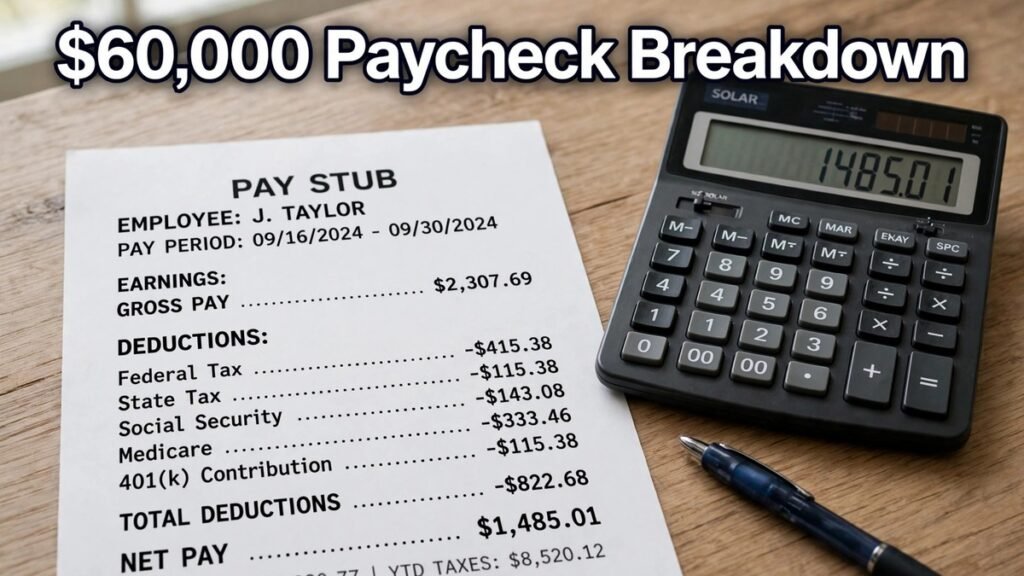
Your annual net pay stays the same, but your pay frequency changes the size of each paycheck. The table below splits the same $48,090.75 net pay from the example above into common pay schedules. As a result, you can match the output to your own payday rhythm.
| Pay frequency | Paychecks per year | Gross per paycheck | Net per paycheck |
|---|---|---|---|
| Monthly | 12 | $5,000.00 | $4,007.56 |
| Semimonthly | 24 | $2,500.00 | $2,003.78 |
| Biweekly | 26 | $2,307.69 | $1,849.64 |
| Weekly | 52 | $1,153.85 | $924.82 |
Small rounding differences may appear because each paycheck rounds to the nearest cent. Biweekly workers receive 26 paychecks, so two months each year contain three paydays. In contrast, semimonthly workers receive 24 paychecks, paid in the middle and at the end of each month.
Hourly Pay and Minimum Wage in the Michigan Paycheck Calculator
Hourly workers can use the same tool by entering their hourly rate and weekly hours. First, the calculator multiplies your rate by your hours and weeks to estimate annual gross pay, and then it applies the same federal, FICA, state, and city rules.
Michigan’s minimum wage rose to $13.73 per hour on January 1, 2026, according to the Michigan Department of Labor and Economic Opportunity. At that rate, a full-time worker who works 40 hours a week for 52 weeks earns $28,558.40 before taxes. Next, the rate rises to $15.00 per hour on January 1, 2027.
Overtime pay raises your gross pay, and Michigan follows the standard time and a half rule after 40 hours a week. If you work regular overtime, enter those hours separately or check your premium pay with our time and a half calculator first. Then, add the overtime total into this calculator for a fuller estimate.

Tips to Increase Your Michigan Take-Home Pay
Small changes to your withholding and benefits can lift your net pay without a raise:
- First, check your MI-W4 exemption count after marriage, a new child, or a second job.
- Next, increase pre-tax 401(k) or HSA contributions if your budget allows, since they lower your federal taxable income.
- Also, review your federal W-4 after major life changes, so your withholding matches your real tax bill.
- Finally, track your city status if you move into or out of a taxing city.
Still, avoid claiming exemptions you do not qualify for, because too little withholding creates an April tax bill.
FAQs
What is the Michigan income tax rate in 2026?
Michigan charges a flat 4.25% income tax in 2026. The rate applies to your taxable income after you subtract your personal exemptions.
How much tax does the Michigan paycheck calculator show on a $60,000 salary?
For a single filer with one exemption and no city tax, deductions total $11,909.25 on a $60,000 salary. That total includes $5,020 in federal tax, $4,590 in FICA taxes, and $2,299.25 in Michigan state tax. Consequently, take-home pay works out to $48,090.75 for the year.
Does Michigan charge a city income tax?
Yes, 24 Michigan cities charge their own income tax in 2026. Detroit residents pay 2.4%, Grand Rapids residents pay 1.5%, and most others charge 1%. Nonresidents who work in a taxing city pay half the resident rate.
What is the Michigan personal exemption for 2026?
The personal exemption is $5,900 per person in 2026. You claim one for yourself, plus one for a spouse on a joint return and one for each dependent. Each exemption saves you $250.75 in state tax, because it removes $5,900 from taxable income at 4.25%.
What is the minimum wage in Michigan in 2026?
Michigan’s minimum wage is $13.73 per hour in 2026. It took effect on January 1, 2026, and rises to $15.00 on January 1, 2027. Tipped workers earn $5.49 per hour in cash wages, provided tips bring them to the full minimum.
How can I check my Michigan pay calculator result against my pay stub?
First, compare the gross pay figure on your stub with the gross amount you entered. Next, match each deduction line: federal tax, FICA, state tax, and any city tax. If a line differs, check your W-4 and MI-W4 settings, because withholding choices explain most gaps.
For more updates visit: CALCIQ