

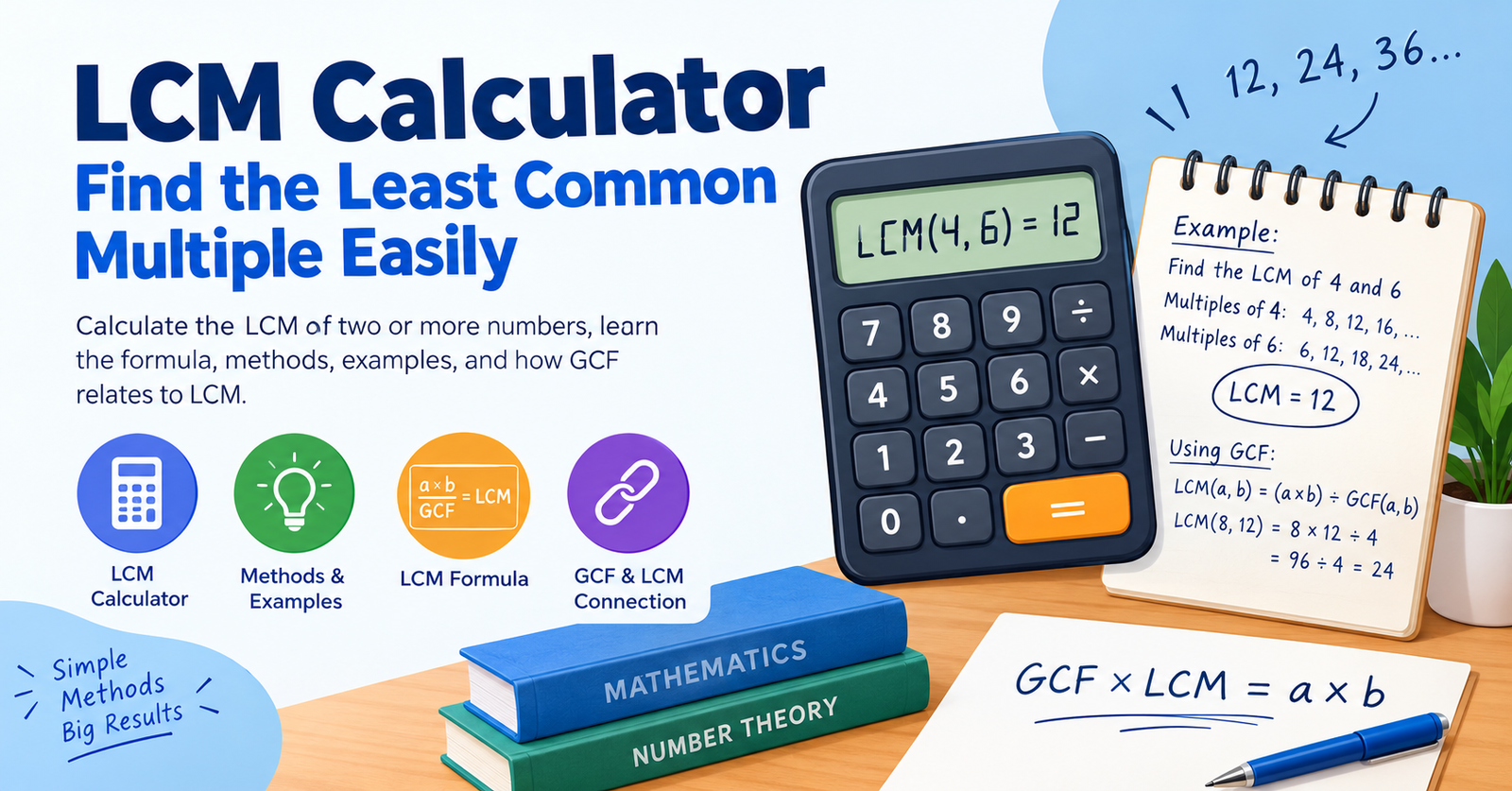
Finding the least common multiple of two or more numbers can take time when you calculate it by hand. An LCM calculator makes the process much faster and reduces the chance of mistakes.
The least common multiple is the smallest positive number that two or more numbers can divide into evenly. It has many uses in maths, especially when working with fractions, repeating patterns, schedules, and number problems.
This guide explains what LCM means, how an LCM calculator works, and how you can find the answer manually. You will also learn how the greatest common factor connects with the least common multiple.
What Is the Least Common Multiple?
The least common multiple, or LCM, is the smallest positive number that is a multiple of two or more numbers.
For example, consider 4 and 6. The multiples of 4 are 4, 8, 12, 16, 20, and so on. The multiples of 6 are 6, 12, 18, 24, and so on.
The first positive number that appears in both sets is 12. Therefore, the LCM of 4 and 6 is 12.
An LCM calculator performs this process automatically. You simply enter the numbers, and the calculator finds their least common multiple.
How Does an LCM Calculator Work?
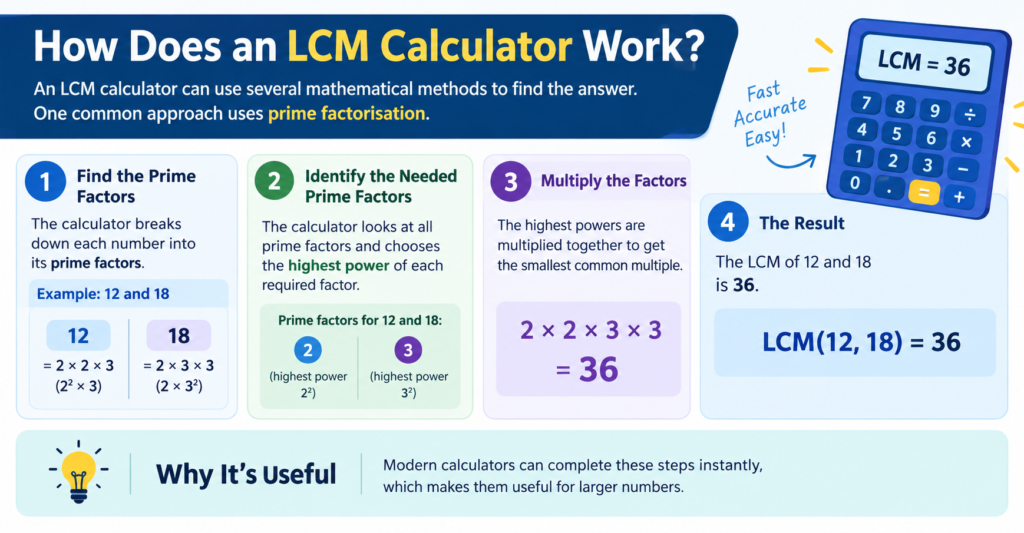
An LCM calculator can use several mathematical methods to find the answer. One common approach uses prime factorisation.
First, each number is broken down into its prime factors. The calculator then identifies every prime factor needed to create the smallest common multiple.
For example, take 12 and 18.
The prime factors of 12 are 2 × 2 × 3. The prime factors of 18 are 2 × 3 × 3.
The highest power of each required prime factor is selected. That gives 2 × 2 × 3 × 3, which equals 36.
Therefore, the LCM of 12 and 18 is 36.
Modern calculators can complete these steps instantly, which makes them useful for larger numbers.
LCM Formula
You can find the LCM of two numbers by using their GCF.
The formula is:
LCM(a, b) = (a × b) ÷ GCF(a, b)
Here, a and b represent the two numbers. GCF means greatest common factor.
For example, suppose you want to find the LCM of 8 and 12.
The GCF of 8 and 12 is 4. Multiply 8 by 12 to get 96. Then divide 96 by 4.
The result is 24.
Therefore, the LCM of 8 and 12 is 24.
This formula works because the GCF removes the common factors that would otherwise be counted twice.
GCF and LCM Calculator
A GCF and LCM calculator can provide both values from the same set of numbers.
GCF stands for greatest common factor. It is the largest positive number that divides two or more numbers without leaving a remainder.
LCM stands for least common multiple. It is the smallest positive number that is a multiple of the given numbers.
For example, the GCF of 18 and 24 is 6. Their LCM is 72.
These two concepts are closely connected. For two positive integers, their product equals the product of their GCF and LCM.
That relationship can be written as:
GCF(a, b) × LCM(a, b) = a × b
This makes the GCF useful when calculating the LCM of two numbers.
How to Find LCM by Listing Multiples
You can find an LCM without a calculator by listing multiples.
Start by writing the multiples of each number. Continue until you find the first value shared by both lists.
For example, consider 5 and 8.
The multiples of 5 include 5, 10, 15, 20, 25, 30, 35, and 40.
The multiples of 8 include 8, 16, 24, 32, and 40.
The first common value is 40. Therefore, the LCM is 40.
This method works well with small numbers. However, it becomes less practical when the numbers are large.
How to Find LCM Using Prime Factorisation
Prime factorisation provides another reliable method.
Suppose you need the LCM of 20 and 30.
The prime factors of 20 are 2 × 2 × 5. The prime factors of 30 are 2 × 3 × 5.
Take the highest power of every prime that appears. You need two 2s, one 3, and one 5.
That gives 2 × 2 × 3 × 5, which equals 60.
Therefore, the LCM of 20 and 30 is 60.
This approach is particularly useful when you want to understand how the answer is calculated.
When Should You Use an LCM Calculator?
An LCM calculator can help with many everyday maths problems.
Students often use it when solving fraction problems or checking homework. Teachers may also use LCM calculations when explaining common denominators.
The concept is useful beyond fractions. You can use LCM to solve problems involving repeating events or cycles.
For example, imagine one event happens every 6 days and another happens every 8 days. The LCM of 6 and 8 is 24.
Therefore, both events will occur together again after 24 days if they start together.
LCM and Fractions
LCM plays an important role when adding or subtracting fractions with different denominators.
Suppose you need to work with fractions having denominators of 6 and 8. Their LCM is 24.
This gives you a common denominator for both fractions.
Once the denominators are converted to 24, you can add or subtract the fractions more easily.
An LCM calculator can save time when the denominators are larger or when several fractions are involved.
LCM of More Than Two Numbers
You can also calculate the LCM of three or more numbers.
For example, consider 4, 6, and 8.
The LCM of 4 and 6 is 12. Next, find the LCM of 12 and 8. The result is 24.
Therefore, the LCM of 4, 6, and 8 is 24.
A calculator can handle this process quickly. It is especially useful when working with several numbers at once.
Common Mistakes When Finding LCM
One common mistake is confusing LCM with GCF. The GCF is the largest common factor, while the LCM is the smallest common multiple.
Another mistake is choosing a number that is a multiple of only one input. A valid LCM must be divisible by every number being considered.
It is also easy to stop at a common multiple that is not the smallest one. Always check whether a smaller positive common multiple exists.
When using the multiplication formula, make sure you divide by the GCF. Multiplying the two numbers alone does not always produce the LCM.
Why Use an LCM Calculator?
An LCM calculator provides a quick way to check mathematical results. It can also help you understand whether your manual calculation is correct.
The tool is particularly helpful with large numbers. Listing multiples for large values can become slow and difficult.
However, understanding the underlying method remains useful. Once you know how LCM works, you can recognise errors and solve simple problems without relying on a calculator.
Conclusion
An LCM calculator provides a simple way to find the least common multiple of two or more numbers. The result is the smallest positive number that each input can divide evenly.
You can also find LCM manually by listing multiples, using prime factorisation, or applying the GCF formula for two numbers.
Understanding both LCM and GCF makes many maths problems easier. These concepts are especially useful when working with fractions, common denominators, repeating cycles, and number theory.
FAQs
What does LCM stand for?
LCM stands for least common multiple. It is the smallest positive number that is a multiple of two or more given numbers.
What is an LCM calculator used for?
An LCM calculator finds the least common multiple of two or more numbers. It can save time and help reduce calculation errors.
What is the LCM of 4 and 6?
The LCM of 4 and 6 is 12. Twelve is the smallest positive number that both 4 and 6 divide evenly.
What is the difference between GCF and LCM?
GCF means greatest common factor and identifies the largest shared factor. LCM means least common multiple and identifies the smallest shared multiple.
How do you calculate LCM using GCF?
For two positive numbers, multiply the numbers and divide the result by their GCF. The formula is LCM(a, b) = (a × b) ÷ GCF(a, b).
Can an LCM calculator work with three numbers?
Yes. An LCM calculator can find the least common multiple of three or more numbers, depending on the calculator’s input options.
For more updates visit: CALCIQ