

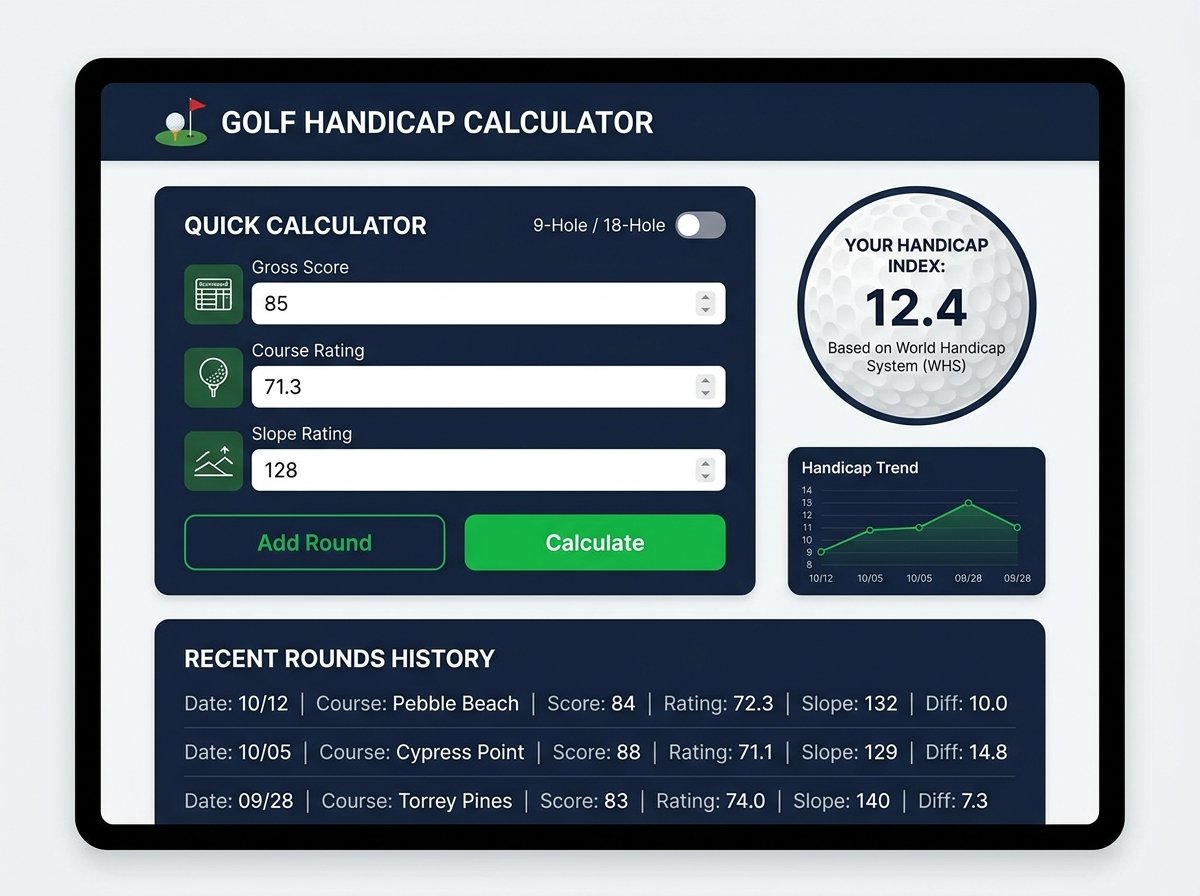
A golf handicap calculator helps you understand your golf ability and compare scores with other players. It uses your recent scores and course details to estimate your handicap under the World Handicap System (WHS). This makes golf more fair for players with different skill levels. Whether you play every week or only now and then, knowing your handicap can help you track progress and prepare for a round. You can also learn the difference between a Handicap Index, Course Handicap and Playing Handicap.
What Is a Golf Handicap Calculator?
A golf handicap calculator is a tool that helps golfers work out their handicap using the World Handicap System. The result reflects a player’s demonstrated ability based on acceptable scores. It also helps players compete on a more equal basis, even when their skill levels differ.
The system uses score differentials from your scoring record to calculate your Handicap Index. A score differential considers your score and the difficulty of the course. Course Rating and Slope Rating are key parts of this calculation.
Your handicap is not simply the average of all your scores. The WHS uses a set method and considers your best score differentials. This approach helps reflect your potential ability rather than only your average performance.
How Does a Golf Handicap Calculator Work?

A golf handicap calculator needs accurate score and course information. Depending on the calculator, you may need to enter your adjusted gross score, Course Rating, Slope Rating and Par. Some tools also ask for details about your existing Handicap Index.
The calculator uses these details to work out a score differential. Once you have enough acceptable scores, the WHS uses the relevant differentials to calculate your Handicap Index. The calculation follows the official rules, including any adjustments that apply.
Your Handicap Index can then help determine your Course Handicap for a particular course. A Playing Handicap may apply when a competition uses a handicap allowance. These values serve different purposes, so they should not be treated as the same number.
Understanding the Golf Handicap Formula
The WHS uses a formula to calculate a score differential. In general, the formula is:
Score Differential = (Adjusted Gross Score − Course Rating − PCC Adjustment) × 113 ÷ Slope Rating
The standard Slope Rating value in this formula is 113. The Playing Conditions Calculation, or PCC, may adjust the calculation when scores suggest that playing conditions were unusually difficult or easy. The exact treatment of this adjustment follows WHS rules.
For example, imagine your adjusted gross score is 90, the Course Rating is 72.0, and the Slope Rating is 120. If no PCC adjustment applies, the calculation is:
(90 − 72.0) × 113 ÷ 120 = 16.95
Your score differential would be 16.95, subject to the applicable WHS calculation and rounding rules.
This figure is not automatically your Handicap Index. The WHS uses the required number of score differentials from your scoring record to calculate that index. The number of scores available affects which calculation method applies.
What Is a Handicap Index?
A Handicap Index represents your demonstrated golfing ability. It allows you to compare your performance with that of other golfers and provides a starting point for working out your handicap on a specific course.
Your index can change as you submit new acceptable scores. The WHS generally uses the best eight score differentials from your most recent 20 scores when a full scoring record is available. Different rules apply when fewer scores are recorded.
A lower Handicap Index usually indicates stronger scoring ability. However, the index does not mean you will shoot that number over par in every round. Course difficulty and the relevant ratings affect the handicap used for each round.
What Is a Course Handicap?
A Course Handicap shows the number of strokes a player receives or gives on a particular course, based on their Handicap Index and the course’s difficulty.
The WHS Course Handicap calculation uses your Handicap Index, the Slope Rating, the standard value of 113, the Course Rating and par. The precise formula can depend on the applicable WHS rules and course setup.
For this reason, the same golfer may have different Course Handicaps at different courses or tees. A more challenging course can lead to a different handicap allowance than an easier one.
What Is a Playing Handicap?
A Playing Handicap is the handicap used for a specific round or competition after applying the relevant handicap allowance. The allowance depends on the format of play and the competition rules.
For example, a competition may use a percentage of each player’s Course Handicap. This helps organisers balance the format while following the relevant WHS guidance.
Your Handicap Index, Course Handicap and Playing Handicap therefore have separate roles. The index represents your ability, the Course Handicap reflects the course, and the Playing Handicap accounts for the format’s allowance.
How to Use a Golf Handicap Calculator
Using a golf handicap calculator is straightforward when you have the correct information. Follow these steps to get a useful result.
- Enter your score: Add your adjusted gross score for the round. Follow the applicable rules for adjusting scores before entering them.
- Add the Course Rating: Find the rating for the course and tees you played.
- Enter the Slope Rating: Use the Slope Rating that matches those tees.
- Include other required details: Some calculators ask for Par, a PCC adjustment or your existing Handicap Index.
- Calculate the result: Run the calculator to view the score differential or handicap estimate.
- Check the result: Confirm that the calculator uses the correct WHS method and current course details.
A single round can help you understand a score differential, but it may not be enough to calculate a full Handicap Index. For an official handicap, follow the rules of your golf club or authorised handicap service.
Why Your Golf Handicap Can Change
Your Handicap Index may change after you submit a new acceptable score. A strong round can affect the differentials used in the calculation. Over time, older scores also leave your recent scoring record.
Course conditions may matter as well. When the WHS applies a Playing Conditions Calculation, it can adjust score differentials to reflect unusual conditions on the day.
Your index does not always fall after a good round or rise after a poor one. The result depends on your current scoring record and the WHS calculation rules. That is why it helps to track scores over time instead of judging your progress from one round.
Common Golf Handicap Calculation Mistakes
Small errors can lead to an incorrect estimate. Check these common mistakes before relying on a result.
- Using the wrong course details: Course Rating and Slope Rating must match the course and tees you played.
- Entering an unadjusted score: The WHS has rules for acceptable scores and score adjustments.
- Confusing the handicap terms: Handicap Index, Course Handicap and Playing Handicap are different values.
- Assuming one round sets your index: A full Handicap Index calculation depends on your scoring record and the rules that apply.
- Ignoring competition allowances: The Playing Handicap may differ from the Course Handicap in a competition.
- Relying on outdated information: Use current course ratings and a calculator that follows the latest applicable WHS guidance.
Checking your details before calculating can help you avoid misleading results. For official handicap records, use your golf club or authorised handicap provider.
Who Should Use a Golf Handicap Calculator?
New golfers can use a golf handicap calculator to learn how handicaps work. It can explain the role of scores, course difficulty and handicap allowances. As players record more acceptable rounds, they can follow changes in their ability.
Regular golfers may use a calculator to check an estimated score differential or understand their Course Handicap before a round. It can also help players prepare for competitions where handicaps affect the result.
Golf clubs and competition organisers may need handicap calculations to help apply the correct rules. However, an online calculator is not always a substitute for an official handicap record. Always check the requirements of your club or competition.
Benefits of Using a Golf Handicap Calculator
A golf handicap calculator makes complex calculations easier to understand. Rather than working through the formula by hand, you can enter the required details and review the result.
It can also help you compare performance across different courses. Since course difficulty affects the calculation, the handicap system offers a fairer way to compare golfers who play from different tees or at different venues.
Another benefit is progress tracking. By recording acceptable scores over time, you can see how your results affect your handicap. This information may help you set realistic goals and identify areas of your game that need work.
For the most reliable result, use accurate course information and follow the official WHS rules.
Conclusion
A golf handicap calculator helps you understand your score differentials and the way the World Handicap System measures golfing ability. It can also explain how your Handicap Index relates to your Course Handicap and Playing Handicap.
For a useful result, enter accurate scores and the correct course details. Remember that a single round does not usually determine your full Handicap Index. If you need an official figure, use the handicap service recognised by your golf club.
With accurate records and a clear understanding of the rules, you can track your progress and prepare for fairer competition.
FAQs
1. How is a golf handicap calculated?
The WHS uses score differentials based on adjusted gross scores, Course Rating and Slope Rating. When a full scoring record is available, the calculation generally uses the best eight differentials from the most recent 20 scores. Other rules apply when fewer scores are available.
2. Can I calculate my golf handicap with one round?
One round can help you calculate a score differential. However, a single round does not usually provide a full Handicap Index under the WHS. The applicable method depends on how many acceptable scores you have submitted.
3. What is a good golf handicap?
There is no single handicap that counts as good for every golfer. A lower Handicap Index generally reflects stronger scoring ability, but experience, goals and the courses played all matter. Tracking your own progress can be more useful than comparing yourself with others.
4. Is Handicap Index the same as Course Handicap?
No. Your Handicap Index represents your demonstrated ability. Course Handicap adjusts that index for the course and tees you play. A Playing Handicap may then apply a competition allowance.
5. Does my golf handicap change after every round?
Your Handicap Index can change when a new acceptable score is added to your record. However, the result depends on the scoring record and WHS calculation rules. A new round does not guarantee that your index will rise or fall.
6. Is an online golf handicap calculator official?
Not always. An online calculator can provide an estimate when you enter the correct information and it follows the relevant WHS method. For an official Handicap Index, check with your golf club or authorised handicap provider.
For more updates visit: CALCIQ