


A dog pregnancy calculator can help you estimate when your dog may give birth. It uses the breeding date to provide an expected due date.
Most dogs have a pregnancy that lasts around 63 days. However, the exact timing can vary between individual dogs. The date of mating does not always match the date of conception.
For this reason, treat any calculated date as an estimate. Your dog’s health, breeding timing, and veterinary checks can provide more useful information as pregnancy progresses.
How Does a Dog Pregnancy Calculator Work?
A dog pregnancy calculator estimates the expected whelping date from the breeding date. Whelping is the term used for giving birth in dogs.
A simple calculation adds about 63 days to the breeding date. This gives you an approximate date when puppies may arrive.
For example, if breeding occurred on 1 January, an estimated due date would fall around 5 March. The actual birth could happen earlier or later.
Several factors can affect the calculation. Sperm can remain viable for several days, while ovulation and fertilisation may not happen on the mating date.
Therefore, a dog pregnancy calculator should be used as a planning tool rather than an exact prediction.
Dog Pregnancy Calculator Formula
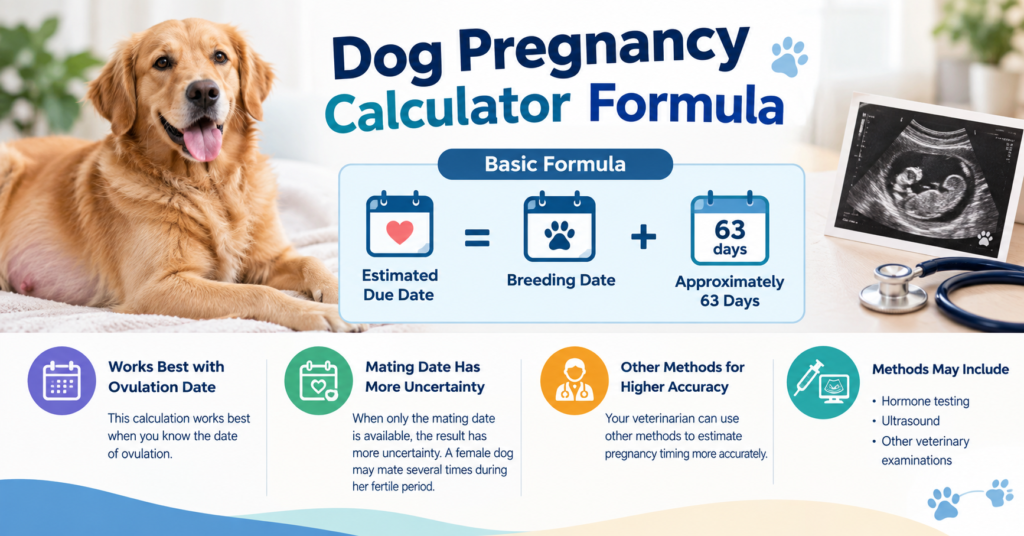
The basic calculation is straightforward.
Estimated due date = breeding date + approximately 63 days.
This calculation works best when you know the date of ovulation. However, most owners know the mating date instead.
When only the mating date is available, the result has more uncertainty. A female dog may mate several times during her fertile period.
Your veterinarian can use other methods to estimate pregnancy timing more accurately. These methods may include hormone testing, ultrasound, and other veterinary examinations.
How Long Are Dogs Pregnant?
A typical canine pregnancy lasts about 63 days from ovulation. This equals roughly nine weeks.
The timeline can differ when pregnancy is measured from mating rather than ovulation. In those cases, the apparent pregnancy length may vary more widely.
Breed size can also influence pregnancy management, although gestation itself usually remains close to the typical canine range.
During these weeks, puppies develop rapidly. Your dog also experiences physical and behavioural changes as birth approaches.
A dog pregnancy calculator can help you track this period and prepare for the expected whelping window.
Dog Pregnancy Stages
Early Pregnancy
During the first few weeks, pregnancy may not cause obvious changes. Some dogs may show mild changes in appetite or behaviour.
Pregnancy can be difficult to confirm based on appearance alone. A veterinarian can provide more reliable confirmation.
Middle Pregnancy
As pregnancy progresses, the puppies grow and your dog may gain weight. Her abdomen can also become more noticeable.
Her nutritional needs may change as the pregnancy develops. However, sudden diet changes should be avoided unless your veterinarian recommends them.
Veterinary monitoring can help ensure that both the mother and developing puppies remain healthy.
Late Pregnancy
The final weeks are an important preparation period. Your dog may become larger and less comfortable as the puppies grow.
Nesting behaviour can appear before labour. Some dogs may also become restless or seek a quiet place.
Your estimated due date can help you prepare for this stage. Still, watch your dog rather than relying only on the calculated date.
When Can You Confirm a Dog Pregnancy?
A veterinarian can use different methods to confirm pregnancy.
Ultrasound can help detect pregnancy and assess developing puppies during the pregnancy. The timing of the examination matters.
Abdominal palpation may also help in some cases, but it requires veterinary experience. It is not a reliable method for owners to use at home.
Later in pregnancy, an X-ray can help determine the number of puppies. The developing skeletons become visible as pregnancy advances.
Your veterinarian can recommend the appropriate examination based on your dog’s breeding history and stage of pregnancy.
How Accurate Is a Dog Pregnancy Calculator?
A dog pregnancy calculator provides an estimate rather than an exact birth date.
The biggest issue is the difference between mating and conception. A dog may mate before ovulation, so fertilisation can happen several days after breeding.
Multiple mating dates can also make calculations more difficult. If your dog was bred several times, you may have a range of possible dates.
A calculator becomes more useful when the ovulation date is known. Hormone testing can help veterinarians identify ovulation timing during planned breeding.
For this reason, use the calculated date as a guide. Continue monitoring your dog as the expected delivery period approaches.
Signs That Your Dog May Be Close to Giving Birth
Behaviour can change as labour gets closer. Some dogs become restless, while others look for a quiet area.
Nesting is another common behaviour. Your dog may scratch bedding or repeatedly rearrange her surroundings.
Her appetite may also change shortly before labour. Some dogs eat less as delivery approaches.
Body temperature can also change before labour. However, temperature monitoring should be discussed with your veterinarian so you understand how to do it correctly.
Contact your veterinarian if you are unsure whether your dog has started labour or if something seems unusual.
Preparing for Your Dog’s Due Date
Once you have an estimated date, start preparing well before the final week.
Your dog should have a quiet, clean, comfortable area where she can give birth. Keep the space away from heavy household activity and unnecessary stress.
Keep your veterinarian’s contact details available. It is also sensible to understand where you would go if emergency veterinary care becomes necessary.
Avoid relying on the calculated date alone. Puppies can arrive outside the estimated date, particularly when the mating date is the only information available.
When Should You Contact a Veterinarian?
Pregnancy and birth can involve complications, so veterinary guidance is important.
Contact your veterinarian if your dog appears unwell, shows unusual discharge, has severe pain, or you are concerned about labour.
You should also seek veterinary advice if labour appears to stop or your dog has difficulty delivering a puppy.
Some breeds have a higher risk of difficult birth because of their body structure or puppy size. Your veterinarian can explain the specific risks for your dog.
Never attempt to manage a serious delivery problem yourself. Prompt veterinary care can be important for both the mother and puppies.
Dog Pregnancy Calculator for Multiple Breeding Dates
Some dogs mate more than once during a breeding cycle. This can make the expected due date harder to estimate.
Instead of treating one mating date as certain, consider all known breeding dates. Each date can produce a different estimated delivery window.
For example, breeding on several days may create several possible due dates. A veterinarian can help narrow the expected timing using reproductive examinations.
This approach gives you a more realistic picture than relying on one date alone.
Can You Calculate a Dog’s Due Date Without a Breeding Date?
It is difficult to calculate a reliable due date without knowing when breeding or ovulation occurred.
You may notice physical changes, but these signs cannot provide an exact pregnancy start date.
A veterinary examination can help determine whether your dog is pregnant and estimate the stage of pregnancy.
If you suspect pregnancy but do not know the breeding date, contact your veterinarian. They can recommend the most suitable examination.
Conclusion
A dog pregnancy calculator offers a simple way to estimate when puppies may arrive. The basic method adds about 63 days to the breeding or ovulation date.
However, the result is only an estimate. Mating does not always occur on the day of conception, and several breeding dates can make the calculation less precise.
Use the estimated date to prepare your dog’s space and plan veterinary care. As the due date approaches, pay close attention to changes in behaviour and physical condition.
When pregnancy or labour causes concern, speak with your veterinarian. Professional monitoring remains the safest way to support your dog and her puppies.
FAQs
How many days are dogs pregnant?
Dogs are typically pregnant for around 63 days when pregnancy is measured from ovulation. The timing can appear different when counted from the mating date.
How do I calculate my dog’s due date?
Add approximately 63 days to the ovulation date. If you only know the mating date, use the result as an estimate because conception may occur later.
Is a dog pregnancy calculator accurate?
It can provide a useful estimate, but it cannot guarantee the exact delivery date. Accuracy improves when the ovulation date is known.
Can a dog give birth before 63 days?
Yes. The timing of birth can vary, particularly when you calculate pregnancy from mating instead of ovulation. Your veterinarian can help assess whether the timing is normal.
Can a dog give birth after the calculated due date?
Yes. A calculated date is not an exact deadline. If your dog is approaching or passing the expected date, contact your veterinarian for guidance.
When can you tell if a dog is pregnant?
Pregnancy can be confirmed through veterinary examinations at suitable stages of pregnancy. Ultrasound is one method used to detect pregnancy and assess developing puppies.
For more updates visit: CALCIQ