

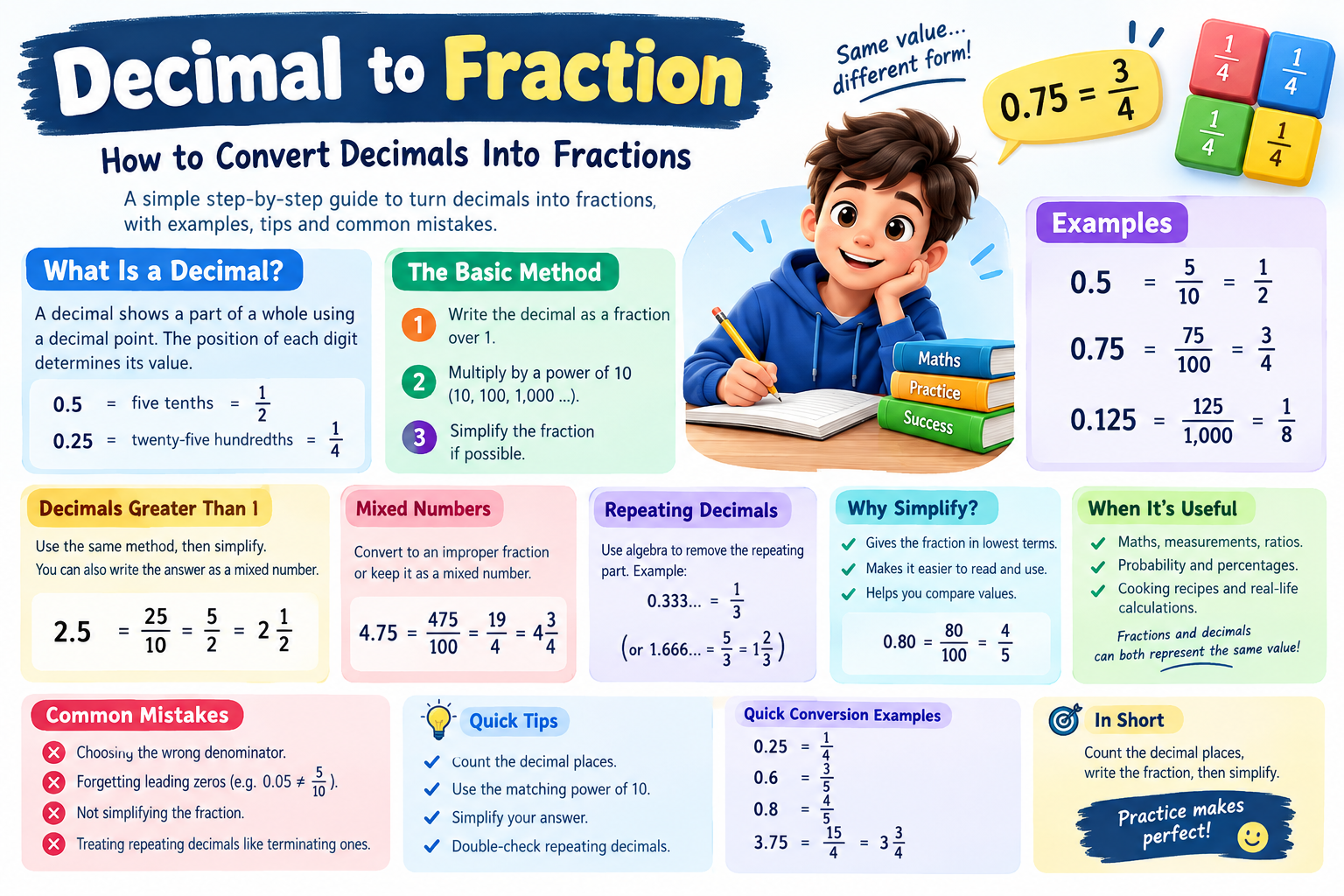
Converting a decimal into a fraction is a useful maths skill. It helps you show an exact value in another form. The method is simple once you understand decimal place values.
For example, 0.5 means five tenths. It can also be written as 1/2. Likewise, 0.75 equals 3/4.
This guide explains how to convert decimal to fraction with simple steps. You will also learn how to handle whole numbers, mixed numbers, and repeating decimals.
What Is a Decimal?
A decimal shows part of a whole. It uses a decimal point to separate whole numbers from smaller values.
The first digit after the decimal point shows tenths. The second digit shows hundredths. The third digit shows thousandths.
For example, 0.5 means five tenths. The value 0.25 means twenty-five hundredths. Understanding these positions makes conversion much easier.
How to Convert Decimal to Fraction
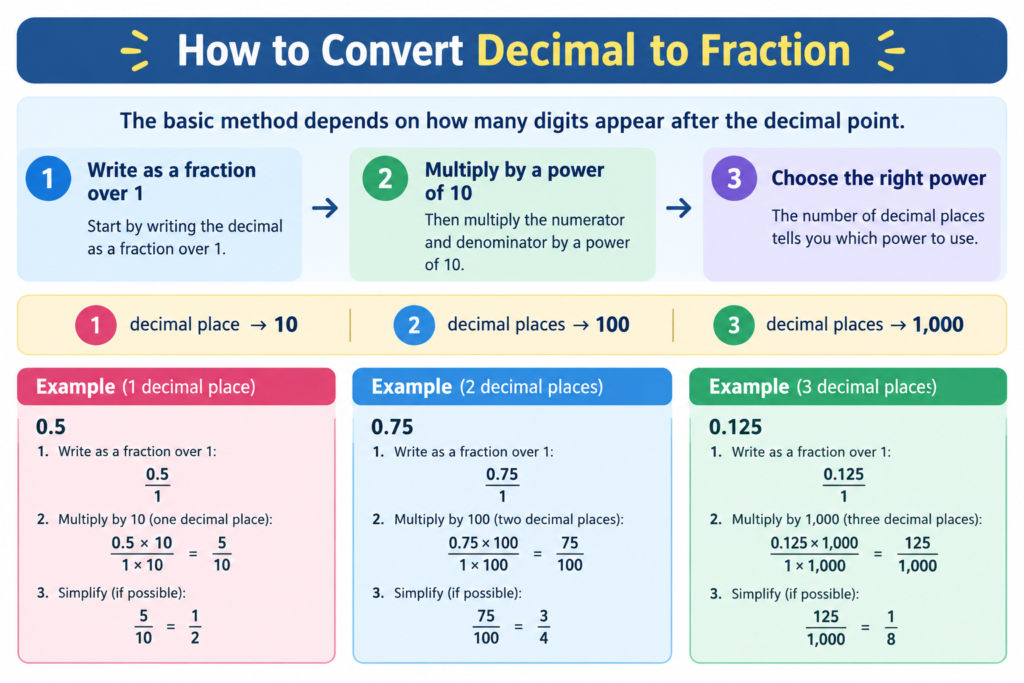
The main method depends on the number of decimal places.
First, remove the decimal point and use the remaining digits as the numerator. Next, choose a denominator based on the decimal places.
One decimal place needs 10 as the denominator. Two decimal places need 100. Three decimal places need 1,000.
Finally, simplify the fraction if possible. This gives you the fraction in its lowest form.
Converting 0.5 to a Fraction
The decimal 0.5 has one digit after the decimal point. Therefore, use 10 as the denominator.
Write 5/10. Both numbers can divide by 5. The simplified answer is 1/2.
So, 0.5 has the same value as 1/2.
Converting 0.75 to a Fraction
There are two digits after the decimal point in 0.75. Use 100 as the denominator.
The first fraction is 75/100. Both numbers can divide by 25.
After simplifying, the answer becomes 3/4. Therefore, 0.75 equals 3/4.
Converting 0.125 to a Fraction
The decimal 0.125 has three decimal places. Its first fraction is 125/1,000.
Both numbers can divide by 125. The result is 1/8.
Therefore, 0.125 is equal to 1/8.
Converting a Decimal Greater Than 1
The same method works for decimals greater than one.
Take 2.5 as an example. There is one decimal place, so use 10 as the denominator.
Remove the decimal point and write 25/10. Divide both numbers by 5 to get 5/2.
You can also write this answer as the mixed number 2 1/2. Both forms have exactly the same value.
Converting a Decimal to a Mixed Number
Some fractions are easier to understand as mixed numbers.
Consider 4.75. Removing the decimal point gives 475/100. Simplifying this fraction gives 19/4.
Now separate the whole number from the fraction. The result is 4 3/4.
Mixed numbers are useful for measurements and everyday quantities. You can also keep the answer as an improper fraction when a calculation requires it.
Converting Repeating Decimals to Fractions
Repeating decimals need a different method. Their digits continue without ending.
A common example is 0.333… This value equals 1/3.
To convert it, let x equal 0.333… Multiply both sides by 10. You then have 10x = 3.333…
Subtract the first equation from the second one. The repeating digits cancel out.
This leaves 9x = 3. Divide both sides by 9. The answer is x = 1/3.
The same idea works with other repeating decimals. Longer repeating patterns may need a larger power of 10.
Decimals With Whole Numbers and Repeating Parts
Some values contain a whole number and a repeating decimal.
For example, consider 1.666… The whole number is 1. The repeating part is 0.666…
The repeating part equals 2/3. Add the whole number to get 1 2/3.
This method can make repeating decimals easier to understand. It also helps you check whether your final fraction matches the original value.
Why Should You Simplify the Fraction?
The first fraction you create may not be in its lowest form.
For example, 0.80 becomes 80/100. Both numbers can divide by 20. The simplified answer is 4/5.
A simplified fraction is easier to read. It also makes comparisons with other fractions much simpler.
Look for a number that divides evenly into both the numerator and denominator. Dividing by the greatest common factor can simplify the process.
Common Decimal to Fraction Mistakes
Choosing the wrong denominator is a common error. The number of decimal places determines the denominator.
For example, two decimal places require 100. Three decimal places require 1,000.
Leading zeros can also cause confusion. The value 0.05 means five hundredths. It does not mean five tenths.
ALSO READ: How Old Am I If I Was Born in 1998?
Another mistake is forgetting to simplify the final fraction. An unsimplified answer may still have the correct value. However, the lowest form is usually preferred.
Repeating decimals cause another common problem. You cannot convert them by simply placing the visible digits over a power of 10. Their repeating pattern needs an algebraic method.
Using a Decimal to Fraction Calculator
A decimal to fraction calculator can save time. It is useful when you need to convert several values.
The tool can also help you check your manual work. However, knowing the basic method is still important.
Simple decimals are often easy to convert without a calculator. You only need to count the decimal places and simplify the result.
A calculator becomes more useful with longer or repeating decimals. It can reduce errors during repeated calculations.
When Is Decimal to Fraction Conversion Useful?
Decimals and fractions can represent the same value. Still, one form may work better in a particular maths problem.
Fractions are common in measurements, ratios, probability, and school maths. They can also show exact relationships more clearly.
For instance, 0.25 is easy to recognise as 1/4. The value 0.5 is also equal to 1/2.
Students often convert between fractions and decimals during maths exercises. The skill can also help with measurements, percentages, recipes, and other everyday calculations.
Conclusion
Learning how to convert decimal to fraction becomes easier with practice. Start by counting the digits after the decimal point.
Use 10, 100, 1,000, or another suitable power of 10. Then write the digits as the numerator and simplify the fraction.
Decimals greater than one follow the same basic process. Repeating decimals need an algebraic method because their digits continue forever.
Once you learn the pattern, most decimal conversions take only a few seconds. A decimal to fraction calculator can also help you check your answer.
FAQs
How do you convert a decimal to a fraction?
Remove the decimal point and use the remaining digits as the numerator. Choose 10, 100, 1,000, or another power of 10 based on the decimal places. Then simplify the fraction.
What is 0.5 as a fraction?
The decimal 0.5 becomes 5/10. Divide both numbers by 5 to get 1/2.
What is 0.75 as a fraction?
Start with 75/100 because there are two decimal places. Divide both numbers by 25. The simplified answer is 3/4.
What is 0.25 as a fraction?
Write 25 over 100. Divide both numbers by 25. The result is 1/4.
Can every decimal become a fraction?
Every terminating decimal can become a fraction. Repeating decimals can also become fractions. However, they need a different conversion method.
How do you convert 2.5 into a fraction?
Write 25/10 because 2.5 has one decimal place. Simplify the fraction by dividing both numbers by 5. The answer is 5/2.
For more updates visit: CALCIQ