

A due date calculator can help you estimate when your baby may arrive. It uses important pregnancy dates to calculate an estimated delivery date.
For many people, the calculation starts with the first day of the last menstrual period. If that date is known, you can estimate the due date quickly.
However, pregnancy does not always follow an exact schedule. Only a small number of babies arrive on their estimated due date. Your healthcare professional may also adjust your date after an ultrasound.
Understanding how your estimated due date works can make it easier to follow your pregnancy timeline. It can also help you understand how many weeks pregnant you may be.
What Is a Due Date Calculator?
A due date calculator estimates the date when your baby may be born. It normally uses the first day of your last menstrual period to make the calculation.
A typical pregnancy lasts around 40 weeks from the first day of the last menstrual period. This period includes about two weeks before conception usually occurs.
The result is therefore an estimated due date, not a guaranteed birth date. Labour can begin before or after this date.
A pregnancy calculator can also show your estimated pregnancy week. This gives you a useful way to track your progress as your pregnancy develops.
How Does a Due Date Calculator Work?
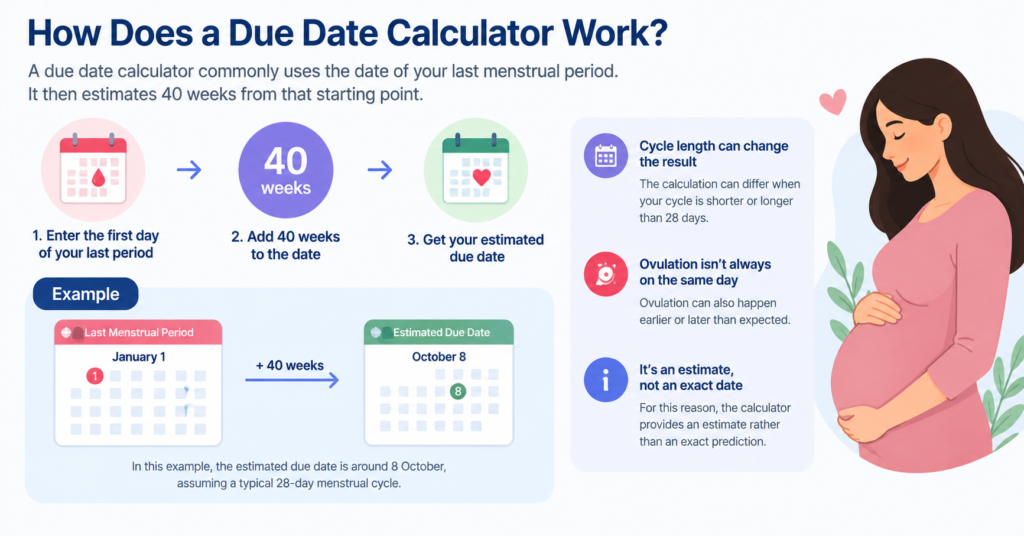
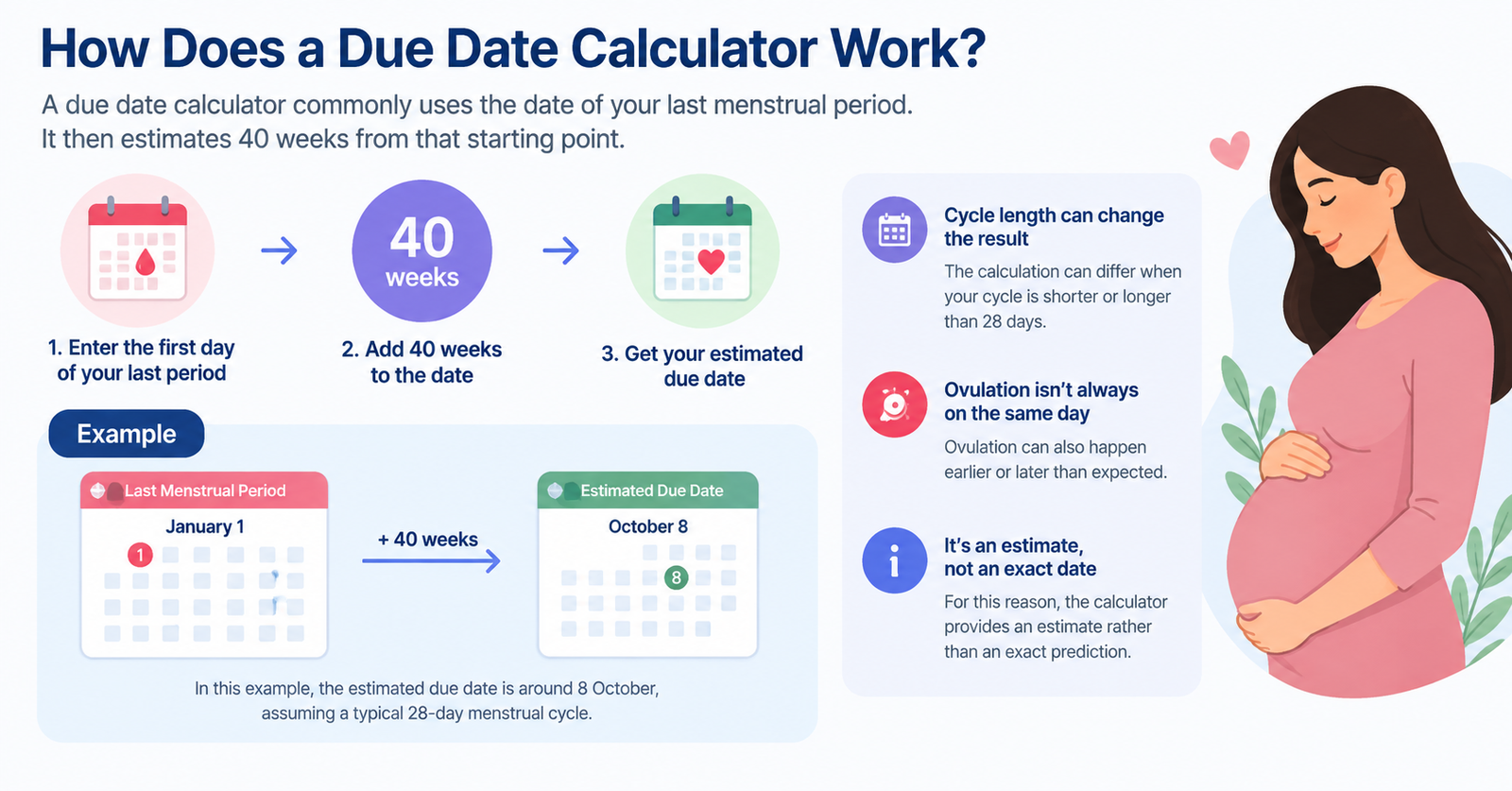
A due date calculator commonly uses the date of your last menstrual period. It then estimates 40 weeks from that starting point.
For example, if the first day of your last period was 1 January, the estimated due date would be around 8 October. This example assumes a typical 28-day menstrual cycle.
The calculation can differ when your cycle is shorter or longer than 28 days. Ovulation can also happen earlier or later than expected.
For this reason, the calculator provides an estimate rather than an exact prediction.
How to Calculate Your Pregnancy Due Date
The traditional method estimates a pregnancy length of 280 days from the first day of your last menstrual period.
Another common approach is known as Naegele’s rule. It estimates the due date by adding one year, subtracting three months, and adding seven days to the first day of the last period.
For instance, a last menstrual period beginning on 10 February would give an estimated due date around 17 November.
This method works best when you have regular menstrual cycles. However, cycle length can vary between individuals.
An online due date calculator simply makes this process faster. You enter the relevant date, and the tool calculates the estimated delivery date.
Can You Calculate a Due Date From Conception?
Yes, you can estimate a due date from a known conception date. Pregnancy generally lasts about 38 weeks from conception.
This method can be useful when you know approximately when conception occurred. However, identifying the exact conception date is often difficult.
Sperm can survive for several days in the reproductive tract. Ovulation can also vary from one cycle to another.
Therefore, a conception-based calculation may still only provide an estimate.
If you know both your last period and conception date, the results may differ slightly. A healthcare professional can help determine which dating method is more suitable.
What If You Do Not Know Your Last Period Date?
Not everyone remembers the first day of their last menstrual period. This can make an initial calculation less certain.
An ultrasound scan can help estimate pregnancy dates. In early pregnancy, ultrasound measurements can provide useful information about how far the pregnancy has progressed.
Your healthcare professional may use your menstrual history, ultrasound findings, and other information when establishing your estimated due date.
Therefore, you should not worry if you cannot remember the exact date. Your maternity team can help establish an appropriate pregnancy timeline.
How Accurate Is a Due Date Calculator?
A due date calculator can provide a useful estimate, but it cannot predict the exact day of birth.
The calculation depends on the information you enter. An incorrect last-period date can change the estimated result.
Cycle length can also affect the calculation. People with irregular cycles may find that a simple calendar-based estimate is less precise.
An ultrasound may provide a more reliable pregnancy dating estimate in certain circumstances. Your healthcare professional will consider your individual situation when assessing your dates.
The estimated due date should therefore be viewed as a guide rather than a fixed deadline.
Why Can Your Due Date Change?
Your estimated due date can sometimes change during pregnancy. This does not necessarily mean anything is wrong.
A difference may occur because your menstrual dates were uncertain. It can also happen when ultrasound measurements suggest a different stage of pregnancy.
Pregnancy dating becomes more useful when healthcare professionals have accurate information about your cycle and early pregnancy measurements.
Your maternity team can explain why a date has changed and which estimated date they are using.
What Does Your Estimated Due Date Mean?
Your estimated due date marks the approximate end of a 40-week pregnancy period. It does not mean your baby must arrive on that day.
Many pregnancies continue beyond the estimated date. Others end before it.
The date is mainly used as a reference point. Healthcare professionals can use it when monitoring pregnancy progress and planning appropriate care.
A due date calculator can also help you understand where you are in your pregnancy journey. Still, medical decisions should rely on advice from your maternity team.
Due Date and Pregnancy Weeks
Pregnancy is usually described in weeks rather than only by months. The week count begins from the first day of your last menstrual period.
This means pregnancy dating starts before conception usually takes place. As a result, pregnancy age is different from the time since conception.
For example, someone described as eight weeks pregnant has usually reached around six weeks since conception.
This system provides a standard way for healthcare professionals to track pregnancy development.
Using a due date calculator can help you understand this timeline. It can also make pregnancy appointments easier to follow.
Factors That Can Affect Your Estimated Due Date
Several factors can affect a pregnancy date calculation. Your menstrual cycle length is one of the main factors.
Irregular periods can make the last menstrual period less useful for dating. Uncertainty about ovulation can also affect an estimate.
Assisted conception may provide a more specific conception date. In these situations, healthcare professionals may use treatment dates and other clinical information.
Ultrasound findings can also influence pregnancy dating. Your healthcare team will consider the available information when deciding which date to use.
When Should You Speak to a Healthcare Professional?
A due date calculator is useful for general information, but it should not replace maternity care.
Speak with your midwife, GP, or maternity team if you are unsure about your pregnancy dates. They can explain how your estimated due date was established.
You should also follow the advice given during your pregnancy appointments. Your healthcare team can provide guidance based on your individual circumstances.
If you have concerns about symptoms, pregnancy progress, or your baby’s movements, seek appropriate medical advice rather than relying on an online calculator.
Conclusion
A due date calculator provides a simple way to estimate when your baby may arrive. Most calculations use the first day of your last menstrual period and estimate around 40 weeks of pregnancy.
The result is only an estimated date. Ovulation, cycle length, menstrual dates, and ultrasound findings can all affect pregnancy dating.
Use the calculation as a helpful starting point. For the most appropriate pregnancy dates, follow the guidance of your midwife, GP, or maternity team.
FAQs
How does a due date calculator calculate my due date?
A due date calculator usually estimates your delivery date from the first day of your last menstrual period. It generally uses a pregnancy length of about 40 weeks.
How many weeks is a normal pregnancy?
A typical pregnancy lasts around 40 weeks when measured from the first day of the last menstrual period. Birth can happen before or after the estimated due date.
Can I calculate my due date without knowing my last period?
Yes. Other information, including an estimated conception date or ultrasound measurements, can help establish pregnancy dates.
Can a due date calculator tell me the exact birth date?
No. It provides an estimated delivery date. Your baby may arrive before or after that date.
Is a conception date more accurate for calculating a due date?
A known conception date can provide useful information. However, conception is not always easy to identify precisely. Your healthcare professional can help assess the most appropriate dating method.
Can my due date change after an ultrasound?
Yes. An ultrasound may provide information that leads your healthcare professional to revise your estimated due date. The timing and accuracy of the scan can affect how useful it is for pregnancy dating.
For more updates visit: CALCIQ



Comments 1