

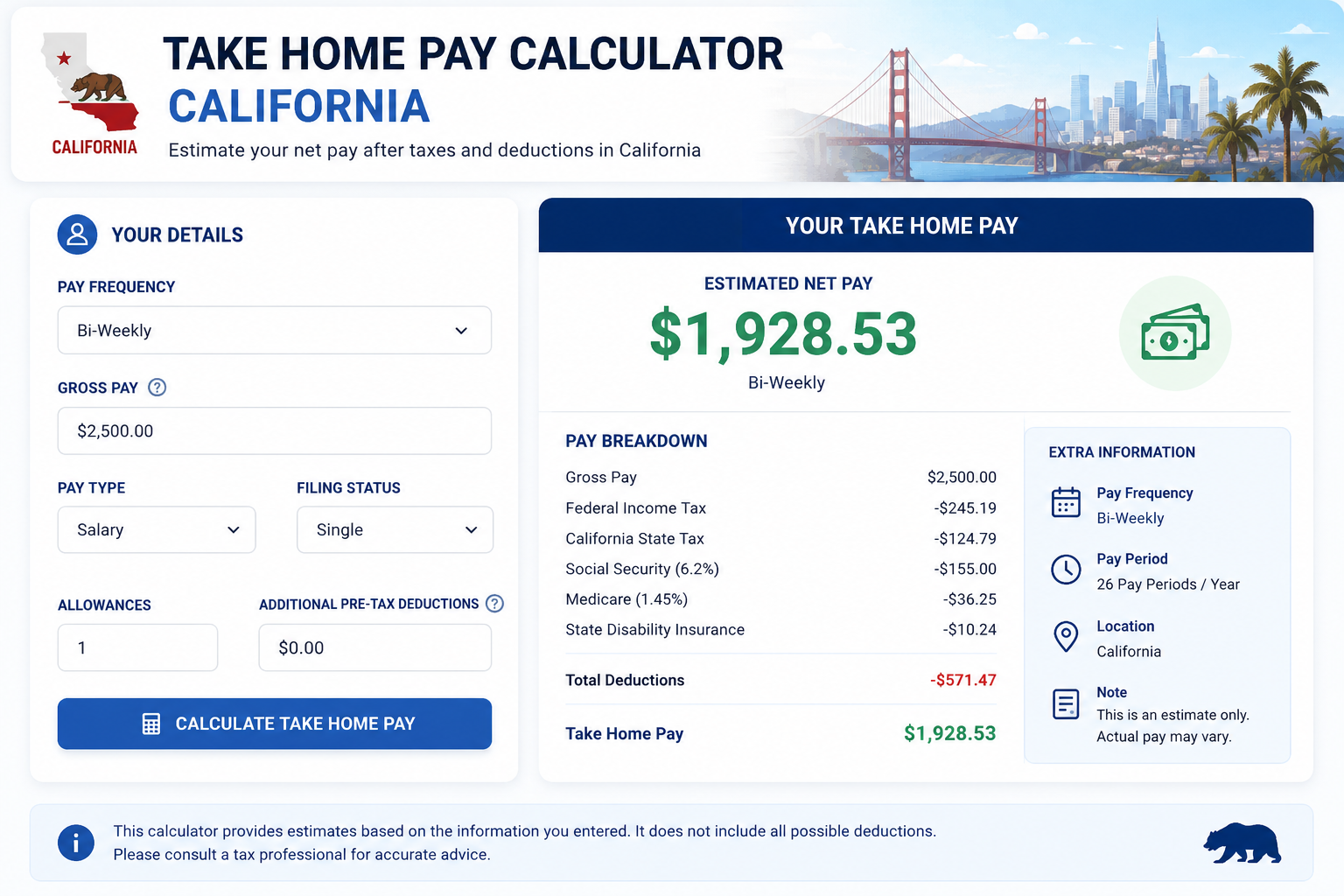
Knowing your salary is only part of the picture. What matters for your budget is how much money actually reaches your bank account after taxes and payroll deductions.
A take home pay calculator California helps estimate your net pay from your gross salary. It can account for federal income tax, California income tax, Social Security, Medicare, and California State Disability Insurance.
Your final paycheck can also change because of benefits, retirement contributions, health insurance, filing status, and other deductions. That is why a salary of $70,000 does not mean you receive $70,000 in spendable income.
This guide explains how California take-home pay works in 2026 and what you should consider when estimating your paycheck.
What Is Take-Home Pay in California?
Take-home pay is the amount left from your gross earnings after taxes and other payroll deductions have been removed.
Your gross pay is the amount you earn before deductions. Your net pay is what you actually receive.
For example, if your annual salary is $80,000, your employer does not simply divide that amount into paychecks and deposit the full amount. Federal taxes, California taxes, Social Security, Medicare, and other deductions may reduce each paycheck.
A take home pay calculator California makes this process easier by estimating the deductions that apply to your situation.
How a California Take-Home Pay Calculator Works
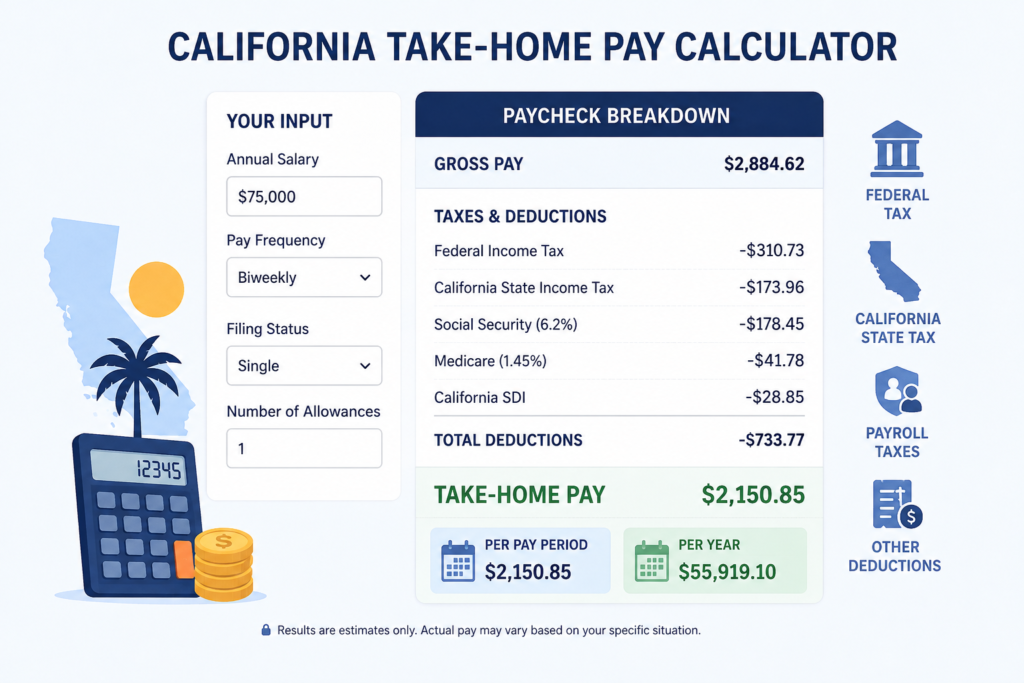
The calculation starts with your gross income. The calculator then estimates the taxes and deductions that reduce your taxable or disposable income.
Federal income tax depends on factors such as your filing status, taxable income, deductions, and credits. For 2026, the federal standard deduction is $16,100 for single taxpayers, $32,200 for married couples filing jointly, and $24,150 for heads of household.
California has its own income tax system. The state tax calculation is separate from federal income tax, so living and working in California can result in both federal and state income tax withholding.
Payroll taxes also affect your paycheck. Social Security and Medicare are generally withheld from employee wages, while California SDI is another employee deduction.
Because several factors interact, your exact paycheck can differ from a simple percentage calculation.
California Income Tax and Your Paycheck
California uses a progressive income tax system. This means different portions of taxable income can fall into different tax brackets.
Your entire salary is not automatically taxed at your highest applicable rate. Instead, each portion of taxable income is taxed according to the relevant bracket.
California also has its own deductions and withholding rules. As a result, your California income tax may differ significantly from what you would estimate using only federal tax rates.
A California paycheck calculator should therefore consider state income tax separately from federal income tax.
Federal Income Tax in 2026
Federal income tax is another major part of the take-home pay calculation.
For 2026, federal income tax rates for individuals range from 10% to 37%. The rate that applies to you depends on your taxable income and filing status.
For a single taxpayer, the 2026 federal brackets begin with a 10% rate on taxable income up to $12,400. Higher portions of taxable income move into the 12%, 22%, 24%, 32%, 35%, and 37% brackets.
The standard deduction can reduce the amount of income subject to federal income tax. However, your paycheck withholding is not necessarily the same as your final tax liability when you file a tax return.
Social Security and Medicare Taxes
Social Security and Medicare are commonly known as FICA taxes. They are generally deducted from employee wages.
Social Security tax applies at a set rate up to the applicable annual wage base. Medicare tax generally applies to covered wages, with an additional Medicare tax potentially affecting higher earners.
These payroll taxes are different from federal income tax. Even if your federal income tax is relatively low, Social Security and Medicare can still reduce your paycheck.
This is an important reason why gross salary and take-home pay can look very different.
California State Disability Insurance
California workers may also see State Disability Insurance, or SDI, deducted from their wages.
For 2026, California’s SDI withholding rate is 1.3%. California also has no SDI taxable wage ceiling, so covered wages remain subject to SDI throughout the year.
SDI helps fund disability and paid family leave benefits. Since it is an employee withholding, it can reduce the amount you receive in each paycheck.
When using a take home pay calculator California, including SDI can make the estimate more realistic.
Why Your Filing Status Matters
Your filing status can have a major effect on your estimated take-home pay.
A single taxpayer may have a different federal tax calculation from someone who files jointly with a spouse. Head-of-household status can also change the applicable federal tax brackets and standard deduction.
Your state tax calculation can also depend on your circumstances.
For this reason, two employees earning the same annual salary can receive different net pay. Filing status, dependents, deductions, credits, and benefits can all affect the final result.
How Pay Frequency Changes Your Paycheck
Your annual salary stays the same, but your paycheck amount depends on how often you are paid.
An employee paid weekly receives more paychecks each year than an employee paid monthly. Biweekly employees generally receive 26 paychecks per year, while semimonthly employees usually receive 24.
The annual net income should generally be considered separately from the amount shown on an individual paycheck.
A take home pay calculator California can help you convert an annual salary into weekly, biweekly, semimonthly, or monthly estimates.
California Take-Home Pay Example
Suppose an employee earns a gross salary of $75,000 per year in California.
The employee’s take-home pay will be lower than $75,000 because federal income tax, California income tax, Social Security, Medicare, and SDI may be withheld.
The exact result depends on filing status and other payroll information. Health insurance premiums, retirement contributions, flexible spending accounts, and other benefits can reduce the paycheck even further.
For that reason, a calculator should be treated as an estimate rather than a guaranteed payroll figure.
Gross Pay vs Net Pay
Gross pay is your earnings before deductions. Net pay is the amount remaining after deductions.
This difference matters when comparing job offers. A higher salary does not always create an equally large increase in take-home pay because the additional income may increase taxes and payroll deductions.
For budgeting, rent, savings, debt payments, and everyday expenses, net income is usually more useful than gross income.
That is why a take home pay calculator California can be helpful when planning your finances.
What Can Reduce Your California Take-Home Pay?
Taxes are not the only reason your paycheck can be smaller than expected.
Employer-sponsored health insurance, dental insurance, vision coverage, retirement contributions, health savings accounts, flexible spending accounts, and other voluntary deductions can reduce your net pay.
Some deductions may be taken before certain taxes are calculated, while others may be taken after tax withholding.
Your actual paystub is therefore the best source for your exact deductions. A calculator provides an estimate based on the information you enter.
How to Get a More Accurate Take-Home Pay Estimate
Start with your expected gross salary or hourly wage. Then enter your California location, filing status, pay frequency, and other relevant information.
If you receive bonuses, overtime, commissions, or irregular income, consider how those earnings may affect withholding.
You should also account for workplace benefits and retirement contributions if you want an estimate that is closer to your actual paycheck.
For the most accurate result, compare the calculator estimate with a recent paystub and adjust the deductions to match your employer’s payroll setup.
Why Your Actual Paycheck May Be Different
A calculator cannot always reproduce every detail of an employer’s payroll system.
Your employer may use specific withholding information from your tax forms. Your paycheck can also include deductions or benefits that you did not include in the calculator.
Changes in tax laws, withholding tables, bonuses, overtime, and personal circumstances can also affect your net pay.
Therefore, use the result as a planning estimate rather than a promise of exactly what will appear in your bank account.
Take Home Pay Calculator California for Salary Planning
A California take-home pay estimate can be useful before accepting a new job.
Instead of comparing salaries alone, you can estimate how much of each offer may remain after taxes and deductions.
For example, a job with a higher salary but expensive employee benefits may have a smaller difference in net pay than expected. Another employer may offer a slightly lower salary with better benefits or retirement contributions.
Looking at estimated take-home pay gives you a clearer picture of your overall compensation.
Conclusion
A take home pay calculator California helps turn a gross salary into a more useful estimate of your actual income.
The calculation can include federal income tax, California income tax, Social Security, Medicare, and California SDI. Your filing status, deductions, benefits, retirement contributions, and pay frequency can also change the final amount.
For 2026, updated federal tax rules and California payroll rates make it important to use current information when estimating your paycheck.
Use your estimated net pay for budgeting and salary comparisons, but always check your actual paystub for the final figures.
FAQs
How does a take home pay calculator California work?
A take home pay calculator California starts with your gross earnings and estimates deductions such as federal income tax, California income tax, Social Security, Medicare, and SDI. The result gives you an estimated net paycheck.
Is California income tax included in take-home pay?
Yes. California income tax can reduce your paycheck through state withholding. The amount depends on your income, filing status, and other relevant factors.
Does California have State Disability Insurance?
Yes. California SDI is generally withheld from employee wages. The 2026 SDI withholding rate is 1.3%, and covered wages have no taxable wage ceiling.
What is the difference between gross pay and take-home pay?
Gross pay is your earnings before deductions. Take-home pay, also called net pay, is what remains after taxes and other payroll deductions are taken out.
Does filing status affect California take-home pay?
Yes. Filing status can affect federal and California tax calculations. Single, married filing jointly, married filing separately, and head-of-household taxpayers can have different tax outcomes.
Does pay frequency change my annual take-home pay?
Pay frequency usually changes how your annual income is divided between paychecks rather than changing your annual salary. Weekly, biweekly, semimonthly, and monthly schedules produce different paycheck amounts.
Is a take home pay calculator California exact?
No. It provides an estimate. Your exact paycheck depends on your payroll information, tax withholding elections, benefits, deductions, and other individual circumstances.
For more updates visit: CALCIQ