


Table of Contents
- How to Use the Wallpaper Calculator
- Why Rolls Are Counted in Strips, Not Square Feet
- The Strip Method, Step by Step
- Two Worked Examples
- Pattern Repeat and Match Types
- Standard Wallpaper Roll Sizes
- Mistakes That Leave You Short of Paper
- FAQs
Wallpaper is one of the few decorating jobs where running out is a real problem. A roll bought later may come from a different print batch, and the colour can shift just enough to show. Ordering too much wastes money, but ordering too little can stall the whole room. This wallpaper calculator counts rolls the way professional hangers do, in whole strips, so the number you order matches the way the paper is actually used.
The wallpaper calculator asks for your room size, the number of doors, your roll size and the pattern repeat printed on the label. It then works out how many strips the room needs, how many strips fit on each roll, and how many rolls to buy. Below the tool you will find the method explained step by step, two worked examples, and a guide to roll sizes and pattern repeats.
Wallpaper Calculator
Enter your room size and roll size to count rolls the way hangers do — in whole strips, with the pattern repeat allowed for.
How to Use the Wallpaper Calculator
Measure the room first. You need the length, the width and the wall height, all in feet. Measure the wall height from the top of the skirting board to the ceiling, and use the tallest measurement if the ceiling slopes or the floor is uneven. Then count the standard doors in the room, because each door takes the place of a full-height strip.
Next, check your wallpaper label. Rolls sold in the United States and Europe are most often 20.5 inches wide and 33 feet long when sold as a double roll, and those are the defaults in the wallpaper calculator. If your roll is a different size, type the real width and length over the defaults. Finally, find the pattern repeat on the label. It is the vertical distance before the design repeats, printed in inches or centimetres. Enter 0 for plain, textured or random-match paper. Press the button, and the tool shows the rolls needed, the strips needed and the strips you will get from each roll.
If you are papering only one or two walls, such as a single feature wall, work from the strip count. Add up the widths of just the walls you plan to paper, divide that total in inches by the roll width, and round up. That gives you the strips you need. Then divide by the strips per roll figure from the tool to get your rolls. The method is the same; only the wall run changes.
Why Rolls Are Counted in Strips, Not Square Feet
Many quick estimators divide the wall area by the area printed on the roll. That method feels logical, but it quietly assumes you can use every inch of the roll. You cannot. Wallpaper hangs in full-height strips cut from the roll, and a leftover piece that is too short for a full strip is waste, no matter how much area it covers.
A standard double roll holds 33 feet of paper. On a room with 8 foot walls, each strip takes a little over 8 feet once trimming is added, so one roll gives you 3 full strips with a short piece left over. The area method counts that leftover as usable coverage and tells you to buy fewer rolls than you need. Specialist estimating guides such as Measure and Build’s wallpaper calculator guide warn about exactly this trap, because it leaves people one roll short on the final wall.
The strip method avoids the problem by counting in whole units. Strips needed is a whole number, strips per roll is a whole number, and rolls are the first divided by the second, rounded up. This wallpaper calculator uses that method, which is why its answers are sometimes one roll higher than area-based estimates. That extra roll is not padding. It is the paper the area method pretended you could use.
The Strip Method, Step by Step
Here is the full method, so you can check any result by hand:
- Find the wall run. Add the length and width of the room and double it to get the perimeter. Then subtract about 3 feet for each standard door, because you do not hang full strips across a doorway.
- Count the strips. Divide the remaining wall width, in inches, by the roll width in inches, and round up. That is how many full-height strips the room needs.
- Work out the strip cut length. Take the wall height and add 4 inches for trimming at the top and bottom. If the paper has a pattern repeat, round that length up to a whole number of repeats, so every strip starts at the same point in the design.
- Find strips per roll. Divide the roll length by the cut length and round down. A part-strip does not count.
- Divide and round up. Rolls needed equals strips needed divided by strips per roll, rounded up to the next whole roll.
The GetBuildTally wallpaper calculator guide sets out the same five steps, including the detail that windows are usually not deducted. You still need short strips above and below a window, and those pieces come from the same rolls.
Our tile calculator uses a similar whole-unit logic for tiles, and the roof square footage calculator helps if you are measuring up a whole house project at the same time.

Two Worked Examples
Example 1: a plain paper in a 12 × 14 foot room. The walls are 8 feet high and there is one standard door. The perimeter is 52 feet. Taking off 3 feet for the door leaves 49 feet of wall run, which is 588 inches. At 20.5 inches per strip, the room needs 588 ÷ 20.5 = 28.7, rounded up to 29 strips. Each strip is cut at 96 + 4 = 100 inches. A 33 foot roll is 396 inches, so it gives 396 ÷ 100 = 3 full strips. The room therefore needs 29 ÷ 3 = 9.7, rounded up to 10 rolls. The total wall area, for reference, is 416 square feet.
Example 2: the same room with a 21 inch pattern repeat. The strip count stays at 29, because the room has not changed. But now each strip must be cut to a whole number of repeats: the plain cut of 100 inches rounds up to 105 inches, which is five full repeats. The roll still gives 3 strips, so the answer stays at 10 rolls, although the waste per strip grows. That will not always happen. On a slightly taller wall, the longer cut can push a roll down from 3 strips to 2, and the roll count jumps sharply. This step effect is the single biggest reason patterned paper costs more than plain paper for the same room.
A smaller test from the same tool: a 10 × 12 foot room with 9 foot walls, two doors and a 12 inch repeat needs 23 strips. Each strip is cut at 120 inches, a roll gives 3 strips, and the total is 8 rolls for 396 square feet of wall.
Pattern Repeat and Match Types
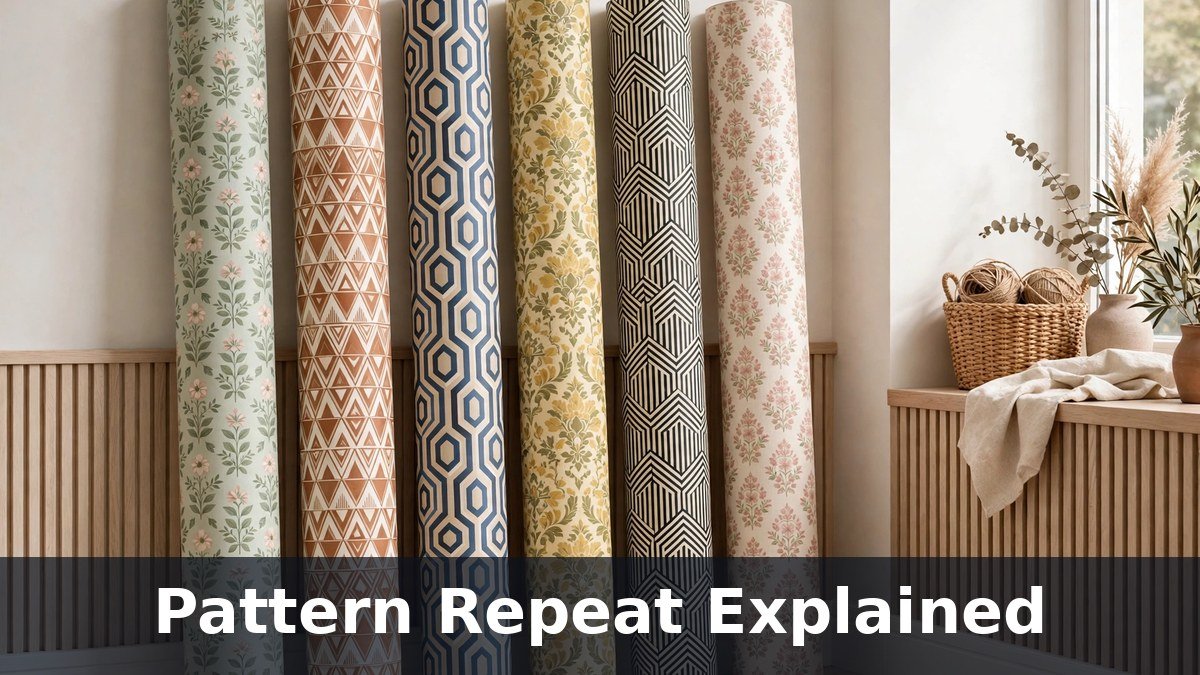
The pattern repeat is printed on every patterned roll’s label, and it drives the whole calculation. It is the vertical distance between one point in the design and the next identical point. Because neighbouring strips must line up at the seams, every strip starts at the same point in the pattern, and the cut length rounds up to the next full repeat.
| Match type | How it hangs | Effect on strips |
|---|---|---|
| Free or random match | No alignment needed between strips | No repeat waste, cut at wall height plus trim |
| Straight match | The pattern lines up at the same height on every strip | Cut length rounds up to a whole repeat |
| Half-drop match | Alternate strips shift down by half a repeat | Most waste, allow roughly 15 to 25 percent extra |
Size matters as much as type. A 12 inch repeat on an 8 foot wall divides exactly into 96 inches, so it wastes nothing beyond the normal trim. A 21 inch repeat on the same wall forces each strip to 105 inches and wastes 9 inches per strip. Large repeats of 24 inches or more can add a third or more to the paper a room needs. When you fall in love with a big, bold pattern, run it through the wallpaper calculator before you fall in love with the price.
Standard Wallpaper Roll Sizes
Roll names cause real confusion, because a ‘single roll’ is often sold only in multiples. In the United States, most residential wallpaper is priced by the single roll but packaged as a double roll, and you usually must buy the double. European rolls follow a standard metric size that is almost identical in practice.
| Roll type | Width | Length | Printed area |
|---|---|---|---|
| US double roll (most common) | 20.5 in | 33 ft | About 56 sq ft |
| US single roll | 20.5 in | 16.5 ft | About 28 sq ft |
| European roll | About 21 in | 33 ft (10.05 m) | About 57 sq ft (5.3 m²) |
| Wide roll | 27 in | 27 ft | About 61 sq ft |
Remember that printed area is not usable coverage. After cutting full-height strips and matching the pattern, a double roll that prints 56 square feet may cover only 30 to 40 square feet of wall. That gap is normal, and it is exactly why the strip method exists. If your walls are an awkward shape, our surface area calculator can help you measure up each wall on its own.
Mistakes That Leave You Short of Paper
The most common mistake is dividing wall area by roll area, which under-orders on almost every patterned paper. The second is deducting windows in full. You still paper above and below them, and those short strips must come from somewhere. The third is forgetting the repeat entirely and ordering as if the paper were plain.
Batch numbers cause a subtler failure. Rolls printed in different batches can vary slightly in colour, so buy every roll for a room in one order and check that the batch or lot number matches on each label. Finally, keep one spare roll if you can. Wallpaper tears, rooms get marked, and a matching roll bought today is the only reliable repair kit for five years from now.
FAQs
How many rolls of wallpaper do I need for a 12 × 14 room?
With 8 foot walls, one door and plain paper, a 12 × 14 foot room needs 10 double rolls. The room takes 29 strips, and each 33 foot roll gives 3 strips. Add a large pattern repeat and the count can rise, so run your exact repeat through the wallpaper calculator before ordering.
Should I deduct doors and windows?
Deduct doors, but not windows. A doorway replaces full-height strips, so the wallpaper calculator takes off about 3 feet of wall run per standard door. Windows still need short strips above and below them, and those pieces come out of the same rolls, so leaving windows in the measurement is the safer approach.
What is a pattern repeat?
It is the vertical distance before the design on the paper repeats itself, printed on the roll label in inches or centimetres. Because every strip must start at the same point in the design, strips are cut to a whole number of repeats. A bigger repeat means more waste per strip and fewer strips per roll.
How many strips do I get from one roll?
It depends on your wall height and repeat. On an 8 foot wall with plain paper, a standard 33 foot double roll gives 3 full strips, because each strip is cut at 100 inches including trim. Taller walls or a large repeat can drop that to 2, which is why the roll count can jump between two similar rooms.
Is it better to buy an extra roll?
Yes, one spare roll is cheap insurance. It covers a torn strip during hanging, a mistake in cutting, and repairs years later. Just make sure every roll in the order carries the same batch number, because colours can vary slightly between print batches.
What is the difference between a single roll and a double roll?
A double roll is simply twice as long as a single roll of the same width, about 33 feet against 16.5 feet at the common 20.5 inch width. Prices are often quoted per single roll even though the paper is sold in doubles, so compare the length as well as the price when you shop.
For more updates visit: CALCIQ