

Table of Contents
- What Is Compression Ratio?
- How to Use the Compression Ratio Calculator
- The Compression Ratio Formula
- Worked Example: A 350 Small-Block V8
- How Each Part Changes the Ratio
- Typical Compression Ratios
- Static vs Dynamic Compression Ratio
- Common Mistakes to Avoid
- FAQs
Compression ratio is the single number that says the most about how an engine is built: how hard it squeezes the air and fuel mixture before the spark fires. It shapes power, efficiency, the fuel the engine needs, and how close it runs to knock. Use the calculator at the top of this page to work out the static ratio of any engine from its bore, stroke and clearance volumes, then read on for the formula, a fully worked small-block V8 example, and a look at how each part moves the number.
Compression Ratio Calculator
| Swept volume per cylinder | |
| Head gasket volume | |
| Deck clearance volume | |
| Total clearance volume | |
| Total engine displacement | |
| Displacement in litres | |
| Displacement in cubic inches |
Volumes are worked out from the standard cylinder formula. One cubic inch = 16.387064 cc. Results are a guide for planning; always confirm with your engine builder and measured volumes.
What Is Compression Ratio?
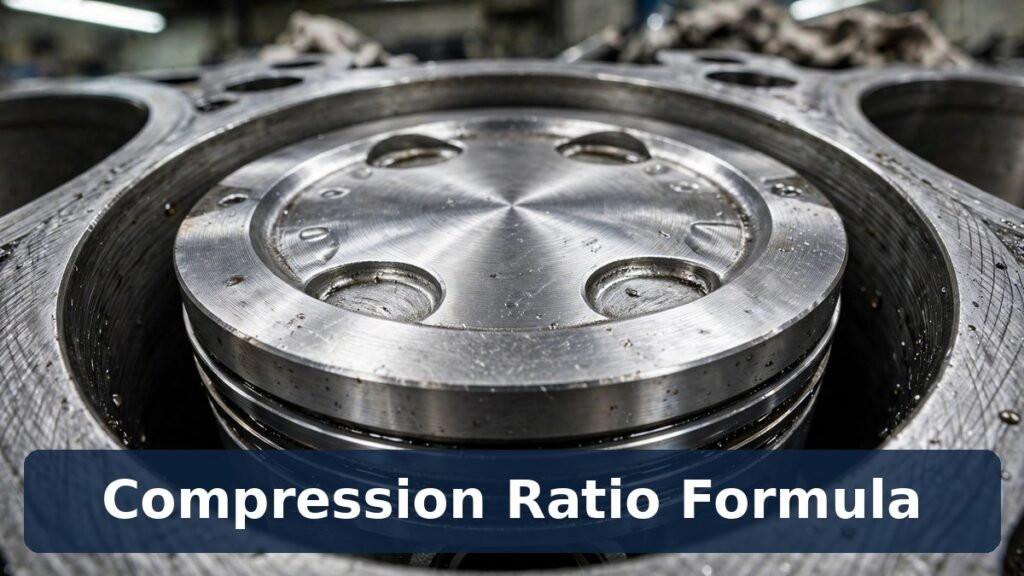
Every piston travels between two end points. At bottom dead centre (BDC) the cylinder holds its largest volume; at top dead centre (TDC) it holds its smallest. The compression ratio simply compares the two: the volume at BDC divided by the volume at TDC, written like 10.21:1 and read as “ten point two one to one”.
The BDC volume is made of two parts. The swept volume is the space the piston sweeps through as it travels — set by the bore and the stroke. The clearance volume is everything still left above the piston at TDC: the combustion chamber, the head gasket, the gap down to the deck of the block, and any dish or dome in the piston crown. Because the swept volume is usually ten or so times bigger than the clearance volume, small changes to the clearance side move the ratio a lot — a theme that runs through the worked example below. Milling a head, choosing a gasket or swapping pistons all change it.
How to Use the Compression Ratio Calculator
Enter the bore and stroke in inches, the number of cylinders, and the chamber volume in cc. Then describe the piston: choose flat top, dish or dome, and type its volume in cc (0 for a flat top). A dish adds to the clearance volume and lowers the ratio; a dome takes space away and raises it, which is why the type matters, not just the number.
Next come the head gasket bore and its compressed thickness, and the deck clearance — how far below the deck surface the piston sits at TDC. Press Calculate and the tool returns the ratio, the swept volume of one cylinder, each clearance volume separately, and the full displacement in cc, litres and cubic inches. If the clearance volume comes out at zero or less, the tool says so, because that points to a dome volume that cannot physically fit the chamber — a useful warning before parts are ordered.
The Compression Ratio Formula
The whole calculation rests on one ratio and one cylinder-volume formula:
Compression ratio = (swept volume + clearance volume) ÷ clearance volume
Swept volume = π ÷ 4 × bore² × stroke
The same pair of formulas, with the clearance volume broken into chamber, gasket, deck and piston parts, is the standard method set out in engine references and used by PowerNation’s compression calculator guide, which also notes the unit conversion below. The gasket volume and deck volume use the cylinder formula too, with the gasket’s own bore and compressed thickness for the gasket, and the cylinder bore and deck height for the deck clearance.
Because bores and strokes are usually measured in inches while chamber volumes are measured in cc, everything is converted to cc first: one cubic inch equals 16.387064 cc. The ratio itself has no units, so as long as every volume is in the same unit before dividing, the answer is the same. Displacement is the swept volume of one cylinder multiplied by the number of cylinders.
Worked Example: A 350 Small-Block V8
Take the classic small-block combination: a 4.000 inch bore, a 3.480 inch stroke and eight cylinders, with 64 cc chambers, flat-top pistons, a head gasket with a 4.060 inch bore and 0.041 inch compressed thickness, and the pistons sitting 0.025 inch below the deck.
Start with the swept volume of one cylinder: π ÷ 4 × 4.000² × 3.480 = 43.73 cubic inches, which is 716.62 cc. The gasket volume is π ÷ 4 × 4.060² × 0.041, giving 8.70 cc. The deck volume is π ÷ 4 × 4.000² × 0.025, giving 5.15 cc. Adding the clearance parts together: 64 + 0 + 8.70 + 5.15 = 77.85 cc.
Now the ratio: (716.62 + 77.85) ÷ 77.85 = 10.21, so this engine has a compression ratio of 10.21:1. Its total displacement is 716.62 × 8 = 5,733.0 cc, or 5.73 litres — the familiar 349.8 cubic inches of a “350” V8.
| Part | Size | Volume |
|---|---|---|
| Swept volume, one cylinder | Bore 4.000 in × stroke 3.480 in | 716.62 cc |
| Combustion chamber | Measured in the head | 64.00 cc |
| Piston (flat top) | No dish or dome | 0.00 cc |
| Head gasket | 4.060 in bore × 0.041 in thick | 8.70 cc |
| Deck clearance | 0.025 in below deck | 5.15 cc |
| Total clearance volume | All clearance parts added | 77.85 cc |
| Compression ratio | (716.62 + 77.85) ÷ 77.85 | 10.21:1 |
| Total displacement | 716.62 cc × 8 cylinders | 5,733.0 cc (5.73 L) |
How Each Part Changes the Ratio
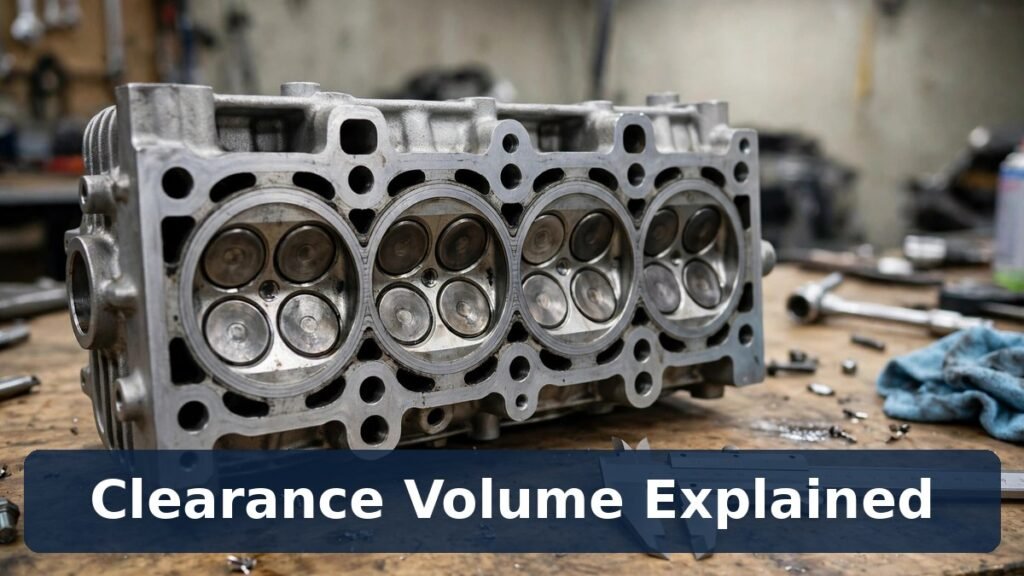
Holding the worked example steady and changing one part at a time shows where the leverage is. The clearance volume is small, so everything that touches it matters; the swept volume is large, so bore and stroke changes move the ratio gently by comparison.
Swap the flat-top pistons for a set with a 6 cc dish and clearance grows to 83.85 cc, dropping the ratio to 9.55:1. Go the other way with a dome that takes away 10 cc and clearance falls to 67.85 cc, lifting the ratio to 11.56:1. Even the head gasket counts: a thinner 0.028 inch gasket shrinks the gasket volume from 8.70 cc to 5.94 cc and raises the ratio from 10.21:1 to 10.54:1. This is why builders measure everything rather than trusting catalogue figures, and why a head skim can need a gasket change to put the ratio back where it was planned.
| Change from the worked example | Clearance volume | Compression ratio |
|---|---|---|
| As built (flat top, 0.041 in gasket) | 77.85 cc | 10.21:1 |
| Dished pistons, +6 cc | 83.85 cc | 9.55:1 |
| Domed pistons, −10 cc | 67.85 cc | 11.56:1 |
| Thinner gasket, 0.028 in | 75.09 cc | 10.54:1 |
Typical Compression Ratios
Ratios cluster by engine type and fuel. A smaller four-cylinder example shows the other end of the scale: a 3.40 inch bore and 3.00 inch stroke with 58 cc chambers and a 4 cc piston dish works out to 446.34 cc swept per cylinder, 71.07 cc of clearance, and 7.28:1, totalling 1,785.4 cc. The ranges below are commonly found in production and performance engines; treat them as planning guides, not targets. While you are comparing engine numbers, our tire size calculator and mileage calculator cover the rolling side of the same project car.
| Engine type | Typical static ratio |
|---|---|
| Older low-compression petrol engines | 7.0:1 – 8.5:1 |
| Modern naturally aspirated petrol, street use | 9.0:1 – 11.0:1 |
| High-performance naturally aspirated petrol | 11.0:1 – 12.5:1 |
| Turbocharged or supercharged petrol | 8.5:1 – 10.0:1 |
| Diesel engines | 14.0:1 – 22.0:1 |
Boosted engines run lower static ratios because the turbo or supercharger adds its own squeeze on top. Diesels run far higher ratios because they rely on compression heat alone to ignite the fuel — a completely different job from a spark-ignition engine.
Static vs Dynamic Compression Ratio
Everything above is the static ratio: pure geometry, using the full stroke. The dynamic ratio is lower, because the intake valve is still open as the piston starts rising, so the effective squeezing only begins when the valve closes. Dynamic ratio therefore depends on the camshaft as well as the parts list.
The static ratio is still the right planning number for comparing builds, and it is what this calculator — like the method summarised at acalculator.org’s compression ratio guide, which traces the formula to Heywood’s standard engine textbook — is designed to give. Just remember that two engines with the same static ratio but different cams can behave quite differently on the road.
Common Mistakes to Avoid
The most frequent error is forgetting a clearance part — usually the deck clearance or the gasket — which makes the clearance volume too small and the ratio too high. The second is mixing units: bore in inches, chamber in cc and stroke in millimetres on the same page will quietly wreck the answer, so convert everything first. Third, using the uncompressed gasket thickness instead of the compressed thickness the maker specifies. Fourth, treating a domed piston’s volume as a positive number. A dome takes space away, so it must come off the clearance volume; entering it the wrong way round swings the result in exactly the wrong direction. Finally, measuring chamber volume without sealing the valves gives a figure that looks precise and is not.
FAQs
What is a good compression ratio for a street engine?
For a naturally aspirated petrol engine on modern pump fuel, somewhere around 9.5:1 to 10.5:1 is a common, comfortable zone for street use, balancing response and economy without demanding high-octane fuel. The worked example on this page, at 10.21:1, sits right in that band. The right figure still depends on the camshaft, fuel available and how the car is used.
How do you calculate compression ratio?
Add the swept volume and the clearance volume together, then divide by the clearance volume: CR = (Vs + Vc) ÷ Vc. The swept volume of one cylinder is π ÷ 4 × bore² × stroke, and the clearance volume is the chamber, head gasket, deck clearance and piston dish or dome volumes combined, all in the same unit.
Does a thicker head gasket lower compression?
Yes. A thicker gasket holds more volume, which increases the clearance volume and lowers the ratio. In the worked example, moving from a 0.028 inch gasket to a 0.041 inch gasket drops the ratio from 10.54:1 to 10.21:1. Builders sometimes use gasket thickness as a fine adjustment, though it also changes the quench (squish) distance, so it is not a free adjustment.
What is the difference between static and dynamic compression ratio?
The static ratio is worked out from geometry alone, using the full stroke, and is the figure quoted for an engine’s specification. The dynamic ratio accounts for the intake valve still being open at the start of the compression stroke, so it is always lower and depends on camshaft timing. Static is the planning number; dynamic is closer to what the running engine experiences.
How much does a dished piston change the ratio?
More than most people expect, because the dish adds straight to the small clearance volume. In the worked example, a modest 6 cc dish drops the ratio from 10.21:1 to 9.55:1 — a change of about two-thirds of a point from a part many buyers treat as a minor detail.
Can a compression ratio be too high?
Yes. Squeeze the mixture too hard for the fuel in the tank and it can ignite early or all at once, causing knock (detonation), which costs power and can damage pistons and bearings. That is why very high ratios go with high-octane or specialist fuels, and why boosted engines keep their static ratios modest.
For more updates visit: CALCIQ


