


If you work in Ohio, your gross pay and your take-home pay are two very different numbers, and an ohio paycheck calculator shows you exactly where the difference goes. First, Ohio now applies a single flat state income tax rate under House Bill 96. In addition, most Ohio cities charge their own municipal income tax on top of it. As a result, two workers on the same salary can take home different amounts in different cities. This guide explains every deduction, and it then walks through a full $60,000 example.
Table of Contents
- How the Ohio Paycheck Calculator Works
- Ohio Pay Calculator Inputs: What You Need to Enter
- Federal Taxes in Your Ohio Paycheck
- Ohio State Tax in 2026: What the Ohio Paycheck Calculator Deducts
- Municipal and School District Taxes in the Ohio Pay Calculator
- Ohio Paycheck Calculator Example: $60,000 Salary in Columbus
- Take-Home Pay by Pay Frequency With the Ohio Pay Calculator
- Hourly Pay, Overtime, and the Ohio Paycheck Calculator
- Simple Ways to Increase Your Ohio Take-Home Pay
- FAQs
How the Ohio Paycheck Calculator Works
Essentially, the ohio paycheck calculator follows the same order your employer’s payroll system uses. First, it starts with your gross pay. Next, it subtracts pre-tax deductions, such as 401(k) contributions or health premiums. Then, it calculates federal, FICA, Ohio, city, and school district taxes in turn.
However, the order matters. For example, a 401(k) contribution lowers federal and state income tax, yet not Social Security or Medicare tax. In short, accurate inputs give realistic results.
Ohio Pay Calculator Inputs: What You Need to Enter
Before you calculate, gather a few details from your latest pay stub. You need your gross pay, pay frequency, and federal filing status. In addition, you need the exemptions on your Ohio Form IT 4, because that form controls your state withholding. You also need your work city and home city, since municipal tax depends on both.
For instance, enter your 401(k) percentage, health premium, and any HSA contribution; hourly workers should also add weekly hours plus overtime. Once entered, the ohio pay calculator combines the federal, state, and local layers in seconds.
Federal Taxes in Your Ohio Paycheck
Federal withholding is the largest deduction for most Ohio workers, so the calculator handles it first. Under IRS Revenue Procedure 2025-32, the 2026 standard deduction is $16,100 for single filers and $32,200 for married couples filing jointly. The tax is progressive, so each slice of income faces its own rate: for a single filer, 10% on the first $12,400 of taxable income, 12% up to $50,400, and 22% up to $105,700.
Next, every paycheck includes FICA taxes, which fund Social Security and Medicare. According to IRS Topic No. 751, employees pay 6.2% for Social Security on wages up to the 2026 wage base of $184,500, plus 1.45% for Medicare on all wages. Together, those rates remove 7.65% of gross pay.
Ohio State Tax in 2026: What the Ohio Paycheck Calculator Deducts
Ohio rewrote its income tax for 2026, and the ohio paycheck calculator now uses a much simpler formula. Under House Bill 96, one flat rate replaces the old graduated brackets, which topped out at 3.125% in 2025. The Ohio Department of Taxation structure starts with Ohio adjusted gross income, minus a personal exemption for you, your spouse, and each dependent: $2,350 per person when modified income is $40,000 or less, $2,100 from $40,001 to $80,000, and $1,850 above $80,000.
After exemptions, the formula is straightforward. If the remaining balance is $26,050 or less, you owe no Ohio income tax. Above that balance, tax is $332 plus 2.75% of the amount over $26,050, per Ohio Revised Code Section 5747.02. Therefore, your effective rate always stays below the 2.75% marginal rate.
| Ohio tax layer (2026) | Rate or amount | How it applies |
|---|---|---|
| State income tax, balance up to $26,050 | 0% | No tax after personal exemptions |
| State income tax, balance over $26,050 | $332 + 2.75% of the excess | Flat rate under House Bill 96 |
| Personal exemption (income $40,001–$80,000) | $2,100 per person | For you, a spouse, and each dependent |
| Municipal income tax, Columbus and Cleveland | 2.5% | On qualifying wages, from the first dollar |
| Municipal income tax, Cincinnati | 1.8% | On qualifying wages, from the first dollar |
| School district income tax | 0.25%–2% | Only in about 210 districts, based on where you live |
Unlike some states, Ohio has no standard deduction of its own, so the exemption and the $26,050 threshold do that job. For comparison, our Florida paycheck calculator guide shows a state with no income tax at all.
Municipal and School District Taxes in the Ohio Pay Calculator
Local taxes are the part of an Ohio paycheck national tools often miss, so the ohio pay calculator treats them separately. Roughly 600 Ohio municipalities levy an income tax, usually between 0.5% and 3%. Columbus and Cleveland both charge 2.5%, while Cincinnati charges 1.8%. Typically, your employer withholds for the city where you work, and your home city usually credits that tax.
In addition, many Ohioans pay a school district income tax where they live. About 210 districts levy it for 2026, at 0.25% to 2%, filed separately on Form SD 100. Interestingly, the Columbus, Cleveland, and Cincinnati city school districts levy none. Before you rely on an estimate, check your exact rates with the Ohio Department of Taxation, because one local point changes a $60,000 salary’s take-home pay by $600 a year.
Ohio Paycheck Calculator Example: $60,000 Salary in Columbus
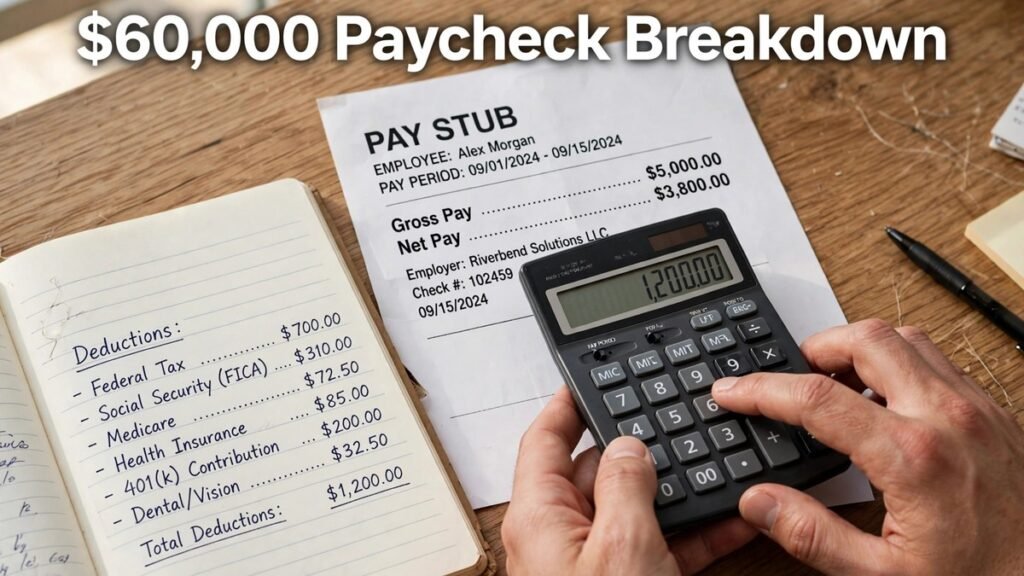
Now, let us run the ohio paycheck calculator on a concrete case: a single filer who earns $60,000, lives and works in Columbus, claims one Ohio exemption, and has no pre-tax deductions or school district tax. First, federal taxable income is $60,000 minus the $16,100 standard deduction, or $43,900. The federal tax is then $1,240 at 10% on the first $12,400, plus $3,780 at 12% on the remaining $31,500, giving $5,020.
Next, FICA takes 6.2% for Social Security ($3,720) plus 1.45% for Medicare ($870). After that, Ohio applies its formula: $60,000 minus the $2,100 exemption leaves $57,900, and tax is $332 plus 2.75% of the $31,850 above the threshold, or $1,207.88. Finally, Columbus tax takes 2.5% of $60,000, or $1,500.
| Line item | Calculation | Annual amount |
|---|---|---|
| Gross salary | — | $60,000.00 |
| Federal taxable income | $60,000 − $16,100 standard deduction | $43,900.00 |
| Federal income tax | $1,240 + 12% × $31,500 | −$5,020.00 |
| Social Security tax | 6.2% × $60,000 | −$3,720.00 |
| Medicare tax | 1.45% × $60,000 | −$870.00 |
| Ohio taxable income | $60,000 − $2,100 personal exemption | $57,900.00 |
| Ohio state income tax | $332 + 2.75% × ($57,900 − $26,050) | −$1,207.88 |
| Columbus municipal tax | 2.5% × $60,000 | −$1,500.00 |
| Total tax | $5,020 + $4,590 + $1,207.88 + $1,500 | −$12,317.88 |
| Net take-home pay | $60,000 − $12,317.88 | $47,682.12 |
Altogether, this worker keeps about 79.5% of gross pay, an effective rate of roughly 20.5%. Federal deductions cause most of the gap, while state and city taxes remove $2,707.88 together. Even so, this example benchmarks any central Ohio offer well.
Take-Home Pay by Pay Frequency With the Ohio Pay Calculator
Annual figures are useful, but you budget from each paycheck. Therefore, the ohio pay calculator also splits the same $60,000 example across the common pay schedules, rounded to the nearest cent.
| Pay frequency | Periods per year | Gross pay per period | Take-home pay per period |
|---|---|---|---|
| Monthly | 12 | $5,000.00 | $3,973.51 |
| Semi-monthly | 24 | $2,500.00 | $1,986.76 |
| Bi-weekly | 26 | $2,307.69 | $1,833.93 |
| Weekly | 52 | $1,153.85 | $916.96 |
Notice that bi-weekly pay creates two months a year with three paychecks instead of two. Many Ohio workers treat those extra checks as built-in savings. In contrast, monthly pay is simpler to budget, yet offers no bonus months

Hourly Pay, Overtime, and the Ohio Paycheck Calculator
Hourly workers can use the ohio paycheck calculator just as easily as salaried staff. Simply multiply your hourly rate by your weekly hours, then by 52, to estimate annual gross pay. For reference, Ohio’s 2026 minimum wage is $11.00 per hour for non-tipped employees, per the Ohio Department of Commerce. At 40 hours a week, that equals $22,880 a year before tax.
Overtime changes the picture quickly, because hours beyond 40 in a week pay one and a half times your normal rate. To model a heavy overtime month, our time and a half calculator shows the gross overtime pay first; you can then run that total through this guide’s tax steps. Keep in mind, though, that one large paycheck is often withheld as if you earned it all year, so any excess returns as a refund.
Simple Ways to Increase Your Ohio Take-Home Pay
Fortunately, you can raise your net pay without changing jobs. First, review your Ohio Form IT 4 and claim every exemption you are entitled to, since missing exemptions inflate withholding all year. Next, update your federal Form W-4 after a major life change, such as marriage or a new child. In addition, pre-tax 401(k) and HSA contributions lower taxable wages, so each contribution costs less than its face value.
For example, a move from Columbus at 2.5% to a township with no municipal tax saves $1,500 a year on $60,000. Finally, compare offers on net pay, not gross pay.
FAQs
How accurate is the ohio paycheck calculator for 2026?
It is accurate for standard W-2 wages with your real filing status, exemptions, city, and deductions. However, bonuses and multiple jobs can shift your final liability. Therefore, treat it as a close estimate and compare it with your first real pay stub.
What is the Ohio state income tax rate in 2026?
Ohio charges no tax on the first $26,050 after personal exemptions. Above that, one flat rate of 2.75% applies, calculated as $332 plus 2.75% of the excess. House Bill 96 removed the old higher bracket for 2026.
Does the ohio pay calculator include Columbus and Cleveland city tax?
Yes. It includes municipal tax separately, because Ohio cities tax wages apart from the state. Columbus and Cleveland charge 2.5%, and Cincinnati charges 1.8%. In addition, about 210 school districts add 0.25% to 2%, based on where you live.
How much tax comes out of a $60,000 paycheck in Ohio?
In our Columbus example, a single filer on $60,000 pays $5,020 federal income tax, $4,590 FICA, $1,207.88 Ohio tax, and $1,500 city tax. Altogether, that is $12,317.88, leaving $47,682.12. Your figures change with filing status, deductions, and city.
What is the minimum wage in Ohio for 2026?
Ohio’s 2026 minimum wage is $11.00 per hour for non-tipped employees, up from $10.70, per the Ohio Department of Commerce. Tipped employees receive $5.50 plus tips. Moreover, smaller employers below $405,000 in gross receipts follow the federal $7.25 minimum.
Why does my Ohio take-home pay change during the year?
Several events change net pay mid-year. For example, Social Security withholding stops once wages pass the $184,500 wage base, so late-year checks grow. Raises, overtime, benefit changes, and updated W-4 or IT 4 forms also shift withholding. Consequently, recheck after any change.
For more updates visit: CALCIQ



Comments 4