

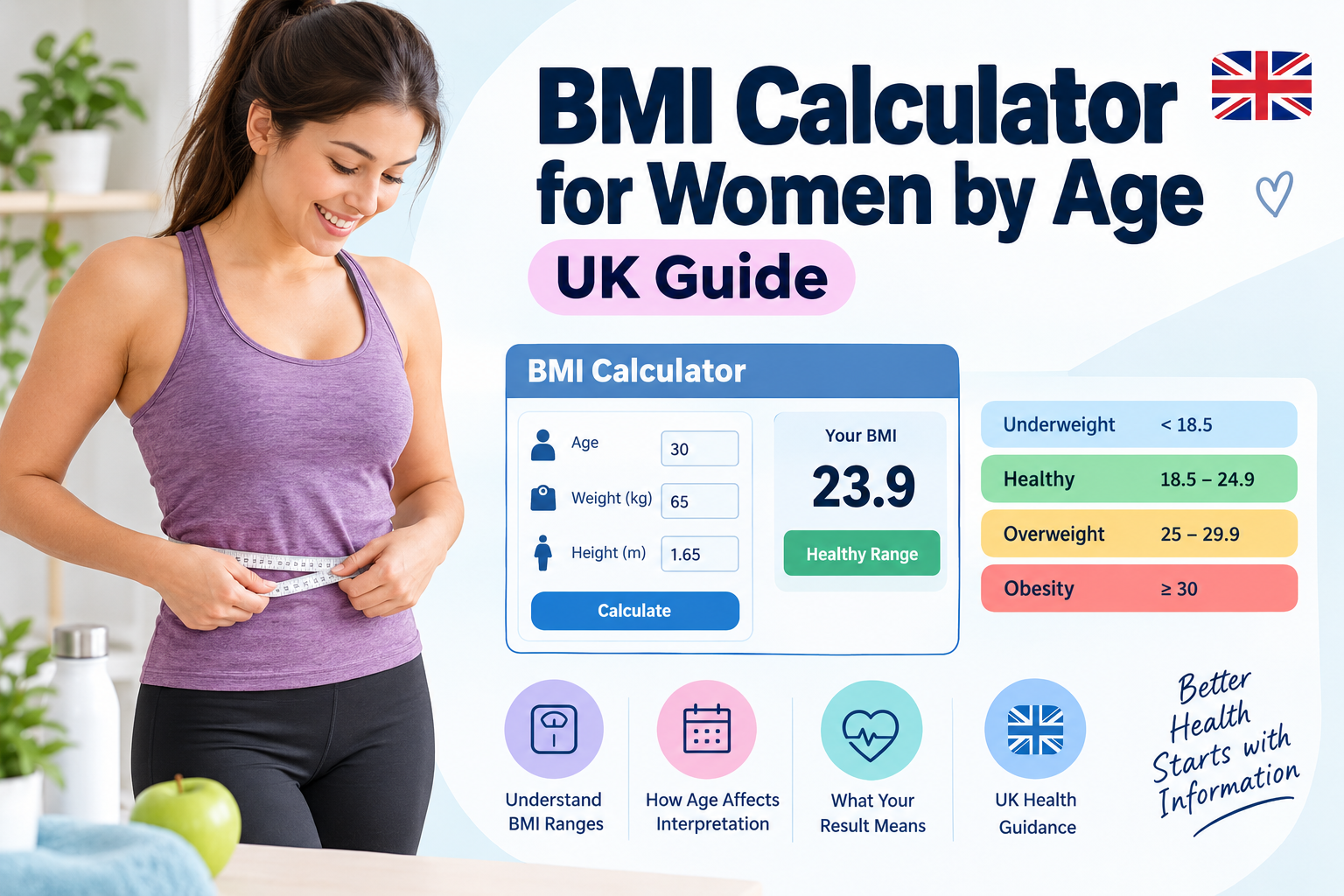
A BMI calculator for women by age can help you understand how your body weight compares with your height. However, age can create confusion because adult BMI is not normally calculated using a different formula for each age group.
For adult women, BMI is based mainly on height and weight. Your age can still provide useful context when interpreting the result, especially as body composition can change throughout adulthood.
This guide explains how a BMI calculator women age tool works, what the numbers mean in the UK, and why BMI should not be viewed as a complete measure of health.
What Is BMI?
Body mass index, commonly called BMI, is a measurement that compares your weight with your height. It provides a simple way to place an adult’s weight into a general weight category.
The standard BMI formula uses weight in kilograms divided by height in metres squared. For example, someone weighing 70 kg and measuring 1.70 metres tall would have a BMI of about 24.2.
BMI is useful because it provides a quick screening measurement. However, it does not directly measure body fat, muscle mass, bone density, or where fat is stored around the body.
BMI Calculator Women Age: Does Age Change the Result?
For adult women, age does not normally change the basic BMI calculation. A woman aged 25 and a woman aged 55 who have the same height and weight will have the same BMI.
This is an important point when using a BMI calculator women age tool. The calculator may ask for your age, but the age itself may be used to provide additional context rather than change the basic BMI formula.
Age can still matter when considering body composition and overall health. Muscle mass may decrease with age, while body fat distribution can also change.
Therefore, two women with the same BMI can have different body compositions and different health considerations.
How to Calculate BMI for Women
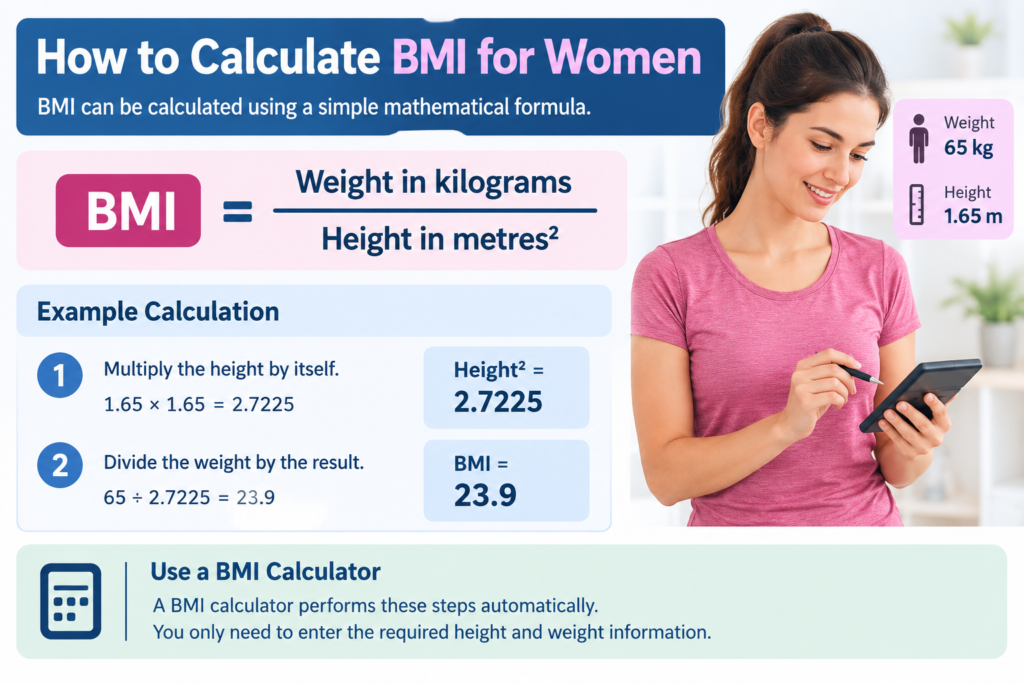
BMI can be calculated using a simple mathematical formula.
BMI = Weight in kilograms ÷ Height in metres²
Suppose a woman weighs 65 kg and is 1.65 metres tall. First, multiply 1.65 by 1.65 to get 2.7225.
Then divide 65 by 2.7225. The resulting BMI is approximately 23.9.
A BMI calculator performs these steps automatically. You only need to enter the required height and weight information.
What Is a Healthy BMI for Adult Women?
For most adults, including adult women, a BMI from 18.5 to 24.9 is generally considered the healthy range.
A BMI below 18.5 is generally classified as underweight. A BMI from 25 to 29.9 is generally classified as overweight, while a BMI of 30 or above falls within the obesity category.
These categories are useful for screening, but they do not provide a complete picture of an individual’s health.
For example, someone with a high level of muscle mass may have a higher BMI without having a high level of body fat.
BMI by Age for Women
BMI for Women in Their 20s
Women in their 20s can use the standard adult BMI categories. Age does not require a separate BMI formula for this group.
However, lifestyle, muscle mass, physical activity, diet, and genetics can all influence body composition.
BMI for Women in Their 30s
The same adult BMI categories generally apply during the 30s. Changes in activity levels, pregnancy, lifestyle, and body composition can affect weight during this stage of life.
For this reason, BMI can be useful as one measurement rather than the only measurement.
BMI for Women in Their 40s
During the 40s, changes in body composition may become more noticeable for some women. Weight distribution can also change over time.
A BMI calculator can still provide a useful screening result, but waist measurement and other health factors may provide additional information.
BMI for Women in Their 50s
Women in their 50s may experience further changes in muscle mass and body fat distribution. Hormonal changes can also influence how body weight is distributed.
The standard adult BMI categories still apply. However, the number should be considered alongside other factors rather than interpreted in isolation.
BMI for Women Over 60
Older women can experience changes in muscle mass, bone health, mobility, and body composition. These factors can make BMI less informative when it is used alone.
A BMI result can still provide a general screening measurement. However, overall health, physical function, waist measurement, diet, and medical history may also be important.
Does BMI Differ for Women and Men?
The standard BMI formula is the same for adult women and men. It uses weight and height rather than sex-specific mathematical calculations.
However, men and women can have different body compositions at the same BMI. Women generally have a higher proportion of body fat than men at equivalent BMI levels.
This means BMI should be interpreted as a screening measure rather than a direct measurement of body fat.
Why Waist Size Can Matter
Where body fat is stored can also affect health risk. Fat carried around the waist is associated with increased health risks, particularly when compared with fat stored in other areas.
For this reason, waist measurement can provide additional information alongside BMI.
A person can have a BMI within the usual range while still carrying a relatively high amount of abdominal fat. Conversely, a person with a higher BMI may have substantial muscle mass.
Using more than one measurement can therefore provide a broader picture.
When BMI May Not Be Suitable
BMI is not appropriate for everyone in the same way. It can be less useful for people with very high muscle mass because muscle weighs more than fat.
It may also require different interpretation during pregnancy. Pregnancy-related weight gain includes the baby, placenta, fluid, and other changes that make ordinary BMI interpretation unsuitable.
Children and teenagers also use different BMI methods. Their BMI is interpreted according to age and sex because their bodies are still growing and developing.
If you have concerns about your weight, eating habits, or health, a healthcare professional can help interpret measurements in the context of your individual circumstances.
How to Use a BMI Calculator for Women Age
A BMI calculator is straightforward to use. Enter your current weight and height using the requested units.
If the calculator asks for your age, enter your current age accurately. For an adult, the age may provide additional information without changing the standard BMI calculation.
Check the resulting BMI and its associated category. Remember that the result is a screening measurement and should not be treated as a diagnosis.
For a more complete assessment, consider the result alongside waist measurement, activity levels, diet, medical history, and other relevant health information.
Common Mistakes When Calculating BMI
One common mistake is entering height in centimetres when the calculator expects metres. For example, 165 cm needs to be converted to 1.65 metres when using the standard metric formula.
Another mistake is using an old weight instead of your current weight. Small changes in either height or weight can affect the final BMI.
It is also important not to assume that BMI tells you exactly how much body fat you have. It is a screening tool, not a direct body composition test.
BMI and Weight Loss for Women
BMI can sometimes be used to monitor changes during a weight-management programme. However, the number should not become the only measure of progress.
Changes in fitness, strength, waist measurement, energy levels, and daily habits can also provide useful information.
A gradual and sustainable approach is generally more useful than focusing only on reaching a particular BMI number. Individual goals can also vary depending on health circumstances and professional advice.
Conclusion
A BMI calculator women age tool can provide a quick estimate of BMI using your height and weight. For adult women, the basic BMI calculation does not normally change simply because you are older.
Age can still provide useful context because body composition, muscle mass, and fat distribution can change throughout adulthood.
BMI is therefore best viewed as one screening measurement rather than a complete assessment of health. Combining BMI with other relevant measurements and professional guidance can provide a clearer understanding of your health and weight.
FAQs
Does BMI change with age for women?
The standard adult BMI calculation does not change based on age. A woman’s BMI is calculated from her weight and height. However, age can affect body composition and how the result should be considered.
What is a healthy BMI for a woman?
For most adults, a BMI between 18.5 and 24.9 is generally considered the healthy range. However, BMI is only a screening measure and does not account for every factor affecting health.
Does a BMI calculator need your age?
Some calculators ask for age to provide additional context. For adults, age does not normally change the standard BMI formula. Children and teenagers require different BMI interpretation based on age and sex.
Is BMI different for women and men?
The standard BMI formula is the same for adult women and men. However, body composition can differ between sexes, so BMI may not represent body fat in exactly the same way for everyone.
What BMI is considered overweight for women?
For adults, a BMI of 25 to 29.9 is generally classified as overweight. BMI categories are screening ranges and should not be treated as a diagnosis.
Can a woman have a healthy BMI but still have too much body fat?
Yes. BMI does not directly measure body fat or show where fat is stored. A person can have a BMI within the usual range while having a higher level of body fat.
For more updates visit: CALCIQ