

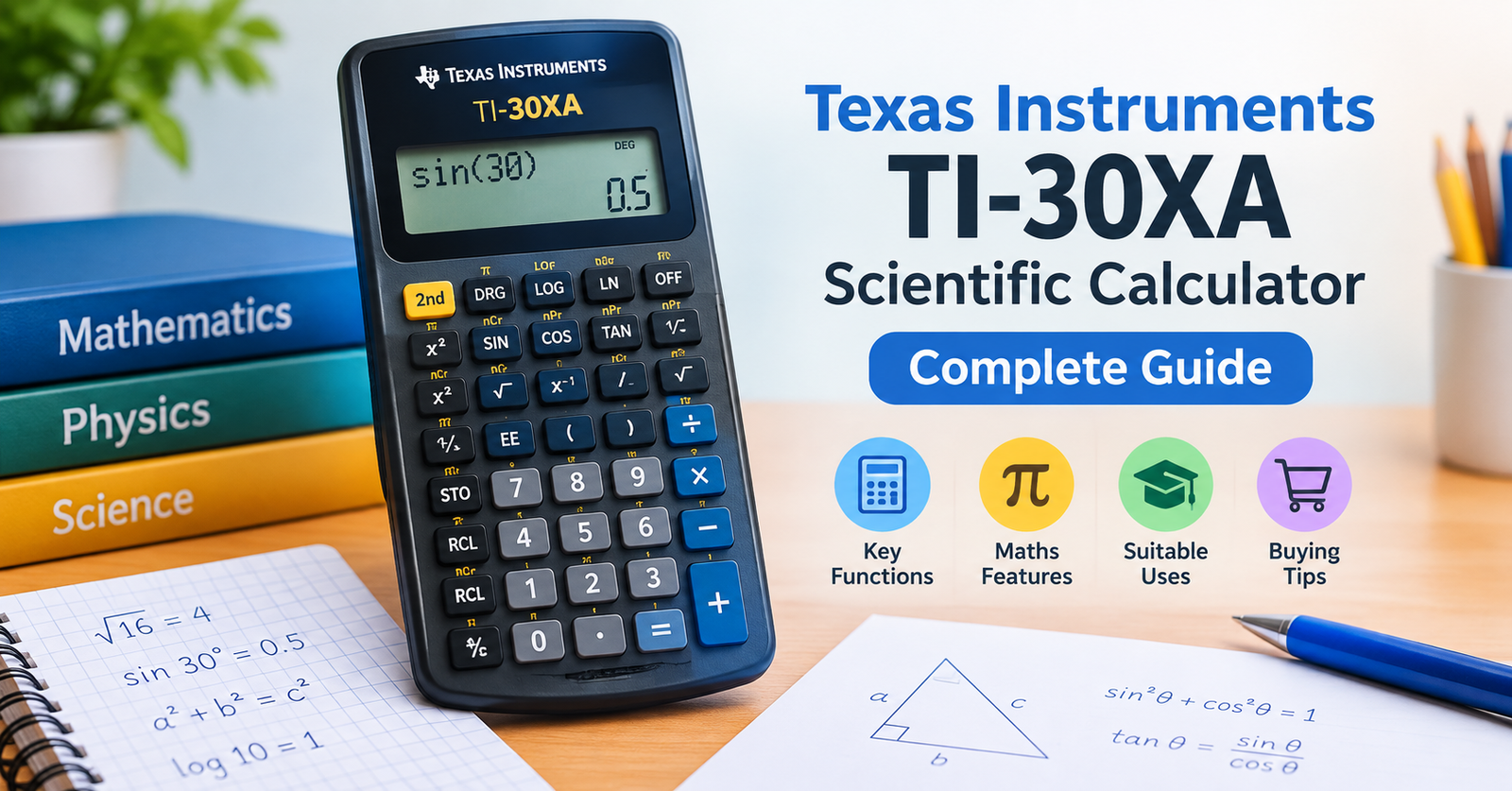
Finding a reliable scientific calculator does not always mean choosing a complicated model. The Texas Instruments TI-30XA scientific calculator is designed for everyday mathematical work, from basic calculations to more advanced scientific functions.
Its familiar layout makes it useful for students, teachers, and anyone who needs more than a standard calculator. It can handle common scientific operations without adding unnecessary complexity.
This guide explains what the calculator can do, who may benefit from it, and how to use its main functions effectively.
What Is the Texas Instruments TI-30XA Scientific Calculator?
The Texas Instruments TI-30XA is a compact scientific calculator from Texas Instruments. It provides functions for mathematical calculations that go beyond basic addition, subtraction, multiplication, and division.
The calculator supports common scientific operations such as powers, roots, logarithms, trigonometric functions, and other mathematical calculations. It also includes features that can help with fractions and percentage-based calculations.
For students, the straightforward design can make it easier to focus on the maths rather than learning a complicated calculator interface.
The Texas Instruments TI-30XA scientific calculator is also portable. Its compact size makes it convenient for school, college, university, or general use.
Who Can Use the TI-30XA?
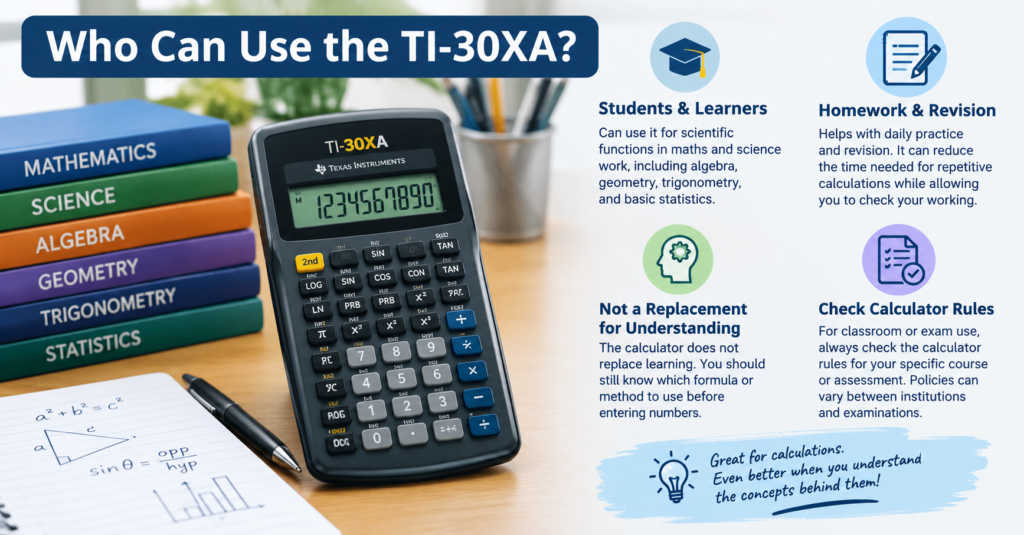
The TI-30XA can suit learners who need scientific functions for maths and science work. It can be useful for calculations involving algebra, geometry, trigonometry, and basic statistics.
Students may also find the calculator helpful during homework and revision. It can reduce the time needed for repetitive calculations while allowing the user to check manual working.
However, the calculator is not designed to replace understanding. Students should still know which formula or mathematical method they need before entering numbers.
For classroom or exam use, always check the calculator rules for the specific course or assessment. Calculator policies can vary between institutions and examinations.
Key Functions of the TI-30XA
The main strength of this scientific calculator is its range of mathematical functions.
Scientific Calculations
The calculator can perform powers and roots, which are useful in algebra and science. These functions can help when working with equations, measurements, and mathematical expressions.
ALSO READ: NJ Sales Tax Calculator Calculate New Jersey Sales Tax
It also provides logarithmic functions. These are commonly used in higher-level mathematics and scientific calculations.
Trigonometric functions are another important feature. They can be useful when solving problems involving angles and triangles.
Fractions and Decimals
Working between fractions and decimals is common in school mathematics. A scientific calculator can make these conversions easier during calculations.
The TI-30XA can help users work with fractional values without relying on separate manual calculations for every step.
This can be useful when checking homework or confirming an answer after completing the working by hand.
Percentage Calculations
Percentage calculations appear in many everyday situations. Students may also encounter them in maths, business, finance, and science.
The calculator can handle percentage operations alongside other mathematical functions. This makes it more versatile than a basic four-function calculator.
Still, users should understand whether a problem asks for a percentage, percentage change, or percentage point difference.
Using Trigonometric Functions
Trigonometry is one area where a scientific calculator becomes particularly useful.
Functions such as sine, cosine, and tangent can help solve problems involving angles and sides. However, the correct angle mode is important.
A calculator can work with different angle measurements, such as degrees and radians. If the wrong mode is selected, the final answer can look incorrect even when the numbers were entered correctly.
Therefore, check the required angle mode before solving a trigonometry problem.
This simple step can prevent many common calculator errors.
Why Students May Prefer a Simple Scientific Calculator
Modern calculators can include advanced features, large displays, graphing functions, and programmable options. Those features can be useful, but they are not necessary for every student.
A simpler scientific calculator can be easier to learn. Users can become familiar with the key functions without navigating through complex menus.
The TI-30XA follows this practical approach. Its design focuses on commonly needed mathematical operations.
For learners who want a calculator for standard maths and science work, that simplicity can be useful.
TI-30XA for School and College Maths
The calculator can support several areas of mathematics.
Algebra students can use scientific functions while checking calculations and working with powers or roots. Geometry students may use trigonometric functions for angle-related problems.
Science students can also use scientific notation and mathematical functions when handling measurements and calculations.
The calculator should still be viewed as a supporting tool. Showing the correct method remains important, especially in school and examination settings.
A calculator can confirm a result, but it cannot explain why a particular formula should be used.
Common Mistakes When Using the Calculator
Even a simple scientific calculator can produce unexpected results when the wrong settings or input method is used.
One common mistake involves entering brackets incorrectly. Mathematical expressions can change significantly when brackets are missing or placed in the wrong position.
Another issue involves angle modes. Using radians when a problem requires degrees can produce a completely different trigonometric result.
Users should also avoid rounding too early. Keeping more accurate values during intermediate calculations can help produce a better final answer.
Finally, always check the displayed expression before accepting the result. A calculator only processes the information entered into it.
Is the Texas Instruments TI-30XA Scientific Calculator Worth Using?
The answer depends on what you need from a calculator.
Someone who needs advanced graphing, programming, or complex equation-solving features may require a more advanced model. Those users may benefit from a calculator designed for higher-level mathematical work.
On the other hand, learners who mainly need standard scientific functions may prefer a simpler option.
The Texas Instruments TI-30XA scientific calculator provides a practical set of functions for everyday scientific and mathematical calculations. Its straightforward approach can make it suitable for users who do not need advanced graphical features.
Before buying one, consider the requirements of your course, exam, or workplace.
How to Get Better Results From the TI-30XA
Learning the important calculator keys can save time. Start by becoming comfortable with basic operations, brackets, powers, roots, fractions, and trigonometric functions.
Next, practise entering complete expressions rather than relying on repeated calculations. This can reduce mistakes and make longer problems easier to check.
It is also useful to practise with the calculator before an important test. Familiarity with the keypad means you can spend more time solving the question itself.
Most importantly, understand the mathematics behind the calculation. A calculator works best when it supports your existing knowledge.
Conclusion
The Texas Instruments TI-30XA scientific calculator offers a practical way to handle common scientific and mathematical calculations. It provides useful functions for areas such as algebra, trigonometry, fractions, powers, roots, and percentages.
Its straightforward design can make it suitable for students and everyday users who need more than a basic calculator.
Before using it in an examination, check the specific calculator rules for your course or awarding body. For normal study and calculation work, the TI-30XA can provide a useful balance between functionality and simplicity.
FAQs
What is the Texas Instruments TI-30XA used for?
The calculator is used for scientific and mathematical calculations. It can help with areas such as algebra, trigonometry, powers, roots, fractions, percentages, and other common operations.
Is the TI-30XA suitable for students?
Yes. Its scientific functions can support students studying maths and science. However, students should check whether their school or examination allows the model they plan to use.
Is the TI-30XA a scientific calculator?
Yes. The TI-30XA is a scientific calculator rather than a basic four-function calculator. It provides additional mathematical functions for scientific and educational calculations.
Can the TI-30XA calculate trigonometry?
Yes. The calculator provides common trigonometric functions. Users should select the correct angle mode before calculating sine, cosine, or tangent values.
Can the TI-30XA work with fractions?
The calculator supports mathematical operations involving fractions. This can make it useful for school and college calculations where fractional values are involved.
Does the TI-30XA work with logarithms?
Yes. Logarithmic functions are among the scientific operations available on the calculator. These functions can be useful in mathematics and science problems.
For more updates visit: CALCIQ