

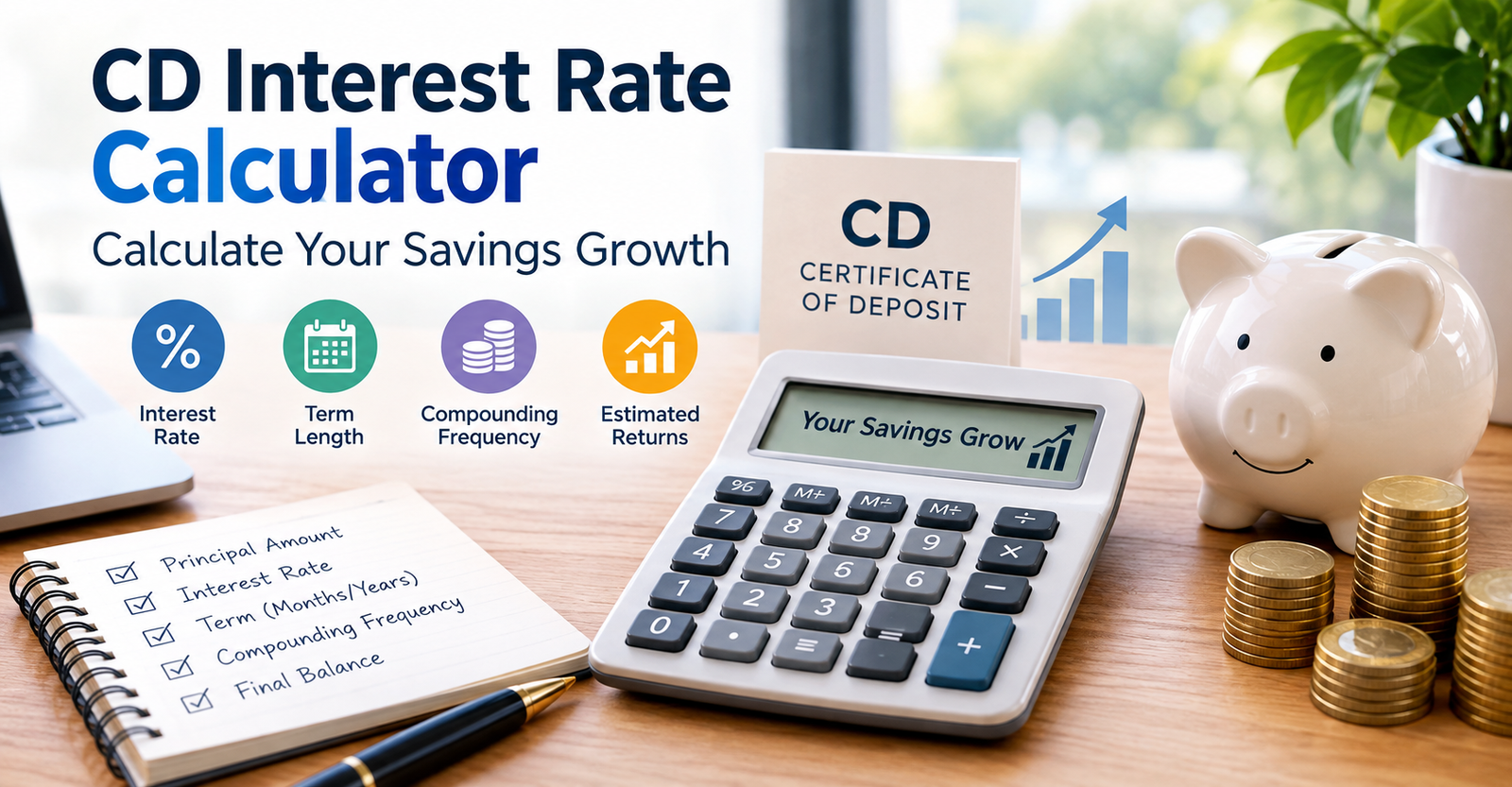
A CD interest rate calculator helps you estimate how much your money could grow in a certificate of deposit. It can show your expected interest and final balance after the CD term ends.
The calculation usually depends on your starting deposit, interest rate, term length, and compounding frequency. By entering these details, you can estimate your potential return before opening an account.
Although CDs are mainly associated with the United States, UK savers can use the same principles for fixed-rate savings accounts. The names and account rules may differ, but the basic interest calculation remains useful.
What Is a CD Interest Rate Calculator?
A CD interest rate calculator is a financial tool that estimates the value of a certificate of deposit over a set period. It uses your initial deposit and interest rate to calculate potential earnings.
A certificate of deposit normally locks money away for a fixed term. In return, the account may offer a fixed interest rate for that period.
The calculator can help you understand how much interest you may earn. It can also show the estimated balance at maturity.
For UK users, a fixed-rate savings calculator can provide a similar calculation. Instead of a CD, you may see products described as fixed-rate bonds or fixed-term savings accounts.
How Does a CD Interest Rate Calculator Work?
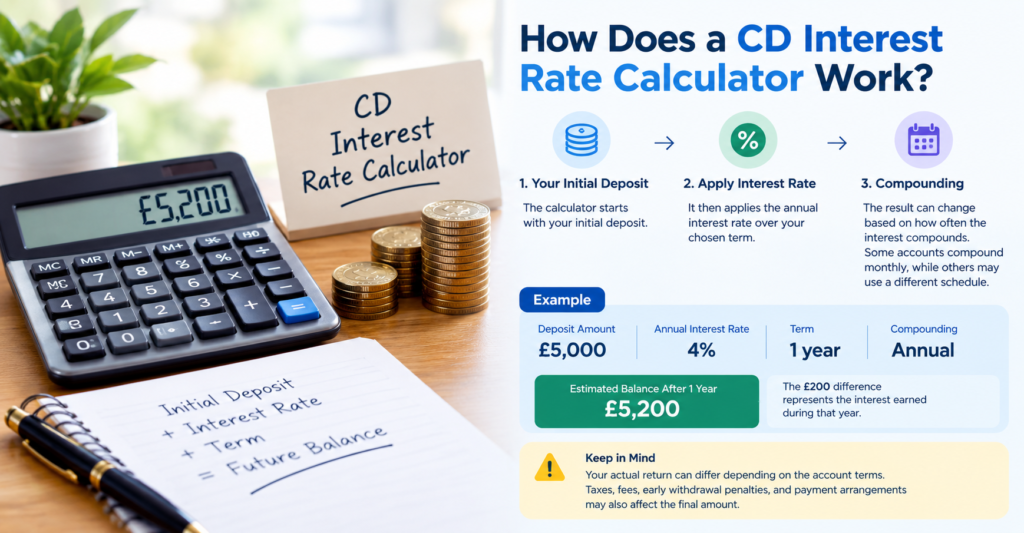
The calculator starts with your initial deposit. It then applies the annual interest rate over your chosen term.
The result can change based on how often the interest compounds. Some accounts compound interest monthly, while others may use a different schedule.
For example, imagine you deposit £5,000 into an account with a 4% annual interest rate. If the interest calculation uses annual compounding, the estimated balance after one year would be £5,200.
The £200 difference represents the interest earned during that year.
Your actual return can differ depending on the account terms. Taxes, fees, early withdrawal penalties, and payment arrangements may also affect the final amount.
CD Interest Rate Calculator Formula
A common compound interest formula is:
A = P(1 + r/n)^(nt)
Here, A represents the final balance. P represents the initial deposit.
The letter r represents the annual interest rate as a decimal. The letter n represents the number of compounding periods per year.
Finally, t represents the number of years.
Suppose you invest £5,000 at an annual rate of 4%. If interest compounds annually for one year, the calculation becomes:
A = £5,000 × (1 + 0.04/1)^(1 × 1)
This produces an estimated balance of £5,200.
The exact formula used by a financial institution may depend on its interest calculation method. Therefore, treat calculator results as estimates unless the account provider confirms the calculation.
Why APY Matters When Comparing CD Rates
The advertised interest rate does not always tell the whole story. You should also understand the difference between an annual interest rate and APY.
APY stands for Annual Percentage Yield. It reflects the effect of compounding during a year.
For example, two accounts could advertise similar rates but compound interest differently. Their effective yearly returns could therefore differ.
A CD interest rate calculator can help you understand this difference. However, always check whether the rate entered into the calculator is a nominal rate or an APY.
Using the wrong figure can produce an inaccurate estimate.
How to Calculate CD Interest
Start by identifying the amount you plan to deposit. Next, find the annual interest rate offered by the account.
Then, check the CD term. A term may last several months or several years.
You should also check how often interest compounds. Monthly, quarterly, and annual compounding can produce different results.
Enter these details into the calculator. The tool can then estimate your interest and final balance.
For instance, a £10,000 deposit earning 4% for one year would generate about £400 in simple annual interest. With compounding, the exact result depends on the account’s compounding schedule.
What Information Do You Need?
A useful calculator normally requires a few basic details.
Your starting deposit is the first key figure. This is the amount you initially place into the account.
The interest rate is another important input. Make sure you enter the correct annual rate.
You also need the investment period. A six-month term and a five-year term can produce very different results.
Finally, check the compounding frequency. This helps the calculator estimate how interest accumulates during the term.
CD Interest Rate Calculator for UK Savers
The term CD is not commonly used in the UK. British banks generally offer products such as fixed-rate savings accounts and fixed-rate bonds.
However, the underlying calculation can be similar. You deposit money, receive interest at an agreed rate, and keep the money invested for a defined period.
UK savers should therefore check the specific account conditions before using a CD calculator. The provider may calculate or pay interest differently.
Tax treatment can also vary depending on the account and your personal circumstances. An estimate from a calculator should not be treated as a tax calculation.
Compound Interest and CD Growth
Compounding allows earned interest to become part of the balance. Future interest can then apply to that larger amount.
This effect becomes more noticeable over longer periods. However, the impact depends on the interest rate and compounding schedule.
A CD interest rate calculator makes this growth easier to understand. You can change the deposit, rate, or term and see how the estimated result changes.
That makes the calculator useful when planning savings goals.
What Happens When a CD Matures?
A CD reaches maturity when its agreed term ends. At that point, the account holder may receive the original deposit plus earned interest.
The available options depend on the account provider. Some products may automatically renew unless you provide different instructions.
Before maturity, review the account terms and available options. Interest rates can change between the time you open an account and the time you reinvest.
A calculator can estimate the maturity value, but it cannot determine what product will be available later.
Factors That Can Change Your Final Return
Several factors can affect your actual earnings.
The interest rate has a direct effect on your return. A higher rate generally produces more interest when other conditions remain the same.
The deposit amount also matters. A larger starting balance can generate more interest at the same rate.
The term length is important as well. Keeping money invested for longer can provide more time for interest to accumulate.
Compounding frequency can make a difference too. Finally, account rules can affect your result if withdrawals, fees, or penalties apply.
Common Mistakes When Using a CD Calculator
One common mistake is entering a monthly rate as an annual rate. Always check the unit shown beside the interest rate.
Another mistake is confusing APY with the nominal annual interest rate. These figures are not always interchangeable.
People also sometimes ignore the account term. A calculator needs the correct period to produce a useful estimate.
Finally, remember that calculator results are estimates. Your actual return depends on the account’s terms and how the provider calculates interest.
Benefits of Using a CD Interest Rate Calculator
A calculator gives you a quick way to estimate potential savings growth. You can test different deposits, interest rates, and terms.
It can also help you understand the effect of compound interest. Instead of relying only on an advertised rate, you can see a projected balance.
The tool is also useful before committing money for a fixed period. You can estimate the return and consider whether the account fits your savings plans.
However, a calculator should support your research rather than replace the account’s official terms.
Conclusion
A CD interest rate calculator can make fixed-term savings easier to understand. It estimates potential interest and the balance you could have at maturity.
The most important inputs include your starting deposit, annual interest rate, term, and compounding frequency. For UK savers, similar calculations can apply to fixed-rate savings products.
Before making a decision, check the exact account conditions. Also consider access restrictions, interest payments, taxes, and any early withdrawal rules.
With accurate inputs, a calculator provides a useful estimate of how your savings could grow.
FAQs
What is a CD interest rate calculator?
A CD interest rate calculator estimates the interest and final balance of a certificate of deposit. It uses details such as your deposit, interest rate, term, and compounding frequency.
How is CD interest calculated?
CD interest can be calculated using a compound interest formula. The calculation depends on the starting balance, annual rate, term, and number of compounding periods.
What does APY mean on a CD?
APY means Annual Percentage Yield. It represents the yearly return while accounting for the effect of compounding.
Can I use a CD calculator in the UK?
Yes. UK savers can use the same basic interest calculations for fixed-rate savings products. However, UK account names and terms may differ from US CDs.
Does a higher CD rate always produce more interest?
A higher rate generally produces more interest when the deposit, term, and other conditions are the same. However, account terms can affect the final return.
Does compounding affect CD returns?
Yes. Compounding can increase the amount earned because previously credited interest can become part of the balance.
For more updates visit: CALCIQ