

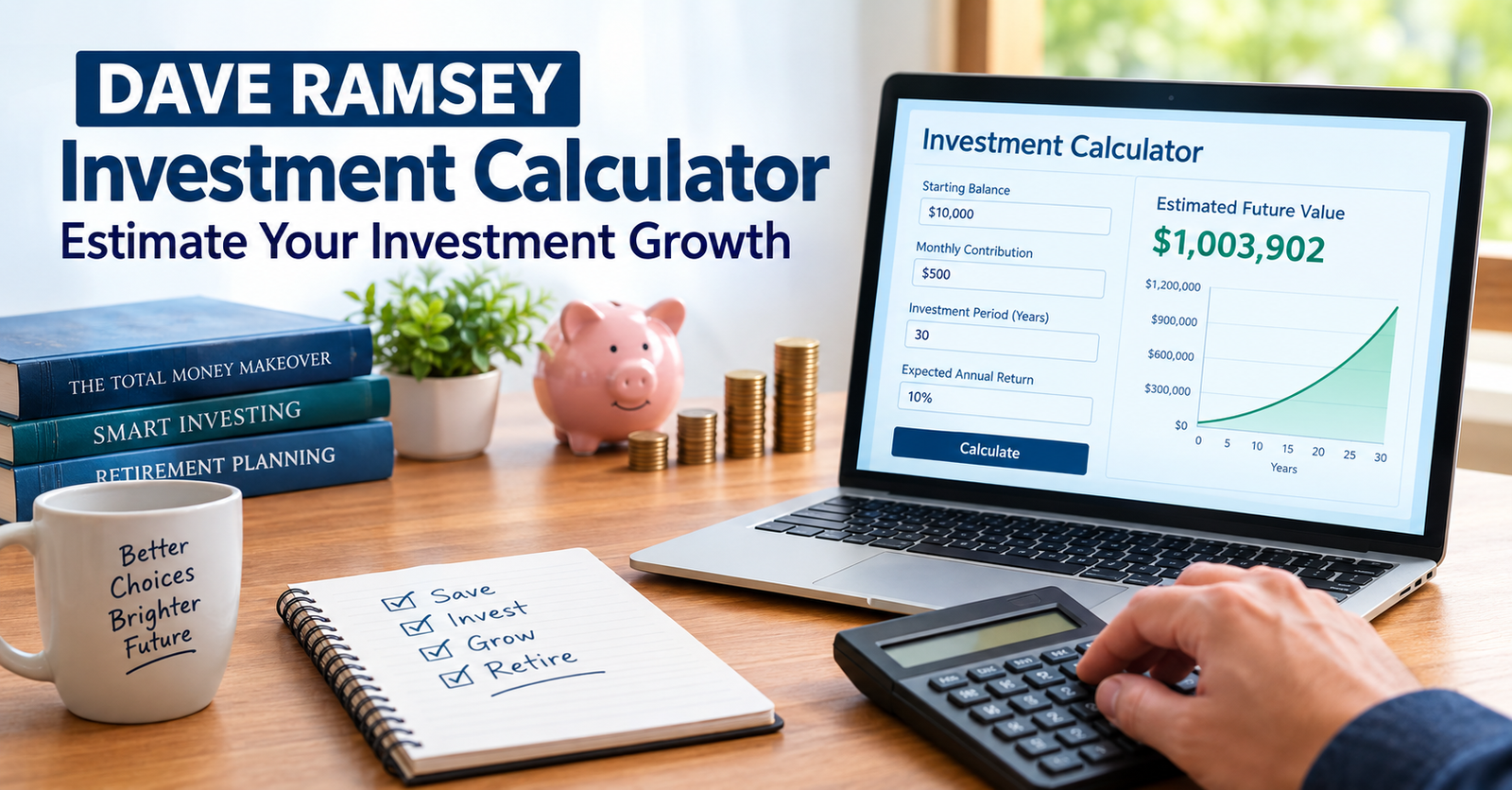
Planning for retirement can feel difficult when you do not know how much your money could grow. An investment calculator can make the process easier by turning your savings plan into a future estimate.
The Dave Ramsey investment calculator is designed to help investors explore potential investment growth over time. You can use figures such as your current balance, regular contributions, investment period, and expected return.
The result is an estimate rather than a promise. Investment returns change from year to year. Therefore, your actual results can differ from any calculator projection.
What Is the Dave Ramsey Investment Calculator?
The Dave Ramsey investment calculator is a tool for estimating how investments may grow over a chosen period. It helps show the effect of regular contributions and long-term compound growth.
You can adjust the numbers to create different scenarios. For example, you might compare investing £300 per month with investing £500 per month.
The calculator can also help you understand how time affects your potential results. Starting earlier gives your contributions more time to compound.
This makes the tool useful for people who are planning retirement or reviewing their long-term savings goals.
How Does the Dave Ramsey Investment Calculator Work?
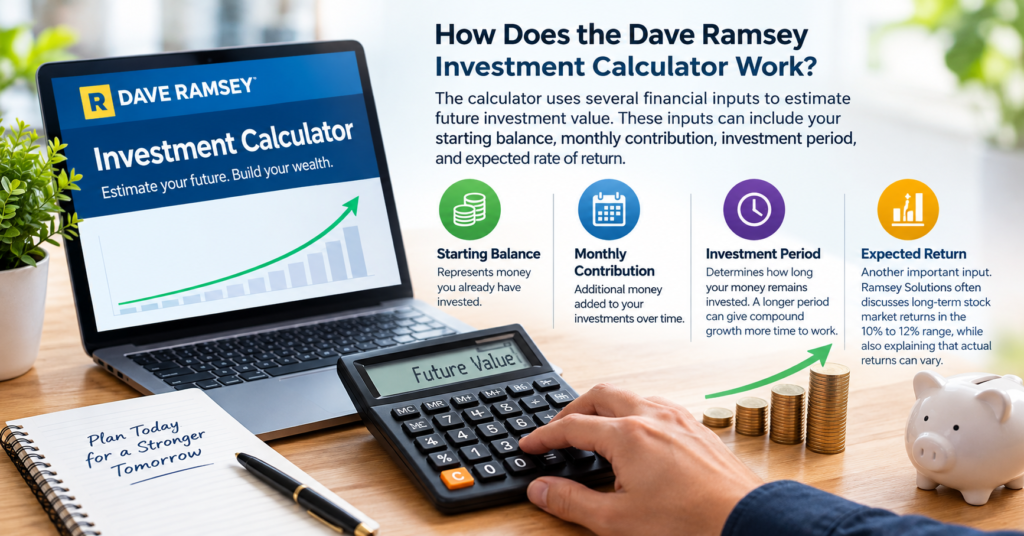
The calculator uses several financial inputs to estimate future investment value. These inputs can include your starting balance, monthly contribution, investment period, and expected rate of return.
Your starting balance represents money you already have invested. Monthly contributions represent additional money added to your investments over time.
The investment period determines how long your money remains invested. A longer period can give compound growth more time to work.
The expected return is another important input. Ramsey Solutions often discusses long-term stock market returns in the 10% to 12% range, while also explaining that actual returns can vary.
Compound Growth and Long-Term Investing
Compound growth happens when investment gains remain invested and can generate additional gains.
Imagine you start with £10,000 and continue adding money each month. If the investments grow, future returns can apply to both your original money and previous growth.
Over several decades, this effect can become significant. However, market performance is not guaranteed.
That is why a calculator should be treated as a planning tool rather than a prediction of your exact retirement balance.
What Information Do You Need?
Using an investment calculator does not require complicated financial knowledge. You mainly need a few reasonable estimates.
Start with your current investment balance. If you are starting from zero, you can enter zero as your initial amount.
Next, consider how much you can invest each month. Even a modest monthly contribution can become meaningful when maintained for many years.
You also need an investment timeframe. Someone investing for 30 years will have a very different projection from someone investing for only 10 years.
Finally, you need an estimated annual return. Changing this figure can have a major effect on the final projection.
Dave Ramsey’s Approach to Investment Returns
Dave Ramsey is known for discussing long-term investing and compound growth. Ramsey Solutions has stated that the historical average annual return of the S&P 500 has been around 10% to 12% over long periods.
Ramsey has also discussed a 12% average return as a historical figure associated with the S&P 500. However, this does not mean an investor will receive 12% every year.
Actual investment performance can move substantially above or below an average in individual years. Market conditions, investment choices, fees, taxes, and timing can all affect results.
Therefore, anyone using a Dave Ramsey investment calculator should understand the difference between an assumed return and a guaranteed return.
How Monthly Contributions Affect Growth
Your contribution rate can have a major effect on long-term investment growth.
For example, increasing your monthly contribution from £300 to £500 means you are putting £2,400 more into investments each year. Over several decades, those additional contributions also have the opportunity to grow.
Consistency matters because compound growth needs time.
ALSO READ: Dave Ramsey Retirement Calculator Plan Your Retirement Savings
Ramsey Solutions generally recommends investing 15% of gross household income toward retirement after paying off non-mortgage debt and building an emergency fund. That guideline is part of its broader Baby Steps approach.
Your own circumstances may differ. Income, debts, pension arrangements, tax rules, and retirement goals can all affect how much you choose to invest.
Using the Calculator for Retirement Planning
An investment calculator can help you connect today’s savings with a future retirement goal.
Suppose you want to retire at 60 or 65. You can estimate how much you might have by that age based on your current contributions and investment timeframe.
You can then change one input at a time. Increasing monthly contributions shows the potential effect of saving more. Extending the investment period shows the effect of giving your money more time.
This approach can make retirement planning easier to understand.
However, the final amount you need for retirement depends on your lifestyle, inflation, taxes, pension income, healthcare costs, and other factors.
Why Calculator Results Are Only Estimates
No investment calculator can know exactly what financial markets will do in the future.
A calculator normally assumes a consistent rate of return. Real investments rarely behave that way.
One year could produce strong gains. Another could produce losses. Long-term averages can hide large short-term changes.
Inflation also matters. A future balance may look large in pounds, but its purchasing power could be lower than it is today.
For that reason, consider calculator results as scenarios rather than guaranteed outcomes.
Dave Ramsey Investment Calculator for UK Investors
The Dave Ramsey investment calculator can still help UK readers understand compound growth. However, some parts of Ramsey’s financial guidance are designed around the US financial system.
For example, US retirement accounts and tax rules differ from UK pensions and investment accounts.
UK investors may need to consider workplace pensions, personal pensions, ISAs, tax treatment, contribution limits, and other local rules.
Therefore, the calculator can illustrate investment growth, but it should not replace UK-specific financial planning.
How to Get More Useful Results
Start with realistic numbers rather than choosing an unusually high return simply to produce a larger future balance.
Try several scenarios instead. You can test a lower return, a middle estimate, and a higher estimate to see how sensitive the result is.
Also consider increasing your monthly contribution when your income rises.
Most importantly, focus on the variables you can control. Your contribution amount, investment timeframe, and consistency are more practical planning factors than trying to predict every market movement.
Conclusion
The Dave Ramsey investment calculator provides a simple way to explore how savings and investment growth could develop over time.
It can show the potential impact of your starting balance, monthly contributions, investment period, and assumed return.
However, calculator results are estimates. Investment markets do not deliver identical returns every year, and future performance cannot be guaranteed.
For UK investors, the tool can help explain compound growth while local pension, tax, and investment rules require separate consideration.
Used carefully, an investment calculator can turn a vague retirement goal into a clearer long-term savings scenario.
FAQs
What is the Dave Ramsey investment calculator?
The Dave Ramsey investment calculator is a tool that estimates potential investment growth over time. It uses information such as starting savings, regular contributions, investment duration, and an expected return.
Does the Dave Ramsey investment calculator guarantee investment returns?
No. Calculator results are estimates based on the assumptions entered. Actual investment returns can vary considerably because financial markets change over time.
What return does Dave Ramsey use for investments?
Dave Ramsey has discussed a 12% average annual return based on the historical average of the S&P 500. However, actual yearly returns can be much higher or lower.
How much should I invest each month?
There is no single monthly amount that suits everyone. Ramsey Solutions generally recommends investing 15% of gross household income toward retirement after certain debt and emergency-fund goals have been addressed.
Does compound growth really make a difference?
Yes. Compound growth allows previous investment gains to remain invested and potentially generate further gains. The effect becomes more noticeable over longer periods.
Can UK investors use the Dave Ramsey investment calculator?
Yes. UK users can use an investment calculator to understand potential compound growth. However, US-specific retirement accounts and tax rules do not directly apply to UK investors.
For more updates visit: CALCIQ