

Ordering too little gravel leaves a project half finished, while ordering too much wastes money. A gravel calculator tons estimate solves both problems before you pay anything. Moreover, the maths takes only a few minutes with a tape measure.
Table of Contents
- How a Gravel Calculator Converts Volume to Tons
- The Gravel Calculator Tons Formula Explained
- Gravel Density: Why Tons per Cubic Yard Vary
- Worked Example: Gravel Calculator Tons for a Driveway
- Gravel Coverage per Ton at Common Depths
- Choosing the Right Depth for Driveways and Paths
- Ordering Tips So You Do Not Run Short
- FAQs
How a Gravel Calculator Converts Volume to Tons
A gravel calculator tons tool starts with the space you need to fill. First, you measure the length and width of the area in feet. Next, you choose how deep the gravel layer should be. As a result, the calculator can work out the volume of material required.
However, suppliers rarely sell gravel by volume alone. Most yards price and deliver gravel by weight, in short tons. Therefore, your volume must be converted into tons before you order. Moreover, one short ton always equals 2,000 pounds, so the weight unit is consistent.
Meanwhile, volume is usually expressed in cubic yards for bulk orders. One cubic yard equals 27 cubic feet, and it fills a cube three feet on each side. Consequently, the conversion has two clear stages. First, you find the volume in cubic yards. Then you multiply by density to get tons.
In addition, the same thinking helps with related jobs around the home. For example, our concrete calculator follows a similar volume-first approach. Finally, accurate measuring at this stage prevents costly mistakes later.
The Gravel Calculator Tons Formula Explained
The gravel calculator tons formula has two simple steps. First, find the volume: length in feet, times width in feet, times depth in feet, divided by 27. As a result, you get the volume in cubic yards. Next, multiply those cubic yards by the density of your gravel. Therefore, the answer is the weight you need in tons.
However, depth is usually planned in inches, not feet. Therefore, convert inches to feet first by dividing by 12. For example, 3 inches divided by 12 equals 0.25 feet. Similarly, 4 inches equals about 0.33 feet, and 2 inches equals about 0.17 feet.
| Depth Planned | Depth in Feet | Cubic Feet per 100 Sq Ft | Cubic Yards per 100 Sq Ft |
|---|---|---|---|
| 2 inches | 0.17 ft | 16.67 | 0.62 |
| 3 inches | 0.25 ft | 25.00 | 0.93 |
| 4 inches | 0.33 ft | 33.33 | 1.23 |
| 6 inches | 0.50 ft | 50.00 | 1.85 |
Moreover, the standard working density for most gravel is 1.5 tons per cubic yard. Therefore, a quick estimate is cubic yards times 1.5. In addition, our guide on how to calculate percentage helps when adding a percentage extra later. Finally, always keep your measurements in feet throughout the calculation.
Gravel Density: Why Tons per Cubic Yard Vary
Density is the figure that turns volume into weight in any gravel tonnage calculator. First, most gravel weighs between about 1.4 and 1.6 short tons per cubic yard. Moreover, this guide uses 1.5 tons per cubic yard as the standard working figure. Therefore, it gives a sensible middle estimate for mixed gravel.
However, the exact figure depends on the type of stone you order. Rounded pea gravel packs less tightly, so it weighs about 1.4 tons per cubic yard. By contrast, angular crushed stone locks together and weighs about 1.5 tons per cubic yard. Meanwhile, dense crusher run, which includes fine particles, reaches about 1.6 tons per cubic yard.
| Gravel Type | Density in Tons per Cubic Yard | Pounds per Cubic Yard | Typical Use |
|---|---|---|---|
| Pea gravel | 1.40 | 2,800 | Paths and play areas |
| Standard gravel | 1.50 | 3,000 | General landscaping |
| Crushed stone | 1.50 | 3,000 | Driveways and drainage |
| Crusher run | 1.60 | 3,200 | Compacted driveway base |
| River rock | 1.35 | 2,700 | Decorative beds |
In addition, moisture changes the weight of a load noticeably. Wet gravel weighs more than dry gravel of the same volume. As a result, two loads with equal volume can differ in tons. Finally, the Wikipedia article on gravel explains how gravel types are graded and classified.
Worked Example: Gravel Calculator Tons for a Driveway
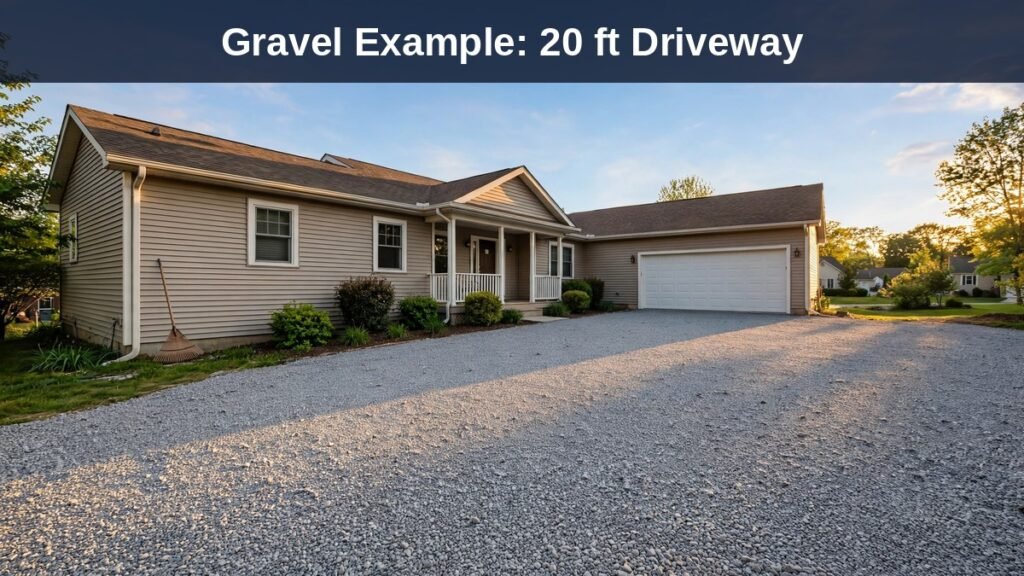
A worked example makes the gravel calculator tons method easy to follow. Suppose you are graveling a small driveway that measures 20 feet long by 10 feet wide. First, the area is 20 times 10, which equals 200 square feet. Next, you choose a depth of 3 inches for this example.
Then convert the depth into feet: 3 divided by 12 equals 0.25 feet. Moreover, the volume in cubic feet is 200 times 0.25, which equals 50 cubic feet. Next, divide by 27 to convert into cubic yards: 50 divided by 27 equals about 1.85 cubic yards. Finally, multiply by the standard density: 1.85 times 1.5 equals about 2.78 tons.
| Step | Calculation | Result |
|---|---|---|
| 1. Area | 20 ft × 10 ft | 200 sq ft |
| 2. Depth in feet | 3 in ÷ 12 | 0.25 ft |
| 3. Volume in cubic feet | 200 × 0.25 | 50 cu ft |
| 4. Volume in cubic yards | 50 ÷ 27 | 1.85 cu yd |
| 5. Weight in tons | 1.85 × 1.5 | 2.78 tons |
| 6. Order with extra | 2.78 × 1.10 | 3.06 tons |
Therefore, you should order about 3 tons for this driveway. In addition, supplier guides such as GravelTools use the same volume-then-density method. As a result, your estimate should match a supplier quote closely.
Gravel Coverage per Ton at Common Depths
Coverage figures give you a fast check on any gravel calculator tons result. First, remember that one ton at the standard density equals about 0.67 cubic yards. That is because 1 divided by 1.5 equals 0.67. Moreover, 0.67 cubic yards equals about 18 cubic feet of material.
Therefore, coverage depends directly on your chosen depth. At 2 inches deep, 18 cubic feet covers about 108 square feet. At 3 inches deep, however, the same ton covers about 72 square feet. By contrast, at 4 inches deep, it covers only about 54 square feet. Consequently, suppliers often round these figures to roughly 100, 70, and 55 square feet.
Meanwhile, one cubic yard covers much more, because it holds 27 cubic feet. For example, one cubic yard covers about 162 square feet at 2 inches deep. Similarly, it covers about 108 square feet at 3 inches and 81 square feet at 4 inches. As a result, comparing quotes in yards and tons becomes much easier.
Finally, use these coverage figures for quick estimates only. Uneven ground, for instance, can change real coverage significantly. Therefore, measure carefully and still add a small extra allowance.
Choosing the Right Depth for Driveways and Paths
Choosing the right depth matters as much as the gravel calculator tons maths itself. First, driveways need a stronger layer because vehicles press down hard. Therefore, plan on about 4 inches of gravel for a driveway surface layer. Moreover, many driveways also need a separate compacted base layer underneath.
By contrast, garden paths carry only foot traffic, so they need less material. A depth of 2 to 3 inches usually works well for pathways and walkways. In addition, 2 inches is often enough for decorative areas around plants. As a result, paths cost noticeably less per square foot than driveways.
However, very shallow layers create problems over time. Thin gravel, for example, shows bare soil quickly and spreads onto lawns. Similarly, gravel that is far too deep feels unstable underfoot. Therefore, staying within the ranges above gives the best finish.
Meanwhile, consider what sits underneath the gravel as well. A level, compacted base, for instance, keeps the surface layer even. Consequently, your measured depth stays true across the whole area. Finally, edging boards help hold the gravel at the planned depth along borders.
Ordering Tips So You Do Not Run Short
Good ordering habits protect both your budget and your schedule. First, always add 5 to 10% extra to your calculated tons. For example, our worked driveway needed 2.78 tons, so ordering about 3 tons made sense. As a result, spreading losses and uneven ground will not leave bare patches.
Moreover, confirm the density figure with your chosen supplier before ordering. Different quarries, for instance, quote slightly different weights for similar stone. Therefore, ask whether their price is per short ton or per cubic yard. In addition, check delivery charges, because they can change the best deal significantly.
Next, prepare the area before the delivery truck arrives. Clear weeds, level the base, and mark where the load should be tipped. Consequently, you can spread the gravel before it settles or gets rained on. Similarly, ordering on a dry day makes heavy loads easier to move.
Finally, keep your gravel tonnage calculator figures written down for the order call. Suppliers can then check your numbers against their own records quickly. However, if their figure differs greatly, ask them to explain why. Therefore, you can resolve any misunderstanding before the load leaves the yard.
FAQs
How do I use a gravel calculator in tons?
Measure length and width in feet, and then choose a depth. Next, multiply length by width by depth in feet and divide by 27. Finally, multiply cubic yards by the density, usually 1.5. As a result, you get the tons needed.
How many tons of gravel are in one cubic yard?
Most gravel weighs between about 1.4 and 1.6 tons per cubic yard. This guide uses 1.5 tons as the standard working figure. However, pea gravel is lighter at about 1.4 tons. By contrast, crusher run is heavier at about 1.6 tons.
How much area does one ton of gravel cover?
At standard density, one ton equals about 0.67 cubic yards, or 18 cubic feet. Therefore, it covers about 108 square feet at 2 inches deep. Moreover, it covers about 72 square feet at 3 inches, and 54 at 4 inches.
How deep should gravel be on a driveway?
Plan on about 4 inches for a driveway surface layer. In addition, many driveways need a compacted base layer underneath. Therefore, total depth can be greater on new driveways. However, a top-up of an existing driveway may need less.
Why should I order extra gravel?
Extra gravel covers spreading losses, compaction, and uneven ground. Therefore, adding 5 to 10% extra is sensible. For example, a 2.78-ton calculation becomes an order of about 3 tons. As a result, you avoid a second delivery charge.
Is a ton of gravel the same as a cubic yard?
No, a ton measures weight, while a cubic yard measures volume. One cubic yard of standard gravel weighs about 1.5 tons. Therefore, one ton is only about 0.67 cubic yards. Consequently, check which unit a supplier is quoting.
For more updates visit: CALCIQ



Comments 2