
Table of Contents
- What Is a Mixed Fraction Calculator?
- How to Use the Mixed Fraction Calculator
- Mixed Numbers and Improper Fractions Explained
- Worked Example: Converting 17/5 to a Mixed Number
- Worked Example: Converting 2 3/4 to an Improper Fraction
- Conversion Examples at a Glance
- Why Bother Converting Between the Two Forms?
- Common Mistakes to Avoid
- FAQs
Fractions come in two costumes. An improper fraction such as 17/5 is best for calculating, while the mixed number 3 2/5 is far easier to picture and to say out loud. Converting between them is a small skill that comes up constantly in homework, cooking and measuring. A mixed fraction calculator performs the conversion both ways, and shows the short working behind each answer so the method sticks.
Mixed Fraction Calculator
The fraction part of a mixed number should always be simplified and smaller than 1.
What Is a Mixed Fraction Calculator?
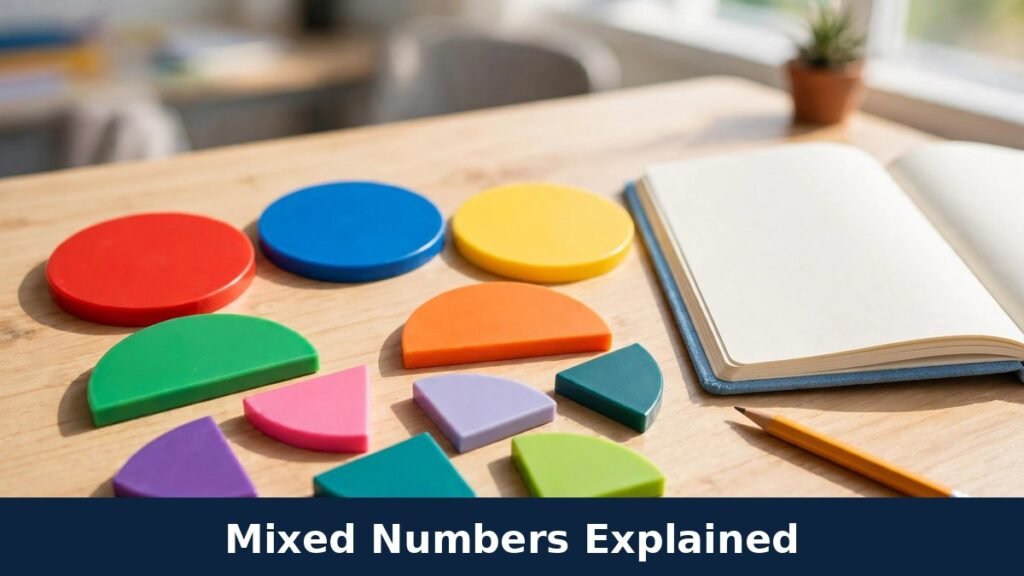
A mixed fraction calculator converts improper fractions into mixed numbers and mixed numbers back into improper fractions. A mixed number combines a whole number with a proper fraction, such as 3 2/5. An improper fraction has a numerator larger than its denominator, such as 17/5. The two forms have identical value; only the writing changes.
The tool on this page handles both directions with one switch. Choose the direction, enter two or three whole numbers, and the answer appears with steps: the division and remainder for one direction, the multiplication and addition for the other. It sits alongside our improper fraction calculator, which focuses on the same family of conversions, and our wider set of fraction tools for calculating and reducing.
How to Use the Mixed Fraction Calculator
The mixed fraction calculator starts in the improper-to-mixed direction, which is the conversion students meet most often. Enter the numerator and the denominator of your improper fraction, then press Convert. The answer shows the mixed number, and the steps show the division: how many whole times the denominator fits, and what remainder is left over.
To go the other way, switch the direction menu to “Mixed number to improper fraction”. Three boxes appear: the whole number, the numerator and the denominator of the fraction part. Enter all three and press Convert. The steps then show the multiplication of the whole number by the denominator, the addition of the numerator, and the final fraction over the same denominator.
In both directions the denominator never changes during the conversion. If either denominator box contains zero, the tool stops with a message, because a fraction over zero has no value. Negative values are allowed in the improper direction; put the minus sign on the numerator and the mixed number carries it as a whole.
Mixed Numbers and Improper Fractions Explained
The name “improper” is misleading: there is nothing wrong with an improper fraction. It is simply a fraction worth more than 1, written as a single fraction. The mixed number writes the same value as a whole part plus a part smaller than 1.
Think of pizzas cut into fifths. Seventeen fifths is three whole pizzas and two fifths left over: 17/5 = 3 2/5. The mixed number is the description you would give at the table. The improper fraction is the form you would use if you had to share those pieces among people or multiply them by something.
Neither form is more correct than the other, but each has its home ground. Measurements, recipes and final answers usually read better as mixed numbers. Multiplication, division and algebra almost always go smoother with improper fractions, because the whole number in a mixed number must be converted before it can join a calculation anyway. The mixed fraction calculator exists so you can move to whichever form the task in front of you needs. A clear illustrated introduction appears on the Math Is Fun page about mixed fractions.
Worked Example: Converting 17/5 to a Mixed Number
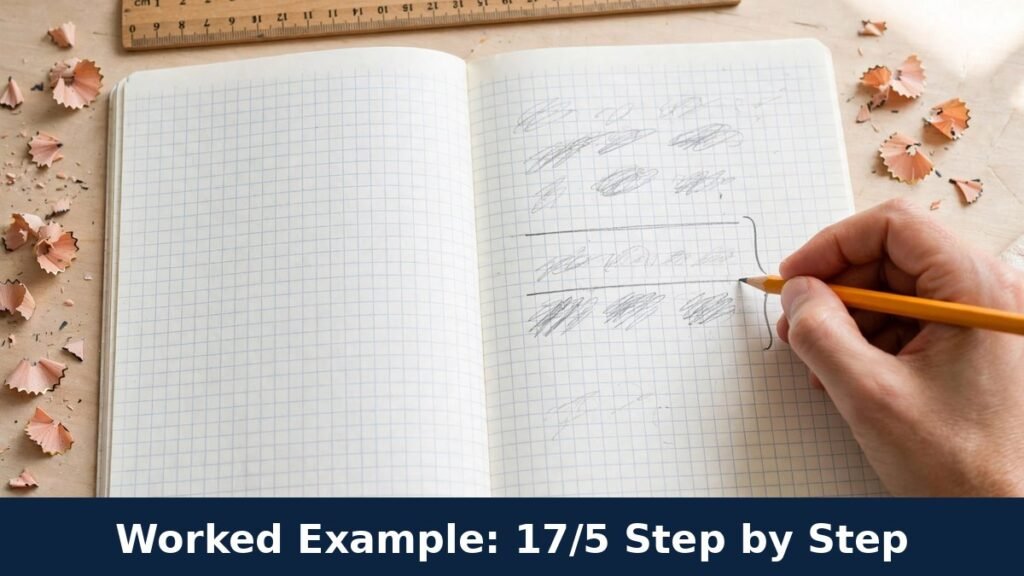
Enter 17 as the numerator and 5 as the denominator. The mixed fraction calculator divides 17 by 5: the answer is 3 with a remainder of 2, because 3 × 5 = 15 and 17 − 15 = 2.
Those two numbers build the mixed number directly. The quotient, 3, becomes the whole number. The remainder, 2, goes on top as the new numerator. The denominator stays 5. So 17/5 = 3 2/5.
A quick value check confirms nothing changed: 3 2/5 means 3 + 0.4 = 3.4, and 17 ÷ 5 is also 3.4. When the remainder is 0, the result is a plain whole number with no fraction part; when the numerator is smaller than the denominator, the fraction was proper already and the whole part is 0.
Worked Example: Converting 2 3/4 to an Improper Fraction
Now run the conversion backwards. Enter whole number 2, numerator 3 and denominator 4. The mixed fraction calculator multiplies the whole number by the denominator: 2 × 4 = 8. Then it adds the numerator: 8 + 3 = 11. The result goes over the same denominator, giving 11/4.
The logic is easy to see with the pizza picture. Two whole pizzas cut into quarters are 8 quarters, plus the extra 3 quarters makes 11 quarters altogether. The denominator never changes because the size of the pieces never changes; you are only counting them differently.
Check the value again: 11 ÷ 4 = 2.75, and 2 3/4 is 2 + 0.75 = 2.75. The two worked examples are mirror images, which is why learning one direction teaches you the other.
Conversion Examples at a Glance
The table below collects typical conversions in both directions. Every answer can be reproduced in the tool, and the fraction part of each mixed number is already in its simplest form.
| Improper fraction | Mixed number | Mixed number | Improper fraction | |
|---|---|---|---|---|
| 17/5 | 3 2/5 | 2 3/4 | 11/4 | |
| 22/7 | 3 1/7 | 3 1/2 | 7/2 | |
| 9/4 | 2 1/4 | 4 5/8 | 37/8 | |
| 31/6 | 5 1/6 | 1 7/10 | 17/10 |
If a conversion produces a fraction part that can be reduced, such as 2 4/6, reduce it afterwards so the mixed number is tidy: 2 2/3. Our simplify fraction calculator does that reduction in one step.
Why Bother Converting Between the Two Forms?
Recipes are the everyday case. A recipe written for four people that must serve six needs its quantities multiplied, and multiplying 1 1/2 cups is clumsy until it becomes 3/2. After scaling, converting back gives a quantity you can actually measure: spoons and cups are marked in mixed-number language.
In school maths, the pattern is identical. Questions are set in mixed numbers because they look friendly, but the working is done in improper fractions, and the final answer is converted back for presentation. Examiners in many countries deduct marks when a final answer is left improper, so the last conversion is worth marks by itself.
Trades use the same moves. A length of 2 5/8 inches is the natural way to read a tape measure, while a calculation of how many such pieces fit in a board runs far better as 21/8. Moving fluently between the two forms, by hand or with the mixed fraction calculator, removes a whole category of small errors.
Common Mistakes to Avoid
The most common error in the mixed-to-improper direction is adding before multiplying, producing (2 + 3)/4 = 5/4 instead of 11/4. The order is fixed: whole number times denominator first, then add the numerator. Writing the small multiplication as a separate line prevents the slip.
In the other direction, students often place the quotient as the numerator and the remainder as the whole number, giving 2 3/5 for 17/5. Remember the remainder is what is left over, so it belongs in the fraction part, on top.
Finally, do not change the denominator in either direction. The pieces stay the same size throughout; only the counting changes. If your answer has a different denominator from your question, something has gone wrong.
FAQs
What is a mixed fraction?
A mixed fraction, or mixed number, is a whole number written together with a proper fraction, such as 3 2/5. It represents the whole part plus the fraction part added together. It is the natural way to state measurements and quantities that fall between whole numbers.
How do I turn an improper fraction into a mixed number?
Divide the numerator by the denominator. The quotient is the whole number, the remainder becomes the new numerator, and the denominator stays the same. For 17/5: 17 ÷ 5 = 3 remainder 2, so the answer is 3 2/5. The mixed fraction calculator shows this division in its steps.
How do I turn a mixed number into an improper fraction?
Multiply the whole number by the denominator, add the numerator, and put the total over the original denominator. For 2 3/4: 2 × 4 = 8, then 8 + 3 = 11, giving 11/4. The denominator does not change during the conversion.
Why is it called an improper fraction?
The term is historical and simply means the numerator is not smaller than the denominator. There is nothing incorrect about it; improper fractions are the preferred form for most calculations. The name contrasts with a proper fraction, where the numerator is the smaller number.
Should a mixed number’s fraction part always be simplified?
Yes. A mixed number such as 2 4/6 is unfinished; its fraction part reduces to 2/3, giving 2 2/3. The fraction part should also be proper, smaller than 1. If a conversion gives you a fraction part that is still improper, fold the extra whole into the whole number.
Can the mixed fraction calculator handle negative fractions?
Yes, in the improper-to-mixed direction. Enter the minus sign with the numerator, for example −17/5, and the result is −3 2/5. In the mixed-to-improper direction, put any minus sign on the whole number and keep the fraction part positive, which keeps the working unambiguous.
For more updates visit: CALCIQ